We are a married couple, one American, one Brit, one male, one female, neither of us as fit as we would like to be, well over 120 years old altogether.
Mayfield Park is the first new park to open in Manchester City Centre in over a hundred years. It’s been there waiting for us to go along for over two years, and now, at last, we’ve paid a visit.
River Medlock
The River Medlock was happy to see daylight after being covered up for fifty years. We expected to walk around a large expanse, 6.5 acres, but in the end, we agreed, the park was much smaller than expected.
The flower beds attract many bees, and once again, I asked Liesel whether she’d brought her Epipen. Just in case.
Manchester has always been a home to radicals throughout its history. From alchemists to non-conformists to communists to suffragettes to ravers, all have made a home here.
Thomas Hoyle, who set up the The Printworks in Mayfield and his son-in-law Neild used their wealth to establish Mayfield House, a social enterprise for all including a free reading room. Hoyle’s peers also went on to establish Manchester University and the Manchester Guardian newspaper.
The playground looks fun and yes, one day, we might take the grandchildren there.
Playground
After a quick coffee, we walked back towards the city centre, and in particular, to Sackville Gardens. Over the road, we saw a wedding party, but even I felt it would be inappropriate to take photos through the bushes. The flowers here were very colourful.
Common mallowBeacon of Hope
The Beacon of Hope was created in 1997 as Manchester’s answer to the threat of HIV. Designed by Warren Chapman and Jess Byrne-Daniels, it consists of elements combining the existing ‘Tree of Life’ planted on World AIDS Day in 1993, with the ‘Beacon of Hope’ light sculpture erected in 2000. Together, both elements describe a metaphorical journey through life, providing the opportunity for contemplation, celebration, remembrance of the lives lost to HIV and solidarity with those living with HIV today. This is the UK’s only permanent memorial for people living with HIV or AIDS and lives lost to it.
The history of HIV/AIDS is described in a series of plaques in this corner of the park, and it’s horrible to be reminded of our government’s inept early response to the so-called ‘gay plague’.
In Sackville Gardens, I shouldn’t have been surprised to find another member of the Bee in the City Trail: this one is the LGBee.
LGBee
Today’s city walk then took us to Bridgewater Hall where we hoped to pick up a programmes of future events. The venue was closed. So we enjoyed early dinner in the nearby community of food outlets known as Society.
Our next ‘meal’ out, a couple of days later, was taken at Quarry Bank Mill where we enjoyed a much shorter stroll than usual.
The first of two medical events for me this week entailed a very early morning drive to Trafford General for an 8am appointment. And, despite temptation, I did not go back to bed when I returned home.
The second involved a trip into Manchester. We passed some time at the Whitworth Art Gallery, again viewing the Turner exhibition. I then just had to walk over the road to St Mary’s Hospital. I wonder if there’s a prize for attending four or more different hospitals in such a short span of time?
Squirrel on a bin, Whitworth Park
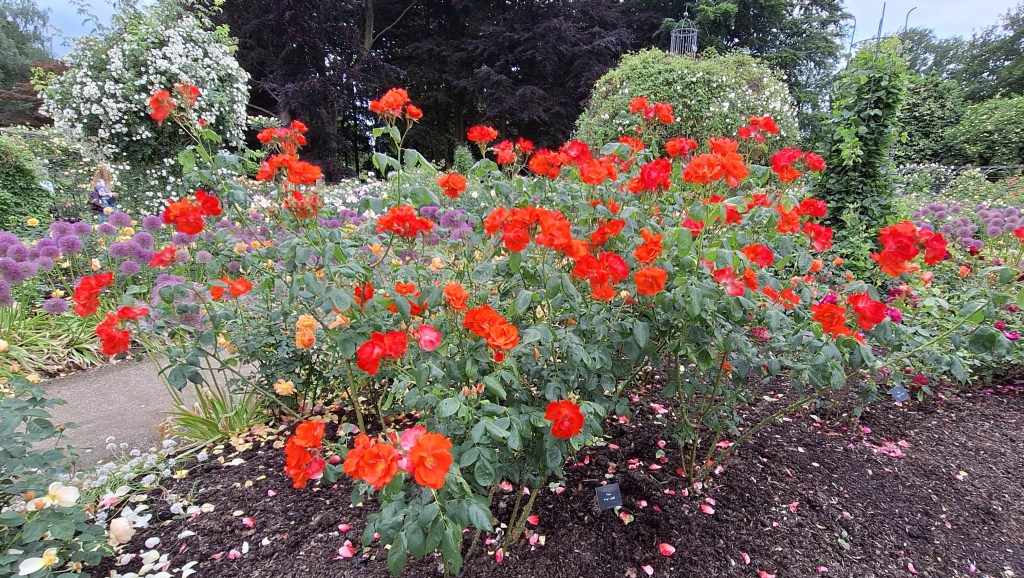
Dunham Massey’s Rose Garden is at its best this time of year, very colourful and aromatic.
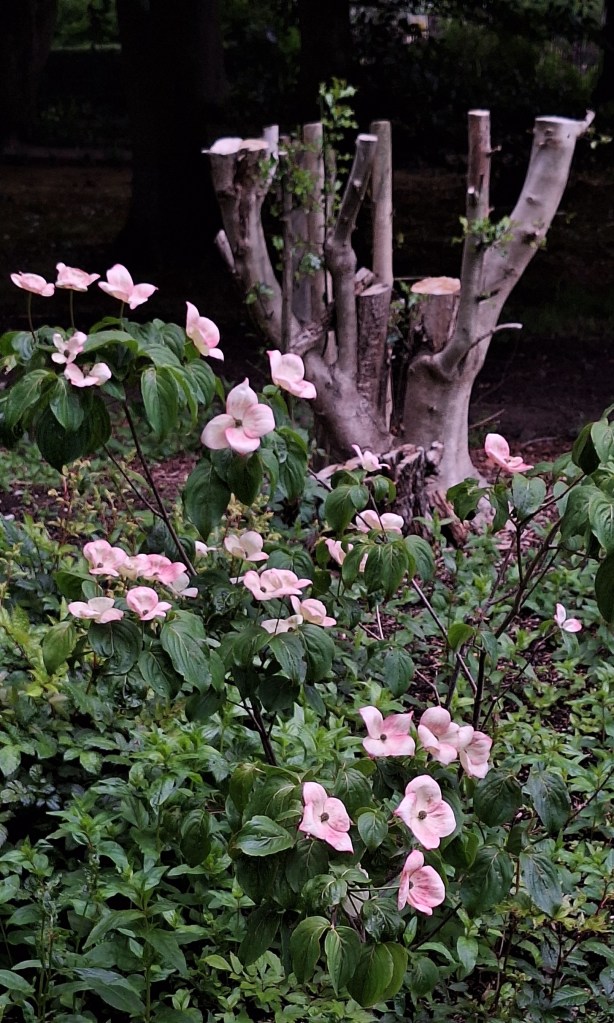
RosesDogwood
I think we were all surprised and delighted to see herons on the far side of the lake. There are always ducks and geese, but I don’t think we’ve seen herons here before. And yes, more than one at a time. Here is a pair, but we spotted five altogether.
Distant herons
Again, I really should dig out my real camera for shots like this. On the other hand, the phone camera is good enough to capture the building works taking place.
Dunham Massey House
A few months ago, early January I’m guessing, occupants from one of our neighbouring apartments disposed of their Christmas tree by dumping it on what passes for the lawn in our communal car park. It’s been an eyesore, certainly compared with the glorious oak tree, but it was time to do something about it. For a couple of weeks now, there have been a couple of surplus wheelie bins out on the pavement. No idea where they belong. Well, I dragged the old Christmas tree out and shoved it into the gaping maw of the green food waste and garden waste bin, as far as it would go.
Shove it
I’m grateful to Liesel for taking its picture as she drove past later in the day. Otherwise, the moment would have been lost to eternity. And we are very grateful to the bin men for taking away the offending item.
Meanwhile, the grandchildren and their parents are having a brilliant, exciting, fun-filled time at Disneyworld, Orlando.
The family at EPCOT
Meanwhile, further west, my sister Pauline is visiting Las Vegas from New Zealand. Not a random urge to hit the casinos, but to be with her son, my nephew, Rob’s wedding to Cristy, a small civil ceremony. Love and congratulations to you all!
Rob and Cristy
Thanks to Pauline for the photo!
So, life goes on, as the song says, and sometimes it’s as exciting as going for a walk around the parks and woods of Wythenshawe. And, how good am I? I’ve got this far without mentioning this week’s torrential rain.
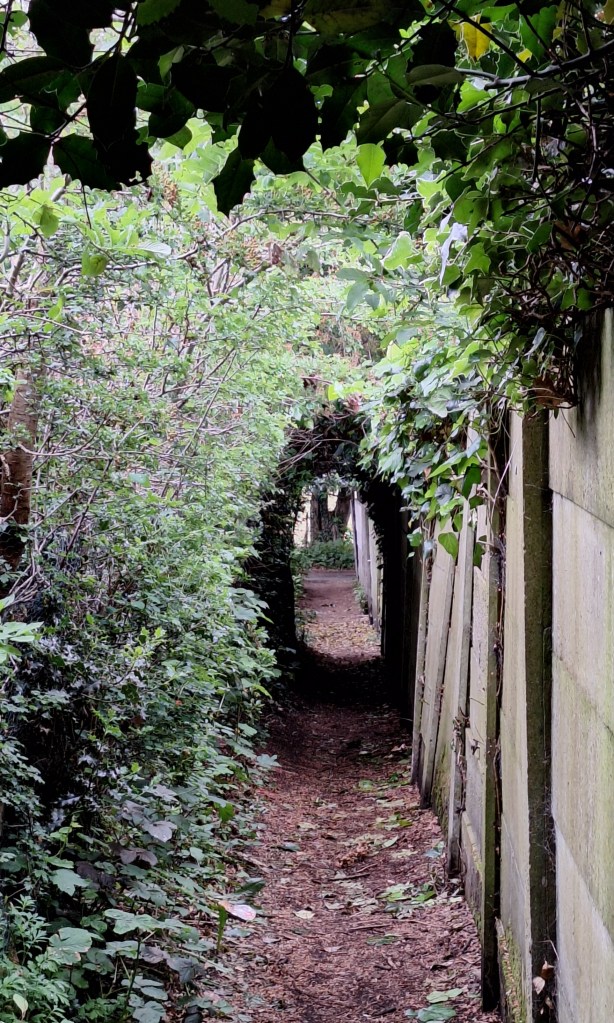
It was a bright and sunny morning so I set off, on foot, towards Didsbury. The route that we dubbed ‘Dogshit Alley’ is a lot more overgrown than the last time I saw it. I must remember to take along some secateurs next time. I’ve said that before, I know. But I did buy some cheap ones to cut back whatever bush it is that grows above where we park our car and deposits tonnes of sticky sap all over our erstwhile pristine vehicle. They were cheap, not all that strong and I should buy a decent pair at a garden shop one day. A sticky car was not something I’d expected to come home to. But it was well worth a tenner to have it washed.
Where were we? Walking along what is now basically a tunnel on the way to the river.
Spooky path
The Riverside Residential Park now seems to consist of proper buildings rather than the caravans all up on stilts.
Message in a bottle
Recent floods have washed away part of the path and there are still barriers up preventing our passage. Well, with a bit of clambering, it’s quite easy to get by.
Road closed
I made it to Fletcher Moss where I couldn’t help but notice a very big bee on a tree.
Fletcher Moss bee
The reason I visited Fletcher Moss park, gardens, whatever, today, was to see the Didsbury Pop-up Cultural Market. I found it in the Parsonage Gardens. There were two stalls with artists displaying their paintings. Is that it, I wondered? Well, there were more arts and crafts on show indoors, in the actual parsonage, I guess. Lots of stuff, some well done, some should have stayed in a bottom drawer somewhere, but just stuff, really, and we don’t need any more stuff.
I tried to get a coffee from the machine but it refused to believe my phone was the source of my spending money, so even the coffee machine lost a customer that day!
I wandered through Didsbry village, nothing new there.
I hadn’t visited Marple Locks before but it was a good venue for a walk with Jenny, Liam and the children.
A narrowboat approached the lock and Martha and William were both keen to help open the gates.
Martha and William, lock keepers
Forever Changes
We walked along the Peak Forest Canal for a while and in the end, completed a large loop. Glad I brought some water, but a bit disappointed there was no coffee shop halfway round.
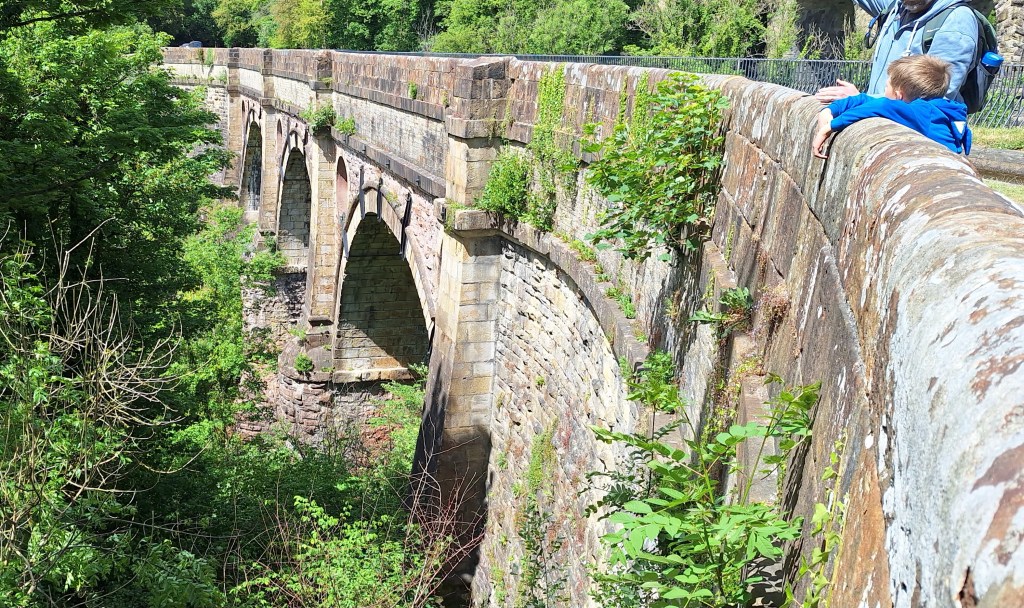
It could have been a bit scary walking along the tallest masonry arch aqueduct in the UK, designed by Benjamin Outram and built between 1794 and 1800.
Marple Grand Aqueduct
Marple Aqueduct is one hundred feet above the river Goyt, and we walked down the bank so that we could follow the river for a while. Martha spotted a frog trying to climb out of the water but as she leaned over to help, it panicked, dived and we haven’t seen it since.
William spotted some cows in a field that turned into horses as we approached more closely. So, for the rest of the day, cows and horses were always mis-identified.
River Etherow
We were above the Etherow, a tributary of the Goyt, part of which once formed the boundary between Cheshire and Derbyshire.
With two young, energetic and loud children with us, we were unlikely to see any interesting wildlife. Well, apart from horses that thought they were cows and cows that identified as horses. So here’s a nice family portrait instead.
Jenny, Liam, William and Martha
Brabyns Park Iron Bridge
This bridge has been restored fairly recently, to mark its 200th anniversary.
After finding our way back to Memorial Park, Marple, we had some fun in the playground. William also found a tree to climb. No health and safety considerations, no risk assessment, I blinked and there he was, twelve feet up in the branches.
William the tree climber
Nearby in the park, we found some gym equipment. I had a go on some of it, but, er, let’s say I just hadn’t warmed up properly. I spent a couple of minutes on the stationary bike, burning a whole 7 calories, ‘riding’ 0.3 miles. That’ll do.
Not saying the children misbehaved at all, but, well, this is the sort of punishment they could appreciate.
Martha and William in the stocks
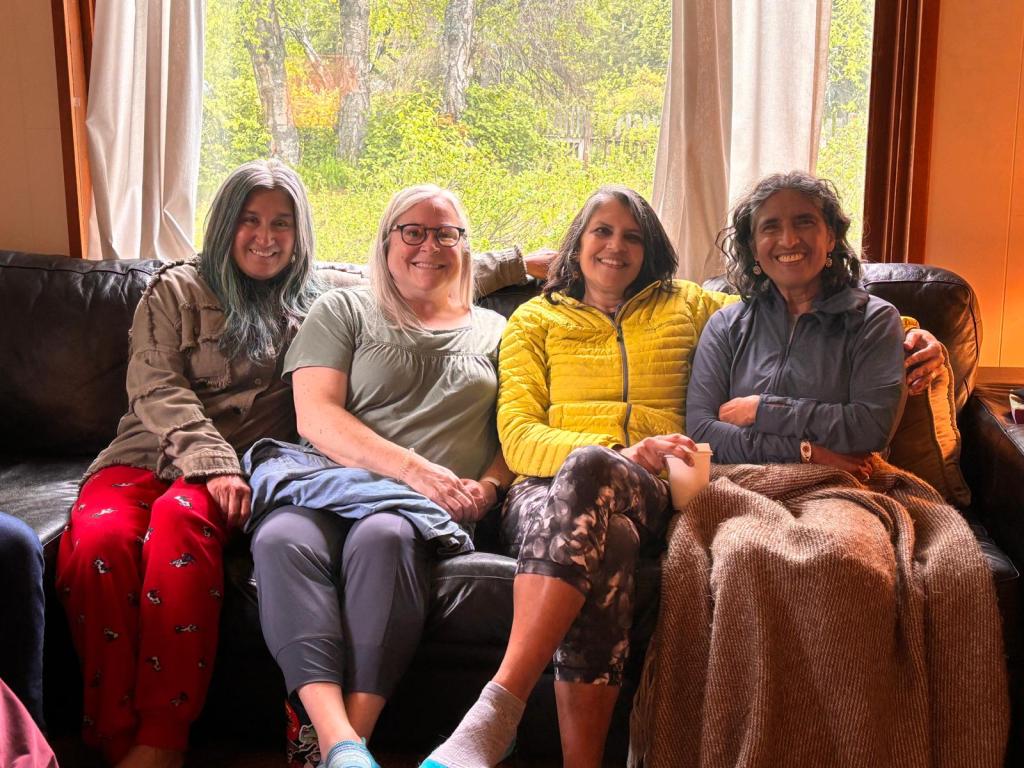
Meanwhile, Liesel was having a good time in sunny Hope, Alaska.
Una, Liesel, Monica, Jyoti
On returning to Anchorage, Liesel packed, and she and her Mom caught the plane to Seattle, where they ate at the vegetarian place, Floret, before the long flight to Reykjavik and then the final leg to Manchester. This is where I met them. And what better way to celebrate their return to England than by going out for a meal at Zumuku with the family.
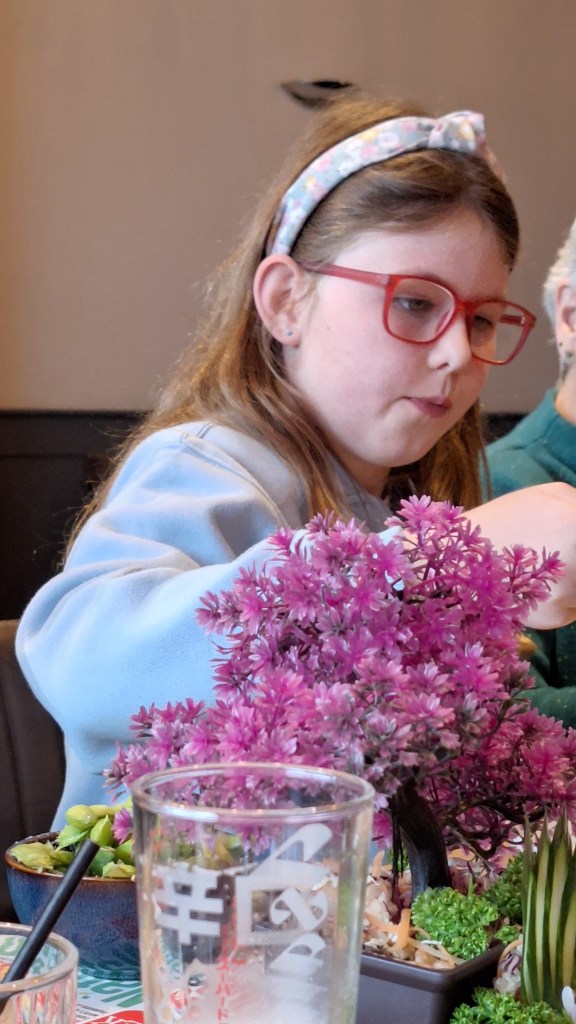
Martha concentrating on the food
Both Martha and William had a jolly good shot at eating everything from the restaurant’s stock room. They’d need the energy for the next week or so in Disneyworld.
Sadly, and annoyingly, the Manchester sunshine was replaced by rain to coincide with Liesel’s return. So we had some soggy walks around Northenden.
Horse-drawn hearse
As I was walking along, I heard the sound of horses behind me. As the empty hearse passed by, I was very tempted to tell the driver that the corpse had fallen out the back. But I resisted the urge.
The regular Thursday walk was well attended this week, but on Friday, there were just the three of us.
Liesel and Leslie are now, slowly, getting over their flight induced sleep deprivation and jet lag.
And in Florida, the grandchildren are having a Mouse of a time.
Once upon a time, I stayed over at Jenny’s house, and even though I anticipated an early morning invasion, neither of the children came into my room to bounce on the bed.
Jenny took me home later in the day and I changed into my eveningware for a musical recital in Manchester. Well, no, I didn’t. But I did go into the big city for a gig.
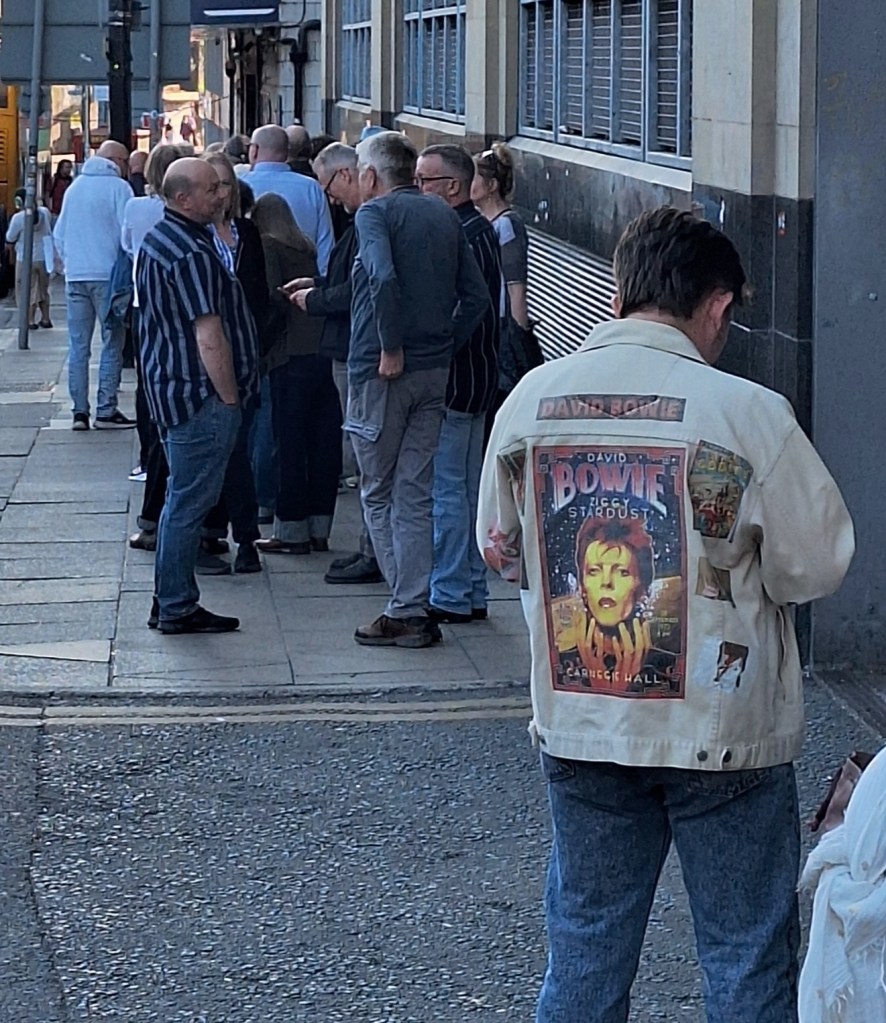
I joined the queue, and I wonder if you can guess who I was here to see?
Bowie fan in the queue
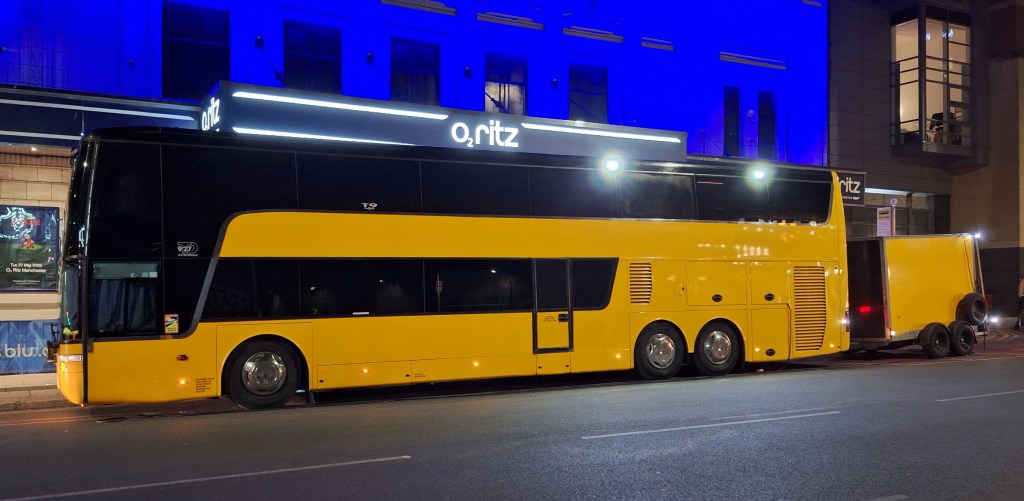
The venue is not one of my favourites, O2 Ritz, but I decided early on that I would head straight for the balcony where I could stand at the front, and lean on the barrier, or, sit down, actually sit down, on a chair or a bench.
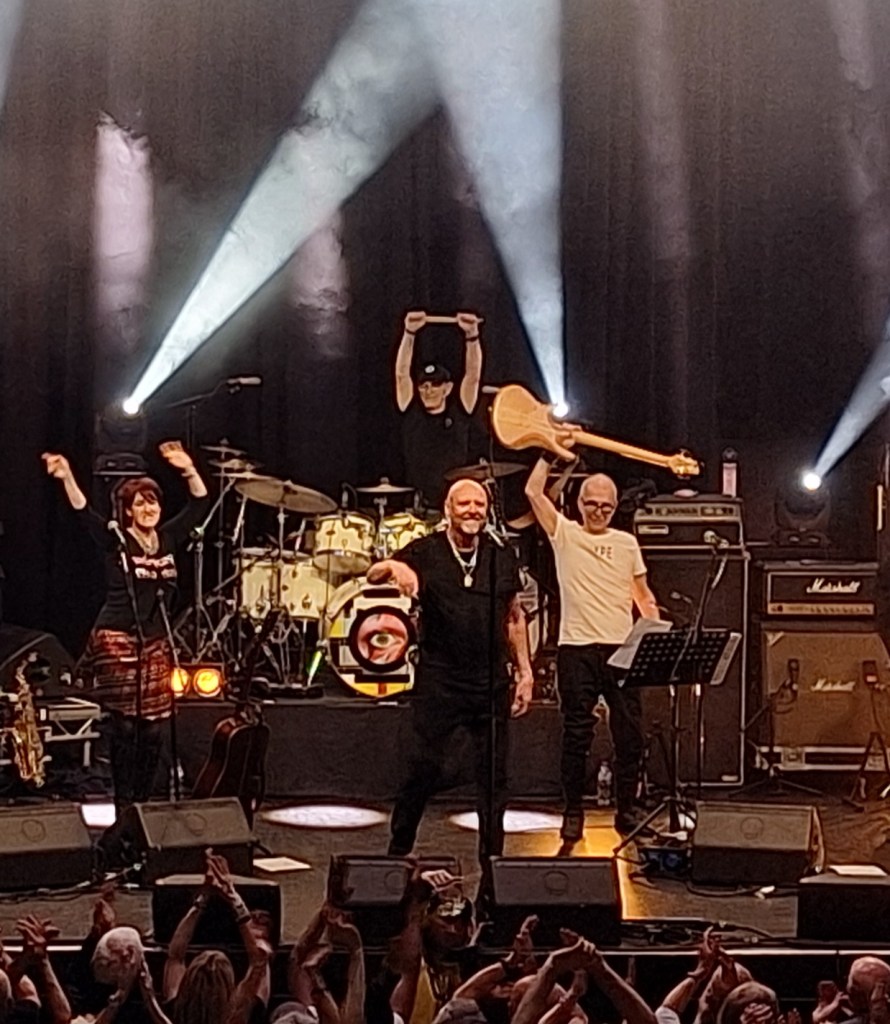
On stage appeared Mark Radcliffe and Marc Riley who told us that the last time they introduced a band on stage together, it was David Bowie with his band. Tonight, they were happy to introduce us to Woody Woodmansey and Tony Visconti’s Holy Holy, performing some of the Best of Bowie. With about 500 songs to choose from, they did well to keep the show down to about two hours.
Who else was in the band? Glenn Gregory from Heaven 17 is a big Bowie fan and he still seems excited and honoured to be singing the songs. Jessical Lee Morgan played guitar and saxophone, not at the same time. Janette Mason did a great job on keyboards and, one day, I hope to see her in concert in her own right.
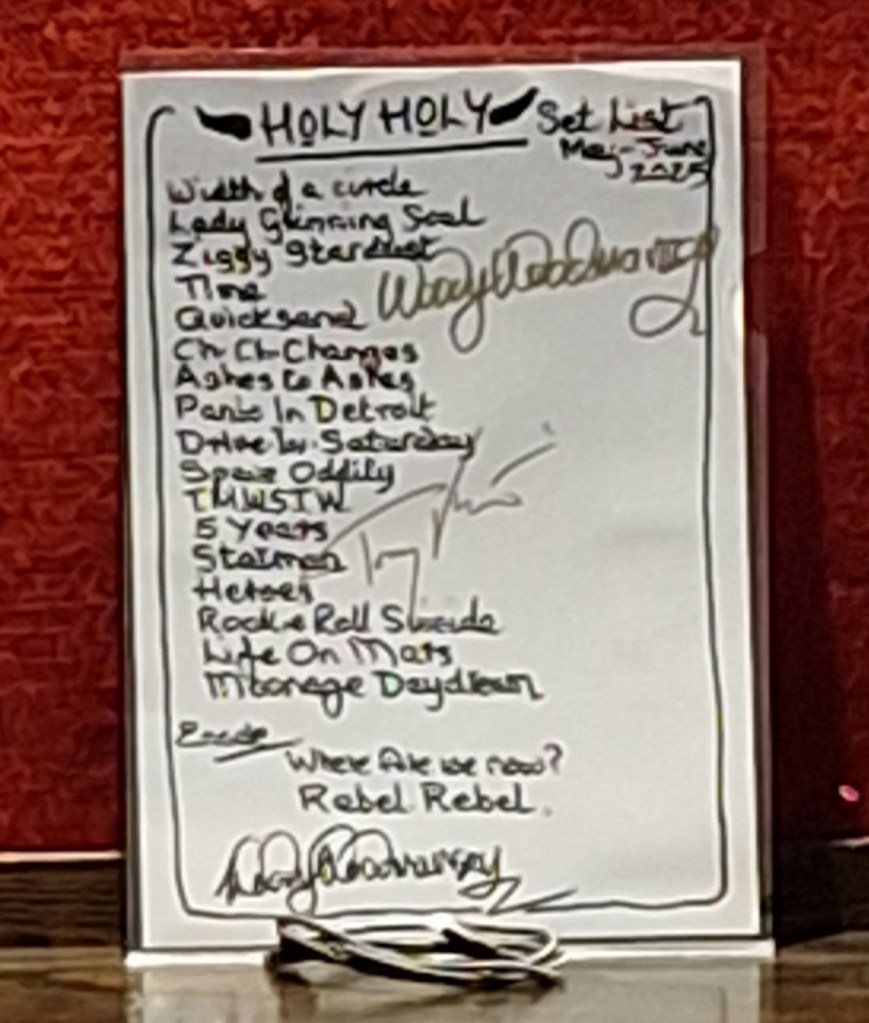
From my vantage point at the front of the balcony, I could watch Chris Thomas working hard on the merch stall. One of the items on sale was a copy of the set list, signed by Woody and Tony. So that saves me having to try and remember what songs were performed.
The set list
There was no support act. No, the band played solidly for two hours, and the audience sang along. A comment from the stage and repeated later on, on Bluesky, suggested this was the loudest crowd of the tour so far.
A young lady was pleased that I let her squeeze in beside me by the barrier. She cried at Life on Mars. There were a few emotional people around, mostly oldies like me, but there were a few young people too.
Holy Holy
From the balcony, It was quite hard to get a decent photo. But we have to try. Unlike some folks, though, I didn’t bother with a flash!
Jess, Woody, Glenn, Tony
T-shirt wars. Tony Visconti was wearing a Hype t-shirt. Hype was the band he was in with David Bowie, even before Space Oddity. This was apparently an original t-shirt. Hmmm. On the other hand, his daughter Jessica was wearing this one, an allusion to one of the encore songs. IYKYK, as the young people say.
Jessica Lee Morgan
Yes, after the show, I went down to the merch stall to see Jess and Chris. I didn’t buy the set list but I did buy a Holy Holy t-shirt, first time I’ve bought a band shirt since about 1994.
I couldn’t fight my way through the crowd to say hello to Woody but it was good to see him enjoying being in the spotlight.
Woody Woodmansey
The tour bus was parked outside, disguised as a bus from Manchester’s Bee Network: bright yellow.
Gig 27
I walked down the road a bit to book an Uber but with perfect timing, I was able to flag down a black cab.
After being home for a couple of weeks now, I felt it was time to go for a long walk. So off I went to Quarry Bank. Sadly, the route that we often follow was still closed, thanks to flooding a few weeks ago. Still, it was good to see some colour.
Azalea maybe, or rhododendron
Where’s Liesel when you need someone to identify the flowers?
Rhododendron or maybe an azalea
Since I couldn’t walk where I expected to, instead, I wandered along a path I don’t think I’ve paid any attention to before, and came across this.
Styal Cross
This cross was originally situated at Cross Farm, Styal. Around 1860 it was moved by Robert Hyde Greg to Holly Lane where it stood until 1930 when it was demolished in a car accident. The base, thought to be medieval, was rebuilt in 1983 on this site but the upper column remained a truncated stump until 2010. A campaign, instigated by the Styal Village Association, raised sufficient funds to rebuild the upper half and restore the cross back to its original state.
But the highlight of the visit was the cheese and onion pasty I had for lunch. The last one available. I got there just in time.
In local news, the occupants of Flat 3, below us, have moved to Stockport.
Like I mentioned, I’ve been back home for two weeks now, and it was time to do some laundry. I’d forgotten how long the wash cycle is on our machine, compared with the bigger American ones. I think washing machine companies here must be in cahoots with the electric companies.
I drove over to Trafford General Hospital for a medical consultation and found it easy to park, despite warnings from other folks who have been. Yes, I have a full collection of hospitals now, but I suppose that means I’m being well looked after.
While waiting in the waiting room, I was messing about with my phone camera.
Selfie of the day
Annoyingly, it was so much quicker to drive to Crewe than to go by public transport. If I’d gone by bus and train, I might have missed the end of the show: either that, or I would have needed to find some accommodation.
In the past, I’ve seen Danny Baker on stage in Salford and in Buxton, but the nearest show on this latest tour was at the Lyceum Theatre in Crewe.
Danny Baker
Another three hours of fun for old and young, without a hint of vulgarity. He got his 10,000 steps in again, pacing up and down the stage as he told us one funny anecdote after another. A bit more name-dropping this time than before, maybe, but he’s the first to admit he’s been very lucky with his career and with the people he’s been able to work with.
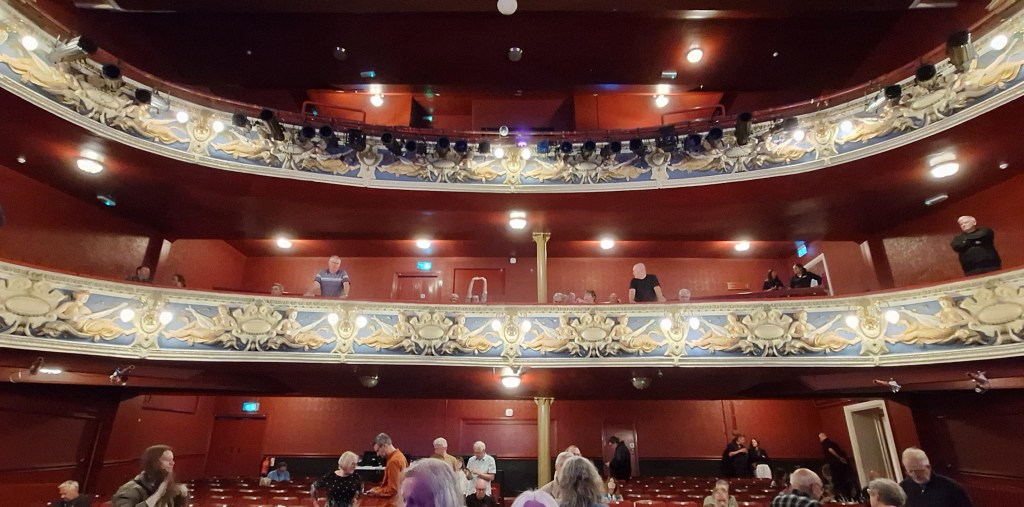
The theatre is magnificent, but the view from the stage must be a bit intimidating, surely? Not for The Candyman, it seems.
Crewe’s Lyceum Theatre
It was good to join one of the local organised walks this week and to have a coffee afterwards. The other two walks? Well, I missed them for other reasons which you can read about if you press the red button.
Well, that was a most satisfying and long sleep with very few interruptions, thank you. And on waking, I realised I actually felt more dazed than tired and jetlagged.
I had to get up to receive the Ocado and Groobarb deliveries. Otherwise I might have stayed in my pit all day, I don’t know.
For the rest of the day, I fought the urge to have a nap while upacking. And it was good to wander round the streets of Northenden again. Nothing much has changed. The new guy in the Post Office is more grumpy than the old guy.
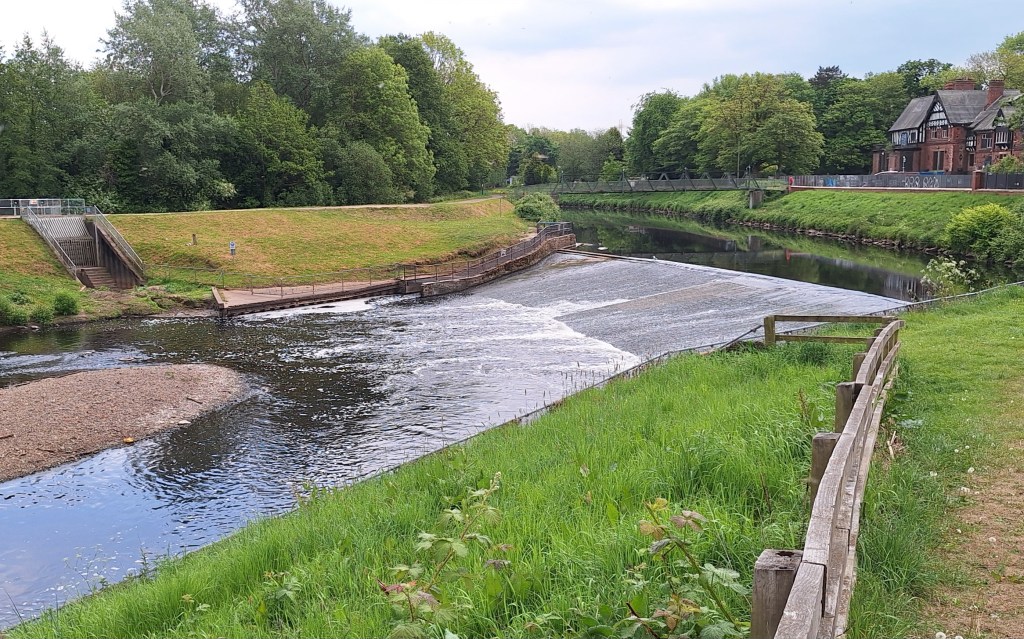
The weir
The weir now seems to be fully repaired. But I did wonder where the bodies were. The whole of Northenden was infested with zillions of small flies. I thought people were being nice, welcoming me home by waving at me, but no, they were just swatting those swarming flies away.
Crow on a heron
Meanwhile, Liesel and Leslie were flying from Albuquerque to Anchorage, planning to stay for the duration of an Alaskan Summer. Liesel plans to work a lot for Amrit and to go on a few hikes.
For me, the rest of the week was getting back to normal, really: reading, writing, walking, watching a little TV, listening to a lot of podcasts, radio shows and especially music. I didn’t quite make it out for any of the organised walks this first week back.
Veronika from a downstairs flat sent a message to say that our missing wheelie bin bad returned from its holiday and was on the pavement around the corner. I doubt the local council will buy back the replacement that we bought a few weeks ago.
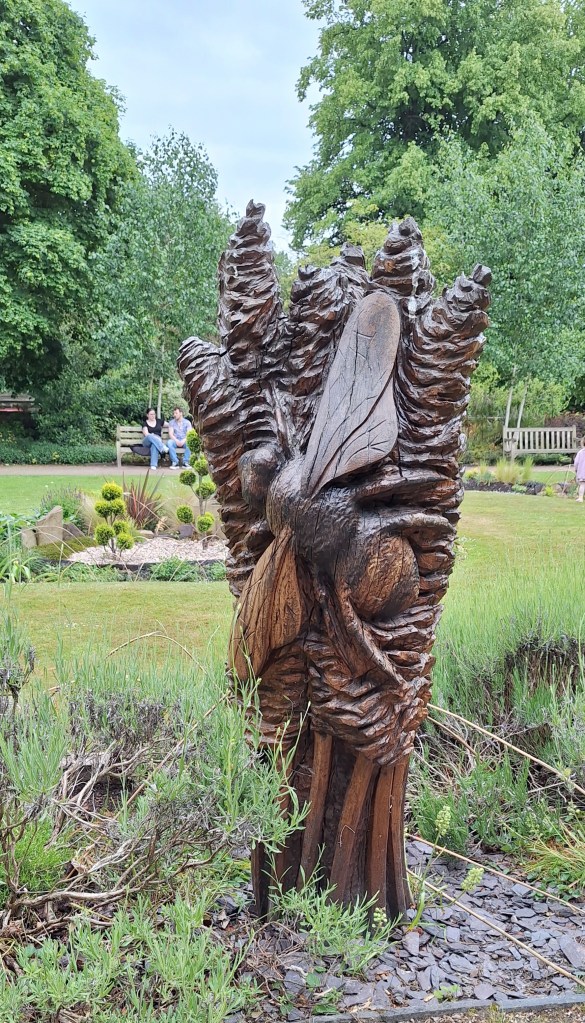
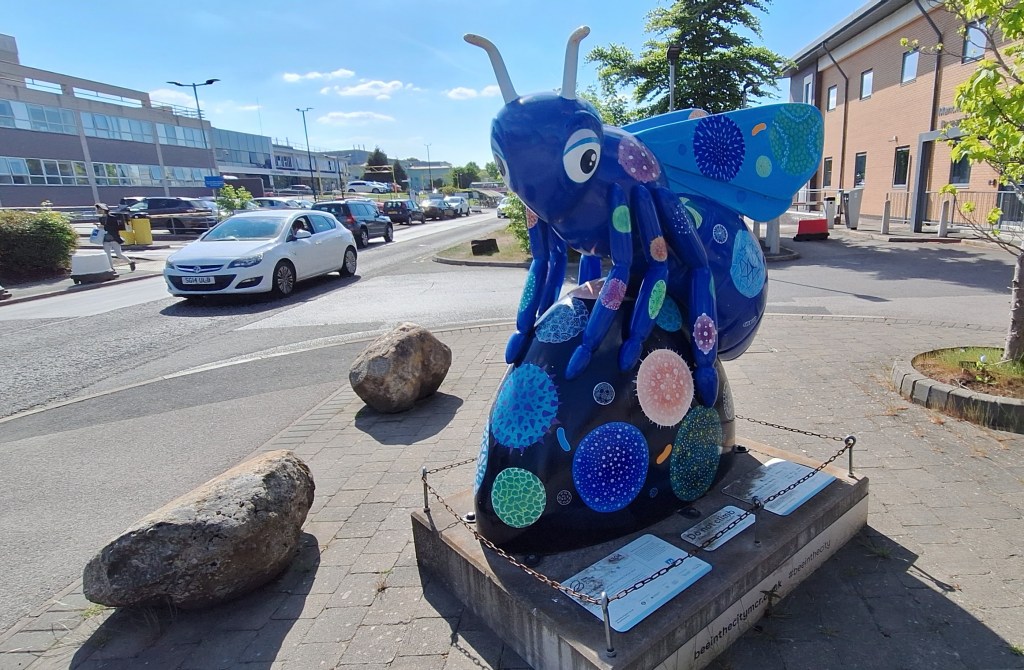
Medical matters managed to make an early appearance, but I was plaeased to see the big bee at Wythenshawe Hospital again.
Sneezebee created by Pam Smart, Michelle Turton and Rose Chapman
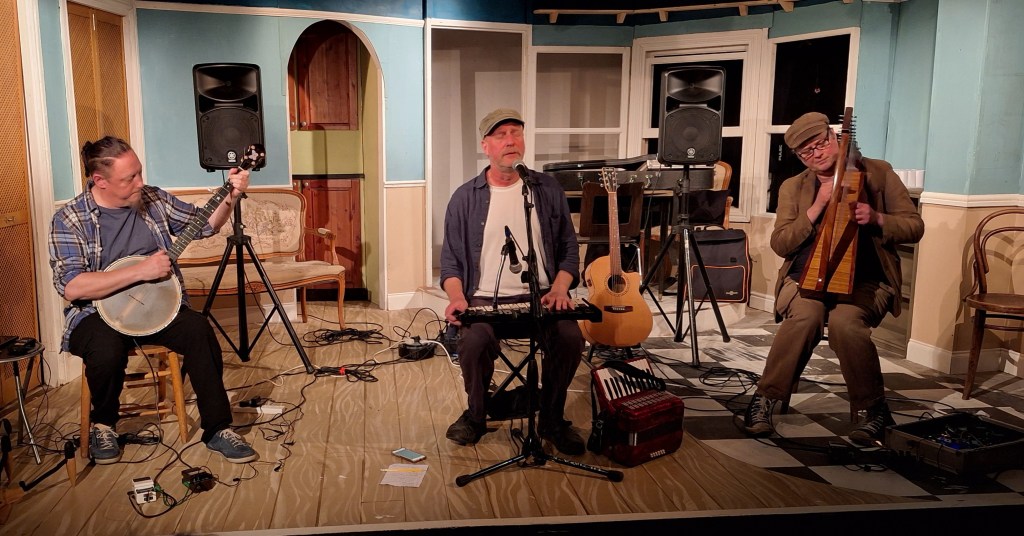
The audience had a great time at the local theatre here in Northenden. We heard many old folk songs, some written nearly 200 years ago. The songs were all unfamilar to me, so I coudn’t sing along: a disappointment for everyone, I’m sure.
Harp and a Monkey
But Harp and a Monkey are the go-to band for songs about cuckolded molecatchers, Victorian bare-knuckle fighters and much more. Look ’em up!
They did have CDs for sale but I said I would just download their music from Bandcamp instead. Liesel wouldn’t appreciate even more CDs in the house, especially at this time when I’m supposed to be reducing the size of our CD collection.
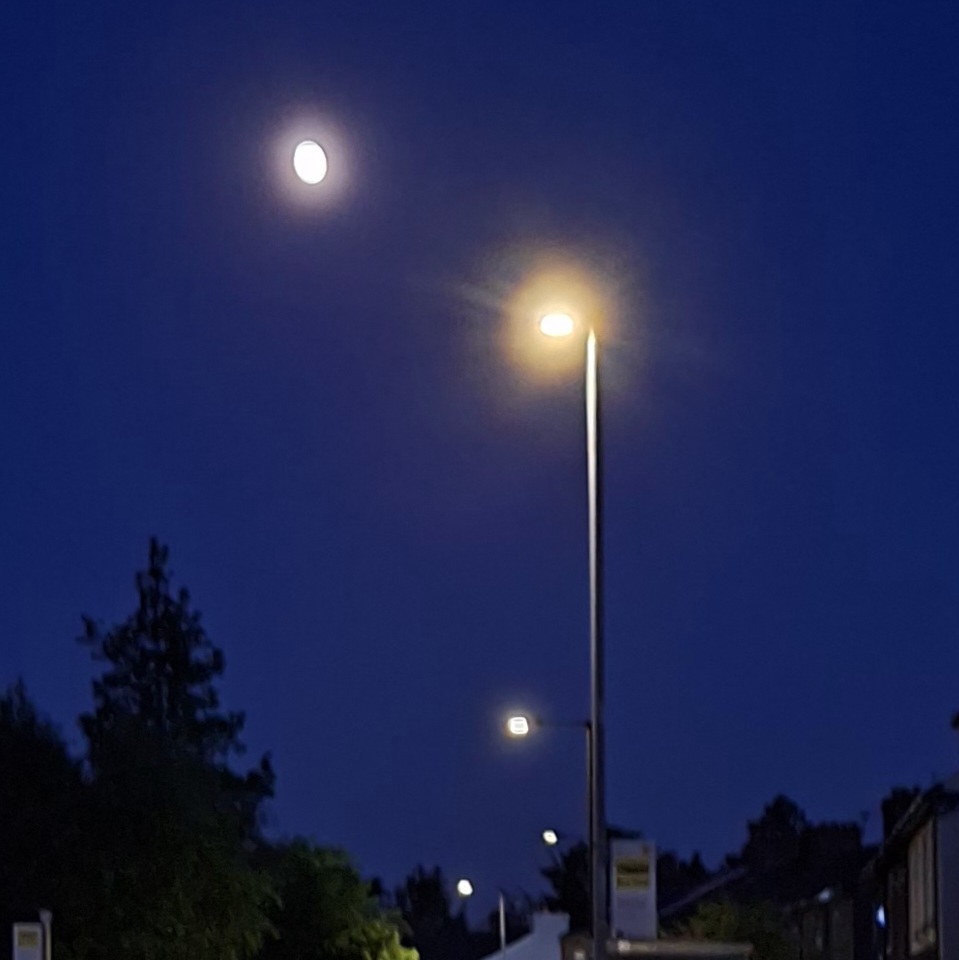
While walking home, using my phone camera, I tried to get an artistic shot of the Moon and a streetlamp but it didn’t really work.
Moon and streetlamp
One thing I didn’t miss about Northenden was the fact that as soon as we have a couple of sunny days in a row, someone lights a bonfire. Another thing I didn’t miss about Northenden was the fact that as soon as we have a couple of sunny days in a row, someone thinks it’s OK to leave their dog outside in the garden, barking all night.
Oh, and don’t forget the fireworks, I missed those!
I was happy to witness one most unusual event though. A fly flew in through the open window, had a good sniff and a look around the apartment, and flew straight back out again, through the same window.
Wythenshawe Park hasn’t changed much. There are still some deep ruts in the grass from where heavy vehicles have been driven, maybe for a circus. Where there used to be a coffee shop, there are now a few trucks, one selling coffee, one offering pizza, and the building itself seems to be permanently closed.
Wythenshawe Park
I visited the farm: well, I just followed the smell, whether of other visitors or the livestock, I’m not sure.
Yum yum, pig’s bum
Well, I can’t complain about the weather, it’s been warm and sunny and bright, and that makes it easier to go out each day. But, after 40 days of no rain in the area, the water companies are threatening us with a hosepipe ban.
I mentioned reading, writing, walking and all that, but sometimes I let myself get sucked into Instagram. A couple of genuinely good or interesting clips, and then press next, next, next, and suddenly an hour’s gone by. I think that’s my worst habit at the moment.
Jenny picked me up and I stayed at her place for a night. The children were camping out on sofa-beds downstairs and I enjoyed kipping in Aunty Helen’s bed. Or is that Auntie? Neither version looks right, so I’ll leave them both, so you can decide.
Martha
No, she’s not assisting a taxiing aeroplane, she’s blowing bubbles. More specifically, sticky bubbles. They stick to your skin rather than bursting straightaway.
William
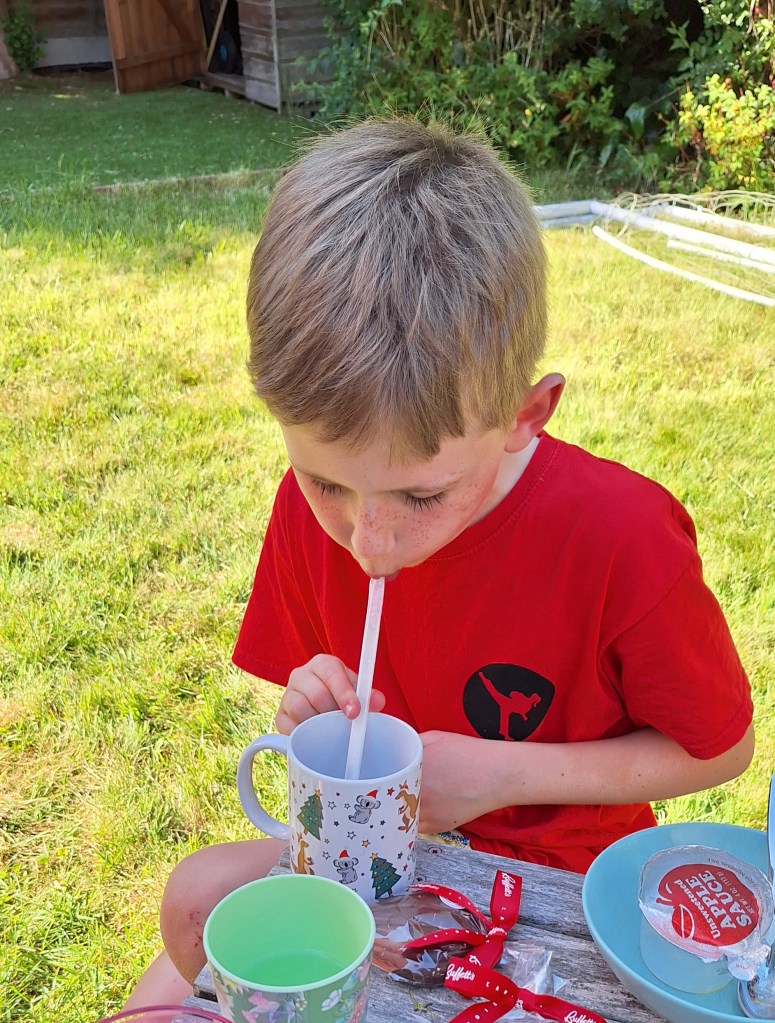
He’s enjoying a milkshake through a straw fresh from New Mexico. The flavour comes from little balls of food-adjacent chemicals inside the straw so that the milk absorbs the flavour as it’s slurped upwards.
Martha and William
And here they are relaxing with their tablets, playing games that are beyond my understanding: another side-effect of getting old.
Surprise
On the way out of the house, I did a double-take. I don’t know why this strikes me as being a bit spooky, but, well, it just is. Scary too.
Martha and I played a game of Backgammon, and she’s picked up the rules pretty well. It won’t be long before we’re playing for real money, using the doubling dice and everything.
It’s not often I watch Doc Martin on TV while eating breakfast and chatting with Liesel’s Uncle Neil, but it happened today for the first time. Neil has one of the shortest email addresses in the known universe, just ten characters in total, which is great, except that some modern sites don’t accept it as a legitimate address.
As well as being a scientist and a mathematician, he’s a bit of a philosopher and has spent the last several decades researching and writing a now 80-page long document about his theory of, well, everything. Having exchanged email addresses, he sent me a copy which I look forward to reading.
While online, I came across a ‘Truth’ or whatever it’scalled by the President:
Donald J. Trump @realDonald Trump
After visiting the beautiful city of Albuquerque earlier this month, I decided that it is disrespectful to America to have a state called New Mexico. It is surrounded by America so it should be called America. I plan to sign an Executive Order renaming the Land of Enchantment New America!
MAKE AMERICA GREAT AGAIN!
Actually, I suspect it’s a fake, but who knows? It’s so believable these days.
As I was packing for my departure, I thought about some things that I’d observed here in Albuquerque, and beyond.
Piñons are very small nuts and the trees are prolific. The nuts are so small, that some of us just find it easier to eat them whole, shells included, rather than trying to peel them.
Indoors is very dry too, very low humidity. So, often I would touch the light switch, or the fridge door handle, or Liesel, and I would experience a static shock. Every time was a surprise.
When out and about, almost everything is covered in a thin layer of dust. It’s a dry, dusty old state. It is being modernised though: we passed by a few solar arrays on our various trips.
Also, while out and about, I was greatly entertained by the many adverts for lawyers on billboards by the highways.
• Do your research: the husband and wife law team. • $1 billion recovered for clients • Hurt? Call Bert • Injured? Get more. Dial 4… • Semi truck collision? Call… • Dead? Call Fred
No, alright, I made the last one up.
There’s one infamous sign that I was hoping to see out on the road, but, disappointingly, it never materialised.
• Eat here and get gas
We didn’t have a barbecue at all here in New Mexico. No Abq bbq, so to speak. Yes, all this time, I could have been using Abq as an abbreviation for ‘Albuquerque’ instead of writing the word ‘Albuquerque’ in full every time I mentioned ‘Albuquerque’.
I know Americans don’t have the monopoly on mangling the English language, but there were a few times on this visit when my ears wanted to pack up and go home. Just a couple of examples:
• When we were in Europe forever ago… • Hope you guys enjoy you guys’s lunch
This sort of thing is very common too: you see a discount on an item but no actual price. So this conversation was very common:
• That’s 50% off • So, how much is it? • Ummm…
Meanwhile, outside the weather was not conducive to a return visit to the Bosque, the Rio Grande River Loop Trail. It rained, again with huge raindrops. As if that wasn’t bad enough, the rumbling thunder was accompanied by a hailstorm. Hailstones as big as peas. There have been larger though. On one occasion, Buzz returned from Phoenix in a car that resembled a golfball. Someone may have been exaggerating, of course!
Hail stones
Helen and Brent called from Australia and Liesel and I had a very nice chat with them. Helen is very happy with her new car, a Toyota.
Liesel and I did get out briefly, though, Gabe drove us to see the storm drains after today’s extensive precipitation. The water was indeed flowing fast.
Storm drain
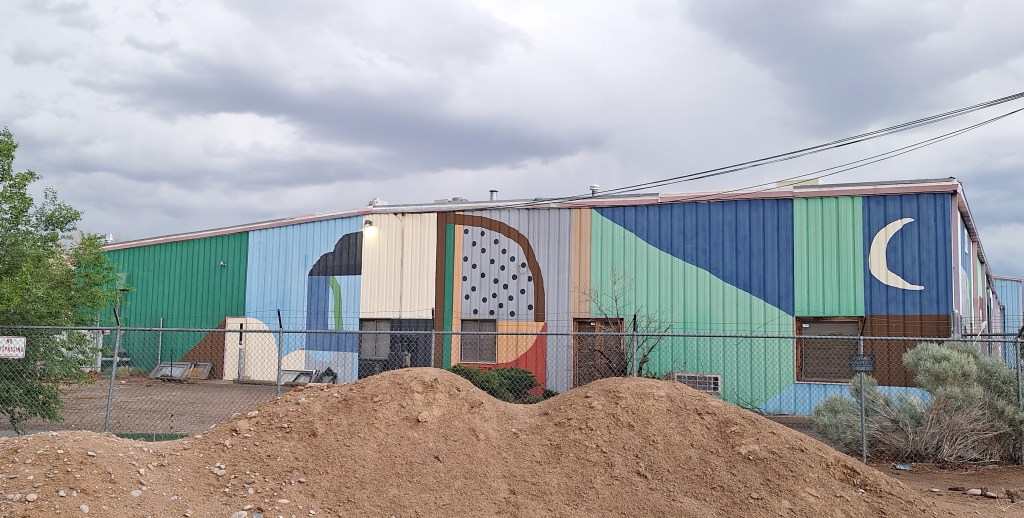
What a boring picture, I know what you’re thinking, so here’s a nearby, colourful, mural.
Mural
And so it was timefor me to say goodbye to our fantastic hosts, Buzz, Neil and Gabe. Liesel drove me to the airport. Now, usually, Liesel drops me off and I’m left to check in by myself. But on the way to the airport today, I received an email telling me that my second leg flight, from Atlanta to Manchester, had been cancelled. I always feel anxious about this aspect of travel, dealing with airlines and airports, because something will always go wrong, right? Well, not always. But this is the first time I’ve had to deal with a cancelled flight.
It was a short queue to check in, because, guess what, Manchester Airport, there were several members of staff working on the counters, all at the same time. Revolutionary.
Tiffany, my Delta agent was great, though. She fought through Virgin Atlantic and Air France’s BS and rearranged my trip back to the UK. I could have postponed the whole thing until the next day, but there’s no guarantee that Virgin Atlantic wouldn’t cancel again, for ‘technical reasons’.
So, rather than Abq to Atlanta to Manchester, I now have three flights: Abq to Atl to Orlando to Manchester. And I would arrive just two hours later than originally planned.
Dream of Flight by Lincoln Fox
So after all the excitement and fun and places of interest in New Mexico, my fear and anxiety of travelling through airports was, today, fully justified.
In Security, I was patted down, because the poppers on my shorts lit up on their very fussy scanner. As someone else joked, rather riskily I thought: usually I’d get dinner and a drink for that.
At the gate, we learnt that our plane was arriving late so we’d be departing late. So of course, I am now more worried about not making the connections. Whereas my original schedule had a 3-hour layover in Atlanta, it was now 1½ hours. Even less with this late departure. Tiffany was at the gate so again I thanked her profusely.
My window seat was OK, but I couldn’t see anything other than the wing. After an uneventful flight, people with connections were allowed off first. Everyone had a connecting flight.
In Atlanta I walked and took the train to my departure gate, arriving with less than an hour to spare. I took more slow, deep breaths before going for a quick wander to find something to eat. A very nice, tasty tomato, cheese and basil crêpe was the best option.
I don’t know why I worry about the size of my carry-on bag when people seem to get away with bulging backpacks and antique Victorian trunks. Well, very nearly.
This flight was late taking off too, for which they apologised but offered no explanation. I had an aisle seat this time, sitting next to a very rude Italian man. He was upset because he’d been made to check his oversize bag but I didn’t laugh out loud: never mess with the Mafia.
Atlanta
And of course, I was now worried about making my connecting flight in Orlando.
My English accent did me no favours on this flight: I failed to get any milk for my welcome cup of tea. While in New Mexico, only one person had accused me of being Australian, but I still can’t recall the circumstances.
The plane landed in Orlando, and we taxied for ages and ages before the pilot announced that there was currently no gate available. Apparently, after a big storm yesterday, they were still catching up on a backlog of delayed flights.
After about half an hour, we were able to disembark. I’d not been to Orlando Airport since 1992 and couldn’t remember it at all and it’s probably changed anyway since then so I really hoped it would be easy to find my next, and final, departure gate. It was, and again I plonked myself down with much less than an hour to go.
I looked around, but there were no ads for Disneyworld, so I failed in my mission to take a selfie with Mickey or Minnie. There were no food outlets either nearby so I was very glad of the cheese sandwich Liesel had made for me.
Annoyingly, I wasn’t able to order a vegetarian meal for this flight. I’d asked at every opportunity, but no, because the flight is within 24 hours. But it was your airline, Virgin Atlantic, that cancelled my original flight. Oh well, never mind was the official response.
My seat was in the back row, right in front of the toilet and I sat next to a nice lady with an English accent. Well, it turns out she lives in New York state, moved there when she was about 2 years old, and was now visiting her cousin in Chester.
I couldn’t sleep, as usual, so I watched two movies: Paddington in Peru, and Heretic, both of which I can recommend, especially if you’re a Hugh Grant fan.
There was just one thing left for me to worry about. Given my flights were late and the connection times were tight, would my checked in bag make it home on the same flight as me?
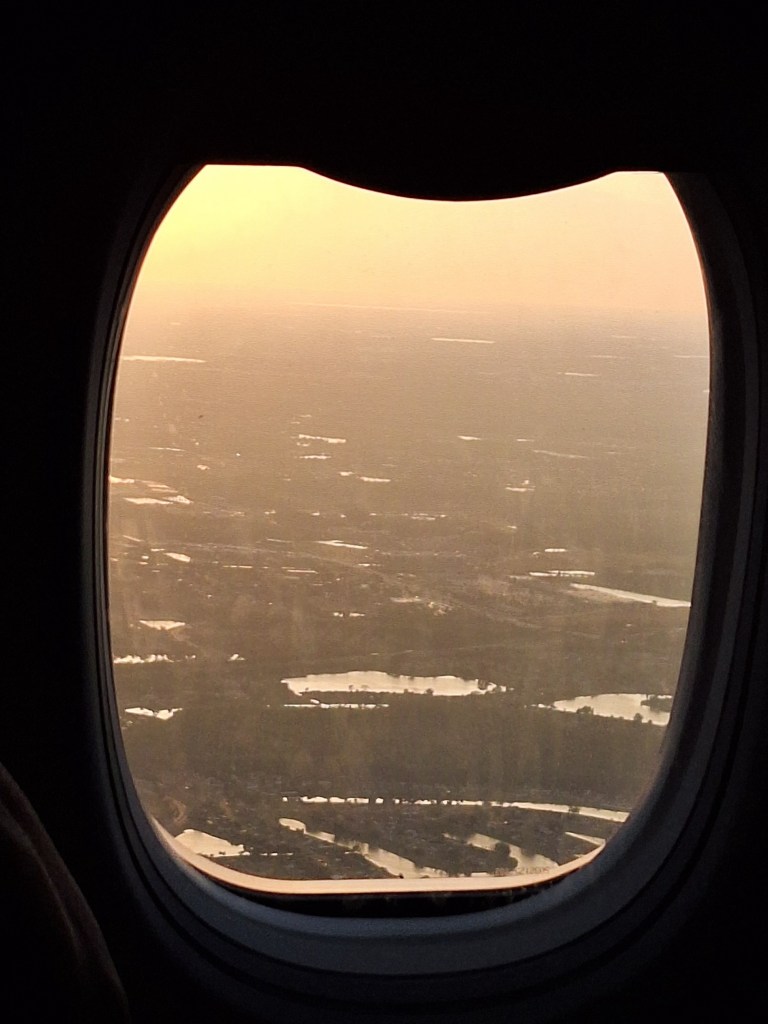
Somewhere in or near Manchester
After landing, disembarking, walking a long way to Passport Control in Manchester Airport’s Terminal 2, the moment of truth. Along with hundreds of other dazed passengers, I watched the baggage carousel with a mix of excitement at being back on home turf and dread at the thought of the bureaucracy I’d have to go through again if my case didn’t turn up. But, no, look, is that it? Yes, is that the right label? Yes, yes and yes.
The taxi driver took me home the long way, but that meant he just got a smaller tip than otherwise.
Arriving home is always a bit of anticlimax. A quick walk to get some milk then I had a cup of tea and, despite my best efforts, a nap.
I managed to stay awake for the duration of the first episode of the new series of Doctor Who before going to bed properly. Good night.
I woke up early, soon after sunrise, and was so glad I’d risen in the middle of the night to take some photos of the night sky, and yes, alright, just to gaze at the night sky with zero light pollution.
Neil hoovered the place, well, until the circuit breaker broke because the batteries had lost too much charge. The solar panels will charge them back up during the day.
First breakfast was cinnamon and apple flavoured oatmeal and a cup of tea.
Buzz’s design studio
We drove out from the cabin once again via Zuni Canyon. And again, I marvelled at the extent of the lava flows. A squirrel wasted no time in running across the road in front of us, phew. A family of ground hogs (same as prairie dogs?) standing in the middle of the road quickly dispersed in all directions. All except one who defiantly stood up on his hind legs until the very last moment, realising that a heavy American car is not to be messed with
‘Do something scary every day’ is one motto I try to live by, although there’s not always the opportunity to do so. Well, I admit, I did forego the opportunity to climb a ladder yesterday. But today, my challenge was, for the first time since about 1979, to eat an Egg McMuffin. We’d arranged to meet Buzz, Liesel, Gabe and Leslie at McDonalds in Grants at 11 o’clock. On arrival, I gave my order, being sure to enunciate to the best of my ability and to emphasise that I didn’t want any bacon on my Egg McMuffin. Loudly tapping the desk, the server who most definitely was not channeling Ronald McDonald’s jolly demeanour, told me that they don’t serve breakfast after 10.30, like everyone knows that, right?Scary Mary was so scary, I was too scared to order anything else to eat, so I just had a cup of tea.
Liesel and co arrived shortly afterwards and after a bit of a chat over tea or coffee or in Neil’s case, a small McFlurry, we all set off again. Neil returned to Albuquerque. The rest of us, almost in a convoy, set off westwards towards Window Rock.
Freight train, mesa, clouds
We ate lunch at the famous Earls Family Restaurant in Gallup. It first opened in 1947 . This date reminded me that I would miss out on visiting Roswell on this visit to New Mexico. My huevos rancheros was accompanied by more green chili, which was just borderline acceptable to my taste buds: a few more Scoville points and my ears would have blown off again. Even so, Liesel did ask whether I was red because of the chili or was I sunburnt?
Funny place to park
Window Rock is just over the border in the next state. So I was looking out for a big, brightly coloured sign saying ‘Welcome to Arizona’, maybe with flags flying, accompanied by a troupe of dancing girls and a big brass band. But no. A small, insgnificant, almost apologetic sign coyly saying ‘Arizona State Line’. That’s it? Well, what an anticlimax.
In Ganado, we visited the Hubbell Trading Post, established in 1878, now the oldest continually operated trading post on the Navajo reservation. J. L. Hubbell, whose family operated the trading post for nearly 90 years, was known among the Navajo as trustworthy and honest. His trading post became a pillar of the community, playing a large role in helping Navajo families rebuild their lives after the Long Walk.
The place was full of rug dealers, many beautifully woven rugs that would look good anywhere. Lots of jewellery too, they all seem very talented, the earrings were made by the maintenance supervisor.
Hubbell Hill
Arizona and the Navajo nation have a love/hate relationship with Daylight Savings. For a while, the times on my phone and Liesel’s phone were an hour different, even though we were in the same room. Another quirk in this place: no sales tax.
The Navajo Nation Museum was interesting, and quite moving. But the first thing you notice on arriving and parking up are the large rocks on an otherwise flat terrain.
Big rocks
The next thing we noticed was the big, black cloud that appeared almost from nowhere. And indeed, when we were inside, it did rain for a while.
Between 1863 and 1866, more than ten thousand Diné prisoners of the U.S. were marched to the Bosque Redondo reservation, known in Navajo as Hweéldi, in present day southeastem New Mexico. The Long Walk is actually a series of forced marches, no less than fifty-three, during which captives walked anywhere from 250 to 450 miles, depending on the route taken.
Many of them (Navajos) died from starvation. The kind of food they had, they died from that. Also, I think a larger percent of deaths was caused by homesickness. They wept from day-to-day, many of them, “I wish I was on my own land bark at Chinle or Kayente.” — Dághá Chíí Bik’is, son-in-law of Manuelito and one of the first Navajo Council members (1951).
The Long Walk, then a Treaty between the Navajo Reservation and the United States that is, literally, not watertight. Disputes about the Treaty are still taking place, resulting in ongoing court cases. One current issue is the water supply. The Navajo nation depends upon just three rivers, and they’re being affected by climate change, like everything else.
Diné Cosmic Order by Donovan Snyder, 2018
At the time of the White Land (Ni’halgai), First Man (Áłtsé Hastiin), First Woman (Áłtsé Asdząą), and other Divinities were choosing rock-star mica chips that were laid out on a buckskin robe to place in the sky. They were forming our constellations to light up the dark night.
Mischievous Coyote (Mą’ii) came along and wanted to help, but after witnessing the slow and methodical placement of the constellations, he became impatient. He grabbed the buckskin and scattered the remaining stars into the sky, which is why some stars today are not seen within in the orderly constellations.
After the rain, it was only a quick downpour, we drove to our final destination of the day, Window Rock. At the first sighting of this natural phenomenon, I took this picture:
UFO?
Window Rock is over there at the back, but, a flying saucer? How cool! Yes, I know it’s a raindrop on the windscreen, but still…
Selfie of the day
The rock with a big hole in it is well protected, fenced off, we really aren’t invited to go up for a closer look. It’s a great venue for graduation photos, as enjoyed by one new graduate today, having a good celebration with his family.
Graduate and family and Window Rock
Here is a fascinating story, we learned a lot about it at the Museum, and there’s a monument here.
The Legendary Navajo Code Talkers:
During World War II, in the South Pacific Theater, the Japanese were extremely proficient at breaking into military radio communications and transmissions. Thus they were able to decipher U.S. Military codes. The U.S. Armed forces needed to find a secure method of communication if they were to have any chance of defeating a clever and intelligent foe. To counter the cleverness of the Japanese cryptographers, 29 Navajo Marines were recruited to devise a secret military code using their native language. By war’s end, there were over 400 Navajo Marines serving as code talkers and the code vocabulary had doubled. So successful was this innovative code that the Marine Corps commanders credited it with saving the lives of countless American Marines and soldiers. It enabled their successful engagements throughout the Pacific Theater which included the battles for Guadalcanal, Wake Island, Tarawa, Saipan, Guam, Midway, Iwo Jima and Okinawa. The code paved the way to early victory for the allied forces in the South Pacific. Major Howard M. Conner, 5th Marine Division Signal Officer stationed on Iwo Jima, commented on the gallantry of the Navajo Code Talkers: “Were it not for the Navajos, the Marines would not have taken Iwo Jima.”
Far from their homes, these brave young Navajo Marines served our nation with honor and dignity. The tale of their exploits remained a closely guarded secret for decades in the event that the Navajo Code Talkers unique talents would be needed again. In 1968 the Navajo code was finally declassified. In July 2001, at the National Capital Rotunda, United States President, the honorable George W. Bush, awarded the Congressional Gold Medals to the first 29 Navajo Code Talkers, their surviving spouses or children. In November of 2001 at the Navajo Nation capital of Window Rock, Arizona, the Congressional Silver Medals were awarded to the rest of the Navajo Code Talkers, their surviving spouses or children. Sadly, many of the Navajo Code Talkers have passed on never knowing of the honor a grateful nation has bestowed upon them. The Navajo Code Talkers will never be forgotten.
Diné Bizaad Yee Atah Naayee’ Yik’eh Deesdlii.
Navajo Code Talker statue
We checked in at our Holiday Inn before wandering over the road to Navajo Westerners Ace Hardware. Some of the fabrics on sale here are very pretty.
Fabrics
Another shop in this Navajo Nation Shopping Center was the supermarket from where we bought a snack: still full from a big lunch, we didn’t need a big evening meal.
We were followed back to the hotel by a stray dog, but I think it didn’t speak English, since it ignored all my stern commands. Another reason to learn Spanish, I suppose. Or maybe even Navajo.
Going down for breakfast in the morning provided the first chortle of the day. Shouldn’t laugh, really, but… There was a poster outside the hotel shop with a mugshot of a young lady. The caption: Anyone know who this is? They stole our security device.
Buzz and Gabe are here at this time for a weekend of fun with the Girl Scouts.They were at the breakast table along with Liesel and Leslie, plus three other Girl Scout leaders, by the time I arrived.
Outside the hotel
Liesel looked at a very pretty necklace in the shop, but decided not to buy it in the end. ‘It’s only stuff’ and ‘I’ll probably only wear it once’.
Over the road, the famous Flea Market was being set up. We wandered around, admiring all the jewellery (of course), ignoring the car tyres and electronics up for sale, and just passed some time until the Navajo Arts and Craft Enterprise opened. More locally made jewellery, and this time, Liesel did buy something, an unusual pair of earrings.
New earrings
I didn’t win, thank goodness
Leslie chose to stay with Buzz today, with the Girl Scouts, so that left Liesel and me to drive back to Albuquerque. Having plenty of time, we paid a visit to El Morro, for more local culture and a walk. Thanks to some roadworks, we found ourselves driving along the rumblestrips at the side of the road, and that’s a very uncomfortable feeling after a while. You’re doing nothing wrong, but we’ve been programmed to think that that noise means we’re too near the edge. Weird.
We listened to Classic Rock 93X: Putting the rock into Window Rock! Well, classic rock? Over half of the songs they played were new to me. They may have been big hits and very popular in the USA, but it was reassuring when the odd, genuine classic, came on.
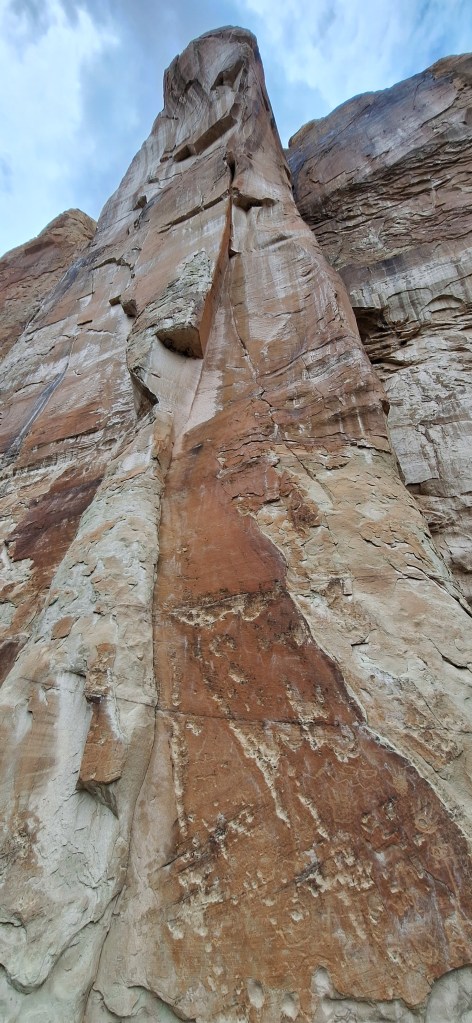
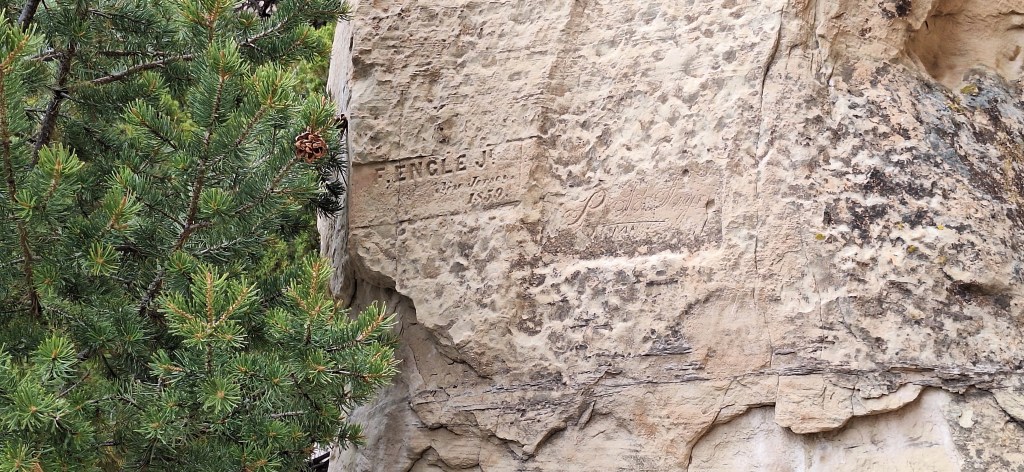
On to El Morro, then. This cuesta has long been an oasis to the travelers who left their mark upon it. A reliable waterhole hidden at the base of a sandstone bluff made El Morro (the headland) a popular refuge for hundreds of years. Native Americans, Spanish explorers and missionaries, and American soldiers and pioneers carved over 2,000 signatures, dates, messages, and petroglyphs. Atop the cuesta are the remains of the fourteenth-century pueblos of Atsinna and North Atsinna where the ancestors of today’s Puebloan communities once lived.
A most enjoyable and interesting walk. The guide lent us a book, and we followed the route more or less as suggested.
Oasis
Petroglyphs
Signatures
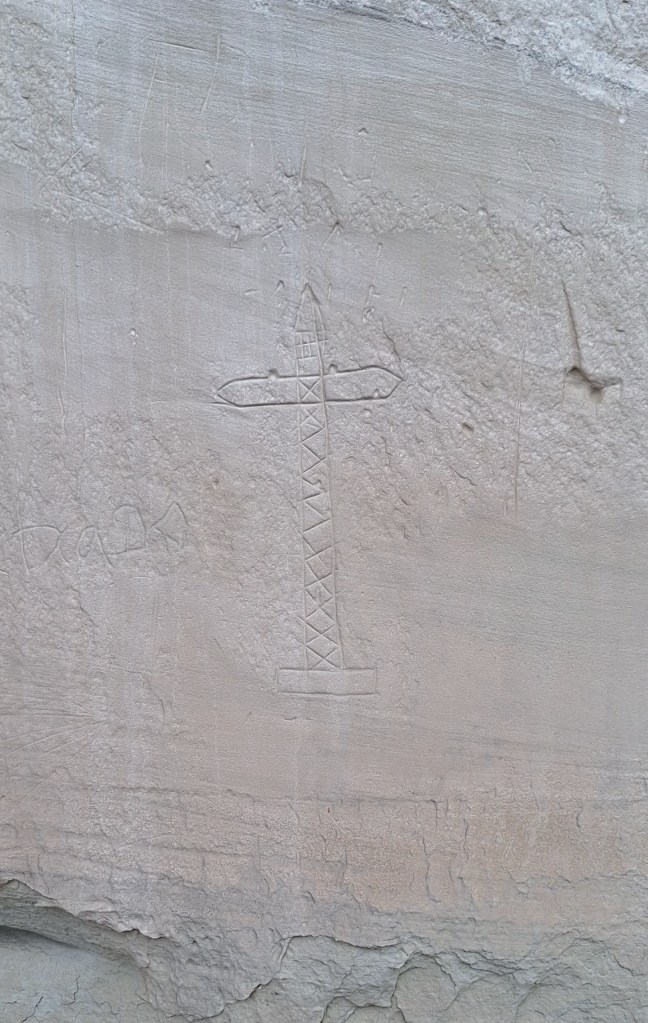
These artefacts won’t last forever, being carved into sandstone and where they’ve tried to hide post-1906 markings, the surface looks unnaturally smooth.
Transmission Tower? From 1605??
As we walked back to the Visitor Centre, we felt a few spots of rain. Big spots. But, just as quickly, we stepped over a crack in the concrete path, and it wasn’t raining any more.
Selfie of the day
We heard the thunder in the distance, relieved that we weren’t caught in a major storm.
Our journey back to Albuquerque continued. We saw sheep and horses close to the highway, mostly behind a fence, but not always. Not ideal when the traffic is moving at 60mph or more.
We can sort of understand why people might choose to live out here in the middle of nowhere, miles from the nearest town. But, then, why would you build your house so close to the noisy highway?
We drove over the Continental Divide, elevation 7200 feet. This was a much more interesting sign than ‘Arizona State Line’. And if there was such a sign, we missed ‘New Mexico State Line’.
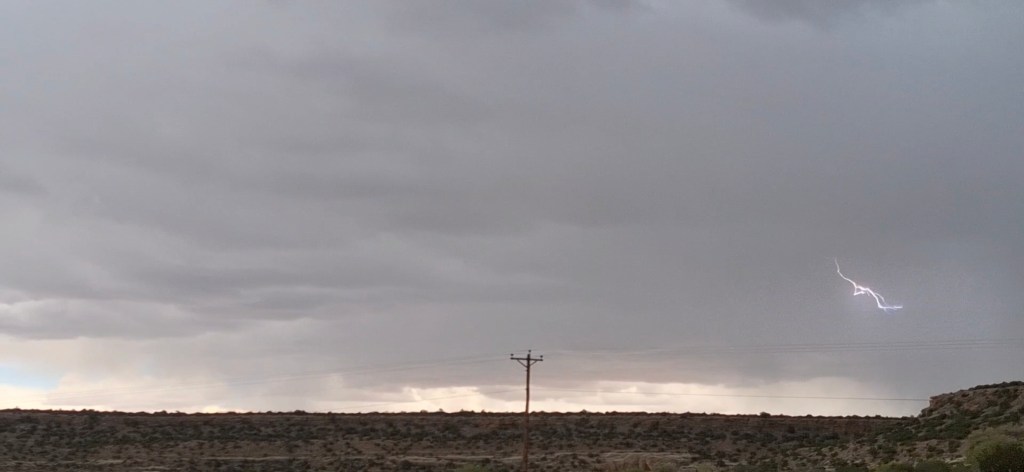
But we couldn’t miss the thunderstorm ahead of us, so of course I had to try and get a picture of the lightning. Liesel wasn’t keen on me almost leaning out of the with with my phone. But it was worth it!
Lightning
Back at home, we took Neil out for a meal at Monroe’s, a return visit for us. I enjoyed my final New Mexico meal: #6 Veggie Tostadas (Gluten free) 2 bluecorn tostada shells stuffed with avocado, whole beans, pico de gallo, mozzarella, lettuce and tomato. Served with calavacitas and salsa. Hey, I remembered what I ate! But only because I screenshot the menu.
Final NM meal? Yes, my time here was nearly up and I had to do some packing. I have more to take home that I came with, especially the Seestar S50. Four weeks here, and it’s all a bit of a blur right now. I need a holiday, as they say.
Oh, and WordPress has just told me that this is the 600th post on this blog. What a lot of antics!
There was no point in revelling in our success at the pub quiz last night, since we didn’t have any! We came joint last, but it was all good fun. In the morning, we left Tammy and Aaron in peace and drove into Santa Fe city centre for breakfast in Clafoutis, the French bakers. No, we didn’t mind sitting at a ‘communal table’. But our ‘companions’ left as soon as we sat down. We had the table to ourselves until a couple of ladies joined us. One from Colorado, the other from Pennsylvania.
Liesel and Tammy had had a great massage last week, so Liesel took me to the same place and we were pummelled and poked for an hour. I think it was a good massage. To recover, we spent a little time in the book shop next door. So many books to catch up on, both new and old.
The drive back to Albuquerque was quick, I think I nodded off for a bit and missed a lot of the stunning New Mexico scenery.
As a prelude to a visit to the zoo, I spotted some wildlife in the courtyard.
Ants
There was nothing special about these millions of ants apart from their speed: they were very busy, or at least, running around, looking busy. Fudgelling, I think, is the word.
Liesel drove Leslie and me to Albuquerque Zoo , or more accurately, ABQ BioPark Zoo. We had a nice wander around the place, which wasn’t as crowded as we’d expected, having seen how packed the car park was.
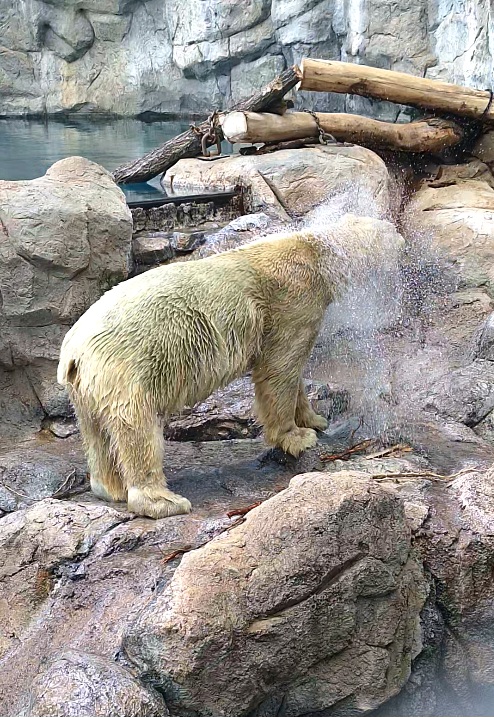
It wasn’t only the animals we were here to see: some of the plantlife was fascinating too. There were some bigger animals, as well, don’t worry. The polar bear here seemed to have a lot more room than that poor old thing in Chessington World of Adventures a few years ago. This one appeared to be having fun too, climbing rocks, diving and swimming.
Polar Bear
The kookaburras responded to my recording of their cousin, made in Australia some years ago. It was mean, really, they probably think they have a new friend. Sorry. That’s nearly as bad as little boys chasing ducks.
In the café, the man had to show me how to order food on the touchscreen because it was too hard for him to listen to my order with his own ears. Having placed the order electronically, he then read it out to me from his own screen, just to confirm what I wanted. Anyway, my bowl of fries was very nice, just what I needed. Liesel and Leslie had an ice cream instead.
The sign on the fence told us there were zebras in this enclosure. Well, that small rodent with a fluffy tail looked more like a squirrel to me, it didn’t even have any stripes.
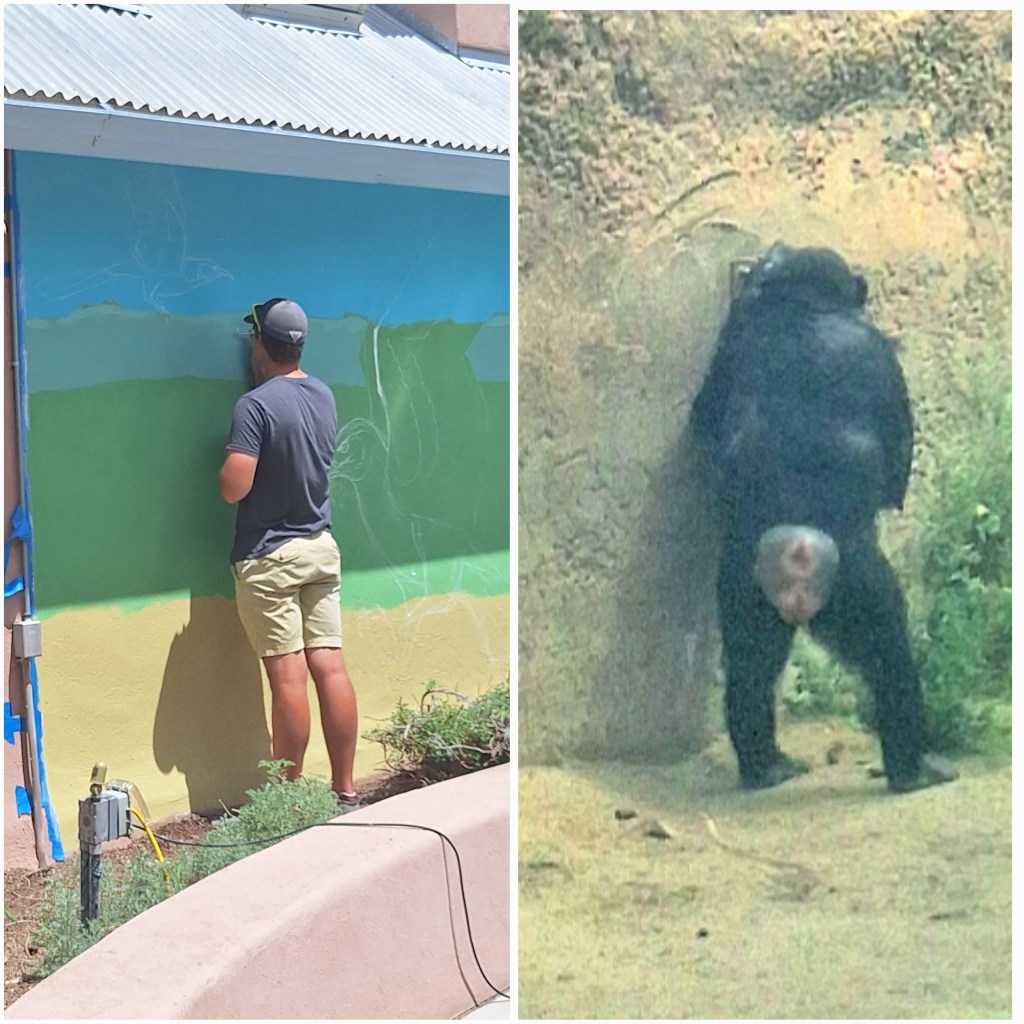
Man v Chimp
One of these characters is preparing to add some charcters to the mural, the other is playing hide and seek with his troop.
The hippos were very active, although Liesel was disappointed that none of them did the thing with their tail, spinning it round and round to spread the love from their bottoms.
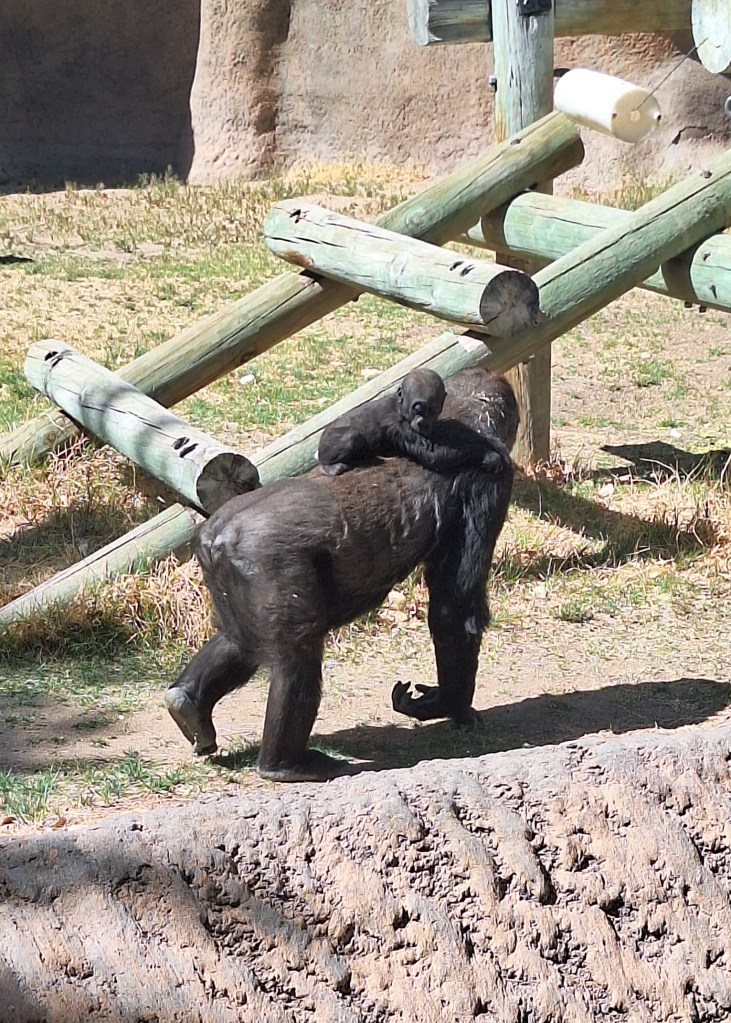
The cutest thing was undoubtedly the Mum gorilla carrying her baby around.
Gorilla Mum and baby
Time for a return visit to the cabin. Neil and I left quite early and spent the day and night there, seemingly out in the middle of nowhere.
The Cabin
I helped Neil with a few odd jobs. Fixing a light fitting was OK. Attaching the fan was OK, I just let Neil climb the ladder. Fitting the fan blades was a bit of a let-down, because the wrong size screws had been supplied.
Another job was plumbing related, definitely not my favourite thing. But we succeeded without losing too much water from the system.
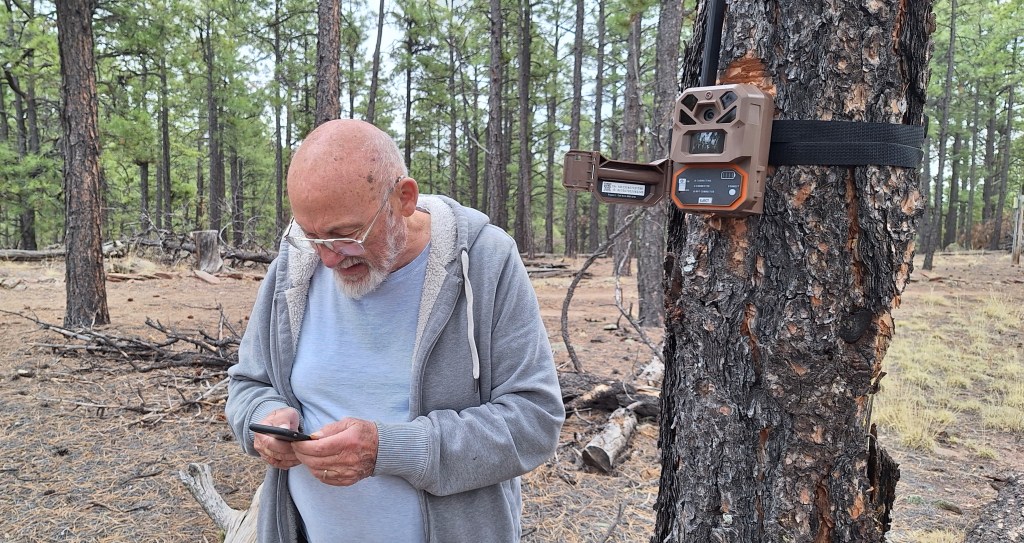
The most interesting job though was to affix a Moultrie Edge cellular trail camera to a tree, facing the cabin, so that from home in Albuquerque, Neil can keep an eye on the cabin and monitor the weather.
Neil with camera
It can be set up with a motion sensor so that any passing wildlife will be captured on film too. Well, not literally film, but you know what I mean. The first animal it took a picture of was, er, me, posing by a tree.
Walking around the area surrounding the cabin cannot be done stealthily. There’s always something crunching under foot, leaves, wood, pine cones.
Later in the evening, I prepared my new Seestar S50. The Moon was easy to spot, but the sky was pretty much obscured by clouds, which was disappointing.
Waxing crescent Moon
I also found Jupiter and its four brightest moons, but I couldn’t discern the coloured bands on Jupiter itself. As it got darker, more clouds moved in, so I went back inside, and very soon, it was time for bed.
At about 1.30, I woke up for the usual reason, and while outside, I couldn’t believe how clear the sky was, how many stars I could see. No clouds at all. Well, even though it was cold, I decided I would take the Seestar out on the balcony again and do some stargazing.
M 13 Hercules Globular ClusterM 51 Whirlpool Galaxy
I was very impressed with these pictures, but I wasn’t so impressed with the how cold it was outside, brrr, apparently it was about 40°F, that’s so different to the daytime temperature. So I went back to bed.
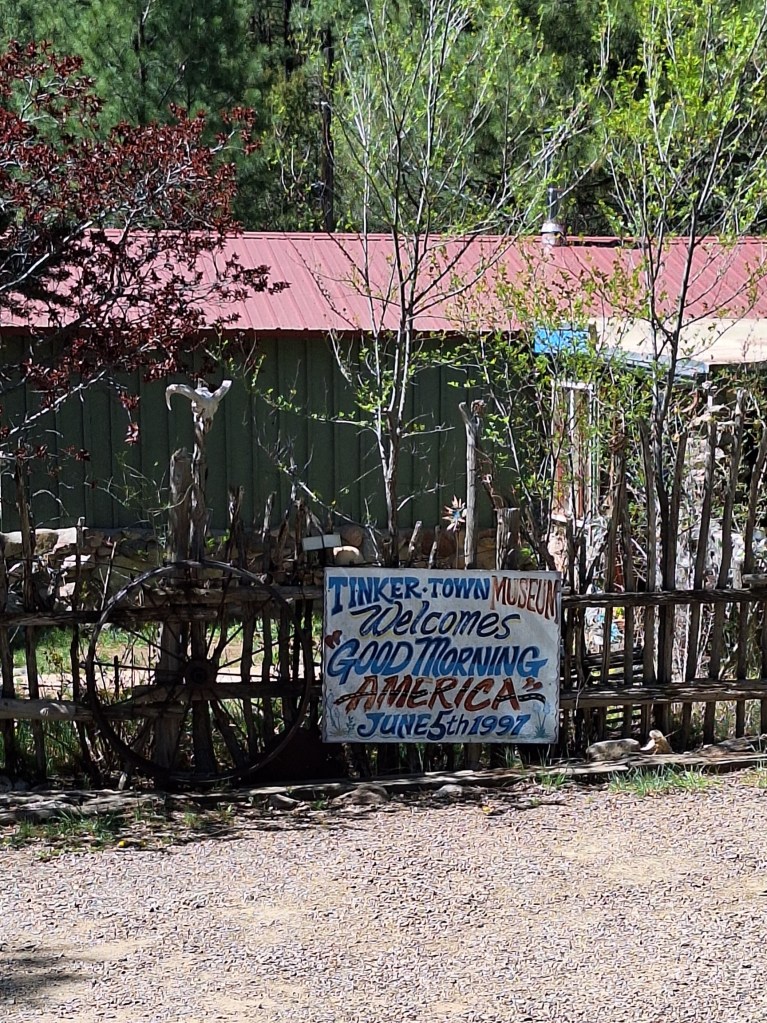
Buzz drove me, Liesel and Leslie to Tinkertown Museum, one of Albuquerque’s more quirky attractions. On arrival, I couldn’t help but notice that they’re still celebrating the fact that in June, 1997, they were visited by the top TV show Good Morning America.
Good Morning America
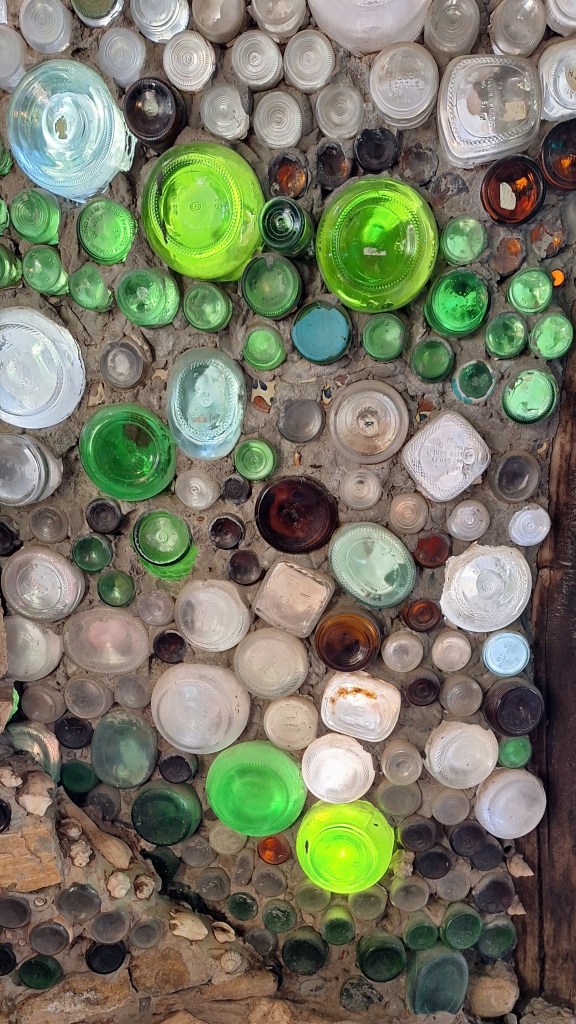
The next thing I noticed was that most of the walls are made from bottles stuck together with some kind of mortar. There must be a name for this innovative construction method.
Bottle and daub
Inside the museum, you see a wonderfully eclectic collection of objects: for example, we found ourselves treading on horsehoes embedded in the floor. There are hundreds of old vehicle registrartion number plates, some of which are just a small amount of rust held together by pure luck.
As one homemade sign says: Tinker Town was started as a hobby in 1962. It was not intended as a public display until your interest helped build our museum.
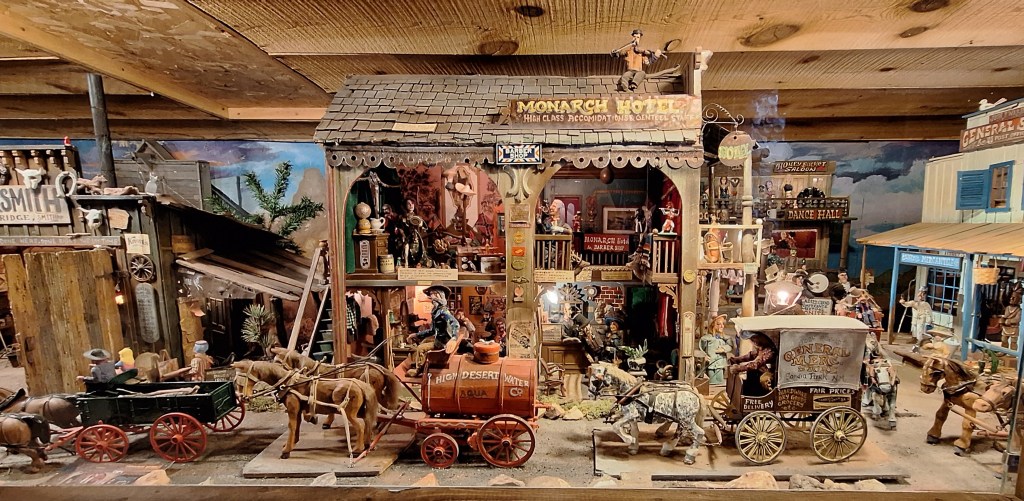
It was a fascinating character called Ross Ward who started the museum. Many of his wood carvings are on display, featured in displays of fairgrounds, wagon trains and other exhibits. Some are animated, and some have buttons to press. It’s all great fun.
Monarch Hotel
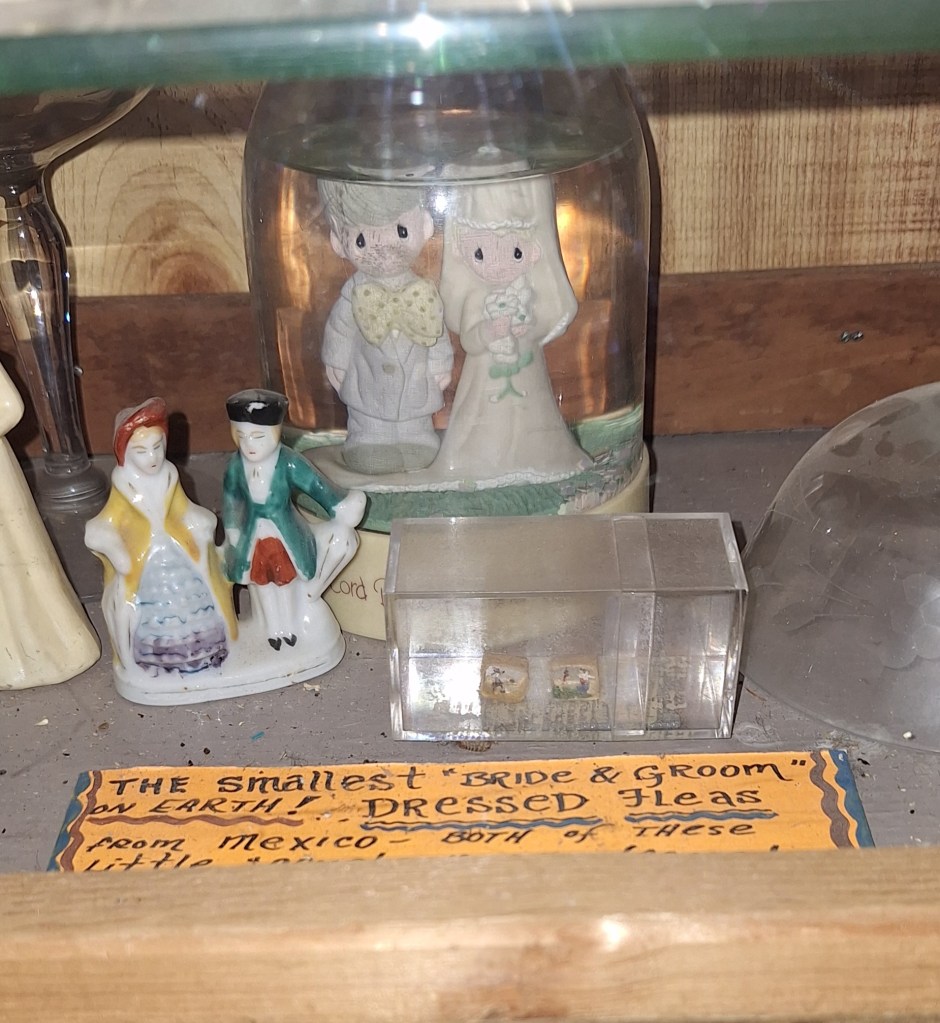
The smallest wedding couple are fleas (I hope I’m not giving too much away). There’s a one-man band named Otto, who’ll play something for a quarter. Yes, Sarah, who greeted us, made sure to give us some quarters when we paid to enter.
Married fleas
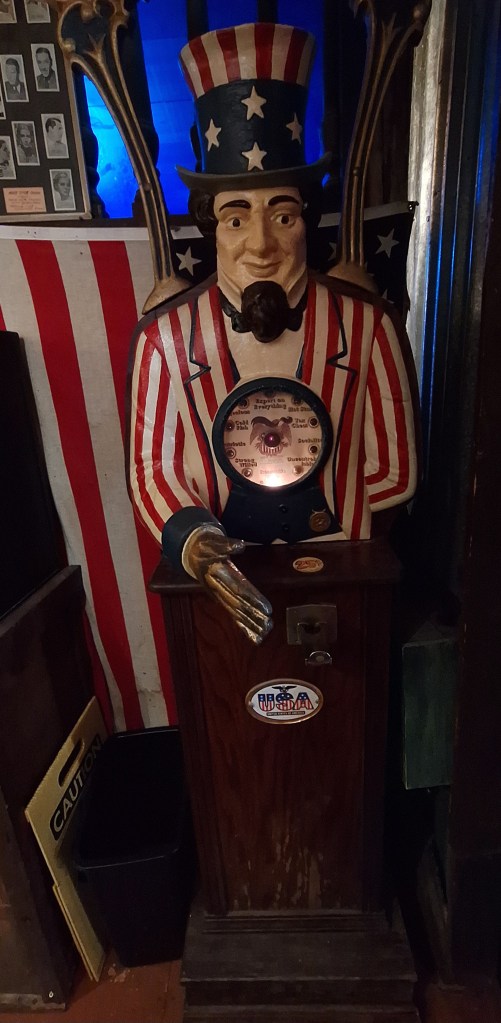
I had my fortune told, and it looks like everything’s coming up roses. For another 25 cents, I shook hands with Uncle Sam and his conclusion was that I am a romantic. On the other hand, in the next room, the Career Pilot told me I was destined to be a fish seller.
Uncle Sam
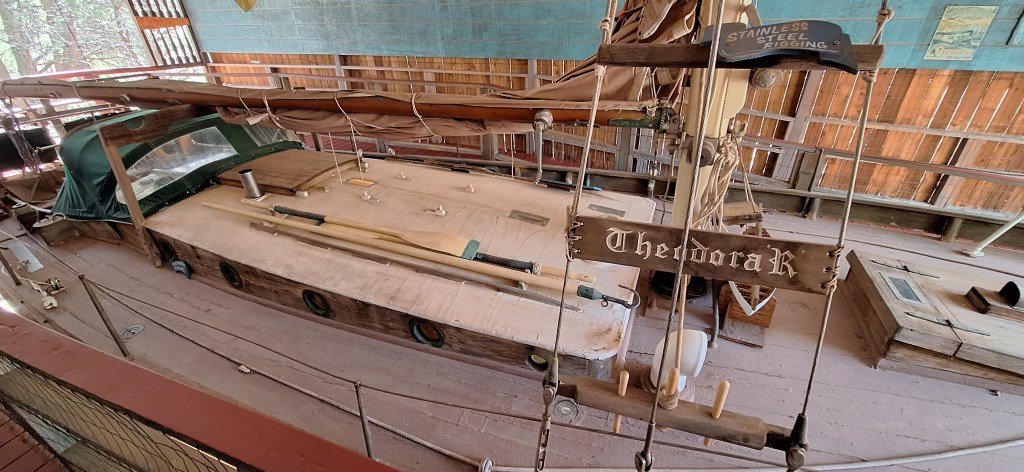
There’s a 35-foot long wooden sailboat that Fritz Damler spent ten years sailing around the world, losing one wife, finding another.
Theodora R
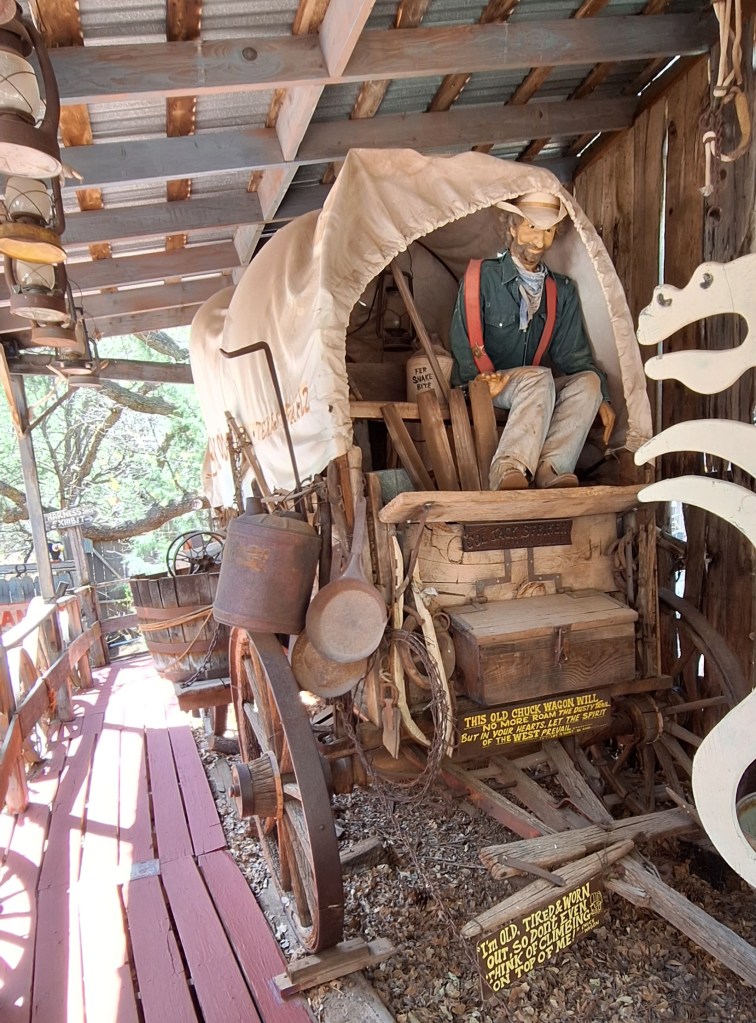
We thought we’d finished wandering around the museum, but no, there was plenty more to look at outside.
Chuck wagon
It was a fun place to visit, but we both thought it needed a bit of TLC: many of the displays were dusty, but I suppose that can’t be helped in a desert.
Lunch was taken at The Cheesecake Factory but my Impossible® Burger didn’t leave enough room for some actual cheesecake. Also, we weren’t served by Penny from The Big Bang Theory.
Buzz drove us up the hill to give us a nice all-round view. I say ‘hill’ but that’s an understatement. We drove up and up a long and winding road, with plenty of nearly hairpin bends, to reach the top, Sandia Crest, the highest peak in the Sandia mountains. Albuquerque is about a mile above sea level and Sandia Crest is another mile above Albuquerque. On a clear day, you can apparently see 100 miles in each direction. Today wasn’t that clear. But it did feel a bit ooky looking down on what might have been a model of the city of Albuquerque, a mile below.
Albuquerque down there
Another really noticeable difference was the temperature. At the top, it was 56°F (13°C) and back at the bottom, on the way back, the mercury reached a massive 81°F (27°C).
Liesel and I had arranged to meet up with Tammy and Aaron one more time in Santa Fe. So after packing, we set off in a northerly direction.
Highlights of the drive up the I-25? Seeing some horses by the side of the road. And we saw a few small dust devils, which would be called ‘willy-willys’ in Australia.
We stopped briefly at a rest stop: such a place wouldn’t normally be of interest to anyone, but here there was a sign for the New Mexico Historic Women Marker Initiative, founded in 2005 by the New Mexico Women’s Forum. The 2006 Legislature funded the project to recognize women’s contributions to New Mexico history with official historic markers.
Official scenic historic marker
This is one of nearly 100 markers erected across the state, recognising women’s contributions in various fields, including arts, business, education, government, healthcare, and science.
Adelitas by Paul Bello
Both Albuquerque and Santa Fe are rightly proud of their murals. This very colourful one celebrates Adelitas, women who supported the Mexican Revolution. It’s outside a Mexican restaurant in Santa Fe, and we passed it on our way to Meow Wolf: House of Eternal Return. This is a large-scale interactive and immersive art installation, a 20,000-square-foot (1,900 m²) facility, including a concert venue.
‘Quirky’ is the word you’re looking for. As you walk through the different rooms, you’re supposed to be able to piece together a story. It’s probably easier with the app, but I was unable to download the app because, it said, I was in the wrong region. Probably it meant that my phone was UK-based.
There were many strange noises and effects, lots of user interaction, though I don’t think everything worked as it should. There were aliens, strange creatures, and it was very colourful.
You can crawl through fireplaces, climb into fridges, enter a wardrobe and come out through a bookcase.
It felt a bit like an escape room, but with no specific puzzle to solve. We’d still be there if we’d tried to read all the printed material lying around, newspapers, books, journals, video displays.
Selfie of the day
Some of the video games required tokens, which we didn’t purchase for our human dollars. And there were some obvious nods to science fiction characters such as those from Star Wars.
Liesel inside a cheap Tardis
A couple of rooms were designed to look like cartoon strips, just black and white imagery.
Happy birthday
You need to visit to see and enjoy the whole experience, of course: no more spoilers here.
We found a place for a delicious ice cream. Two scoops for me: green chili and vanilla flavour, a perfect combination. While sitting inside the parlour to enjoy our treats, a group of young people were outside decorating the pavement. There was no political message, just a lot of squiggles in blue paint.
Street art
We arrived at Tammy’s house bang on 6 o’clock, our agreed time, after driving via the local supermarket.
Almost immediately, Tammy whisked us away to El Dorado Fusion Tacos. We ordered our meals, said we were going to the pub next door, Santa Fe Brewing Company Eldorado, and the guy said they’d bring our food over.
No, I don’t know why sometimes it’s one word and sometimes two words: Eldorado or El Dorado? Anyway, it is the title of one of my favourite ELO records.
Aaron joined us straight from work and we ate, drank and prepared ourselves for a gruelling pub quiz.
In the end, there were only 16 questions, with a points system based on the TV quiz show Jeopardy, so 200, 300, 400 or 500 points for a correct answer. There were four categories.
After the main quiz, our team, Autopilots, was tied in the lead with Rolling Stones, both of us having a score of 3200 points. The quiz is decided though, again in a twist from Jeopardy, in which the teams wager a certain number of points on one final question. We bet all 3200, of course. But we got the answer wrong and ended up with zero. No wooden spoon for losers here, though!
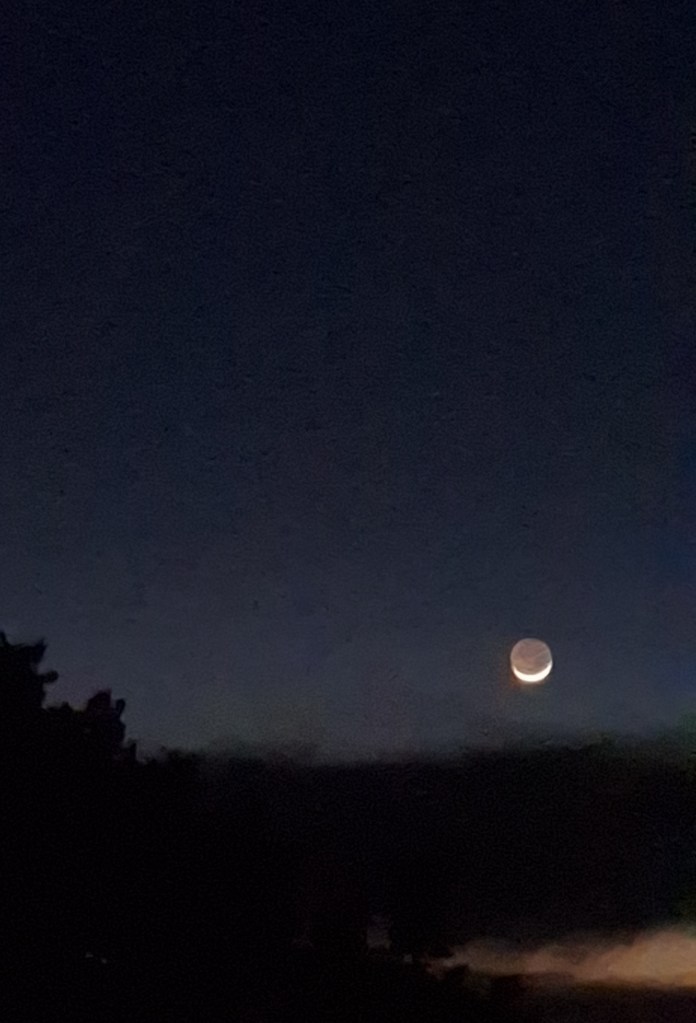
Great fun, but all over by about 9pm. On the drive home, we observed a very thin crescent Moon just about to follow the Sun and set. I should have brought my telescope, but I’d decided not to because I thought the quiz would finish much later and we wouldn’t have time to use it. So what’s the best my phone could do?
The Moon
PS I would have taken a picture of a slighly fatter crescent the following night if only there hadn’t been 100% cloud cover over Albuquerque, but that’s all to come…
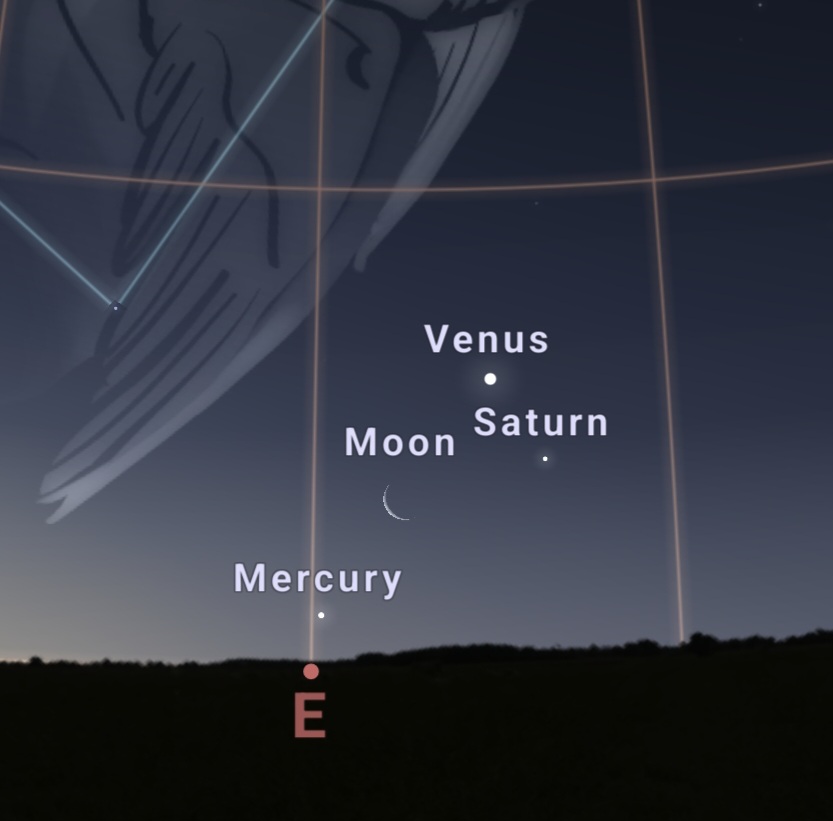
Smile, you’re on Candid Camera, said the world to the Moon. As a thin crescent, with Saturn and Venus both in the right place, we should have seen a big smiley face in the sky just a bit before sunrise. Not me. I got up in time, the sky was clear but I couldn’t see through the Sandia mountains to the east. So I crawled back into my pit.
What I missed, according to Stellarium
Liesel, me, Gabe, Elizabeth (Gabe’s daughter who I met for the first time today), Buzz, Lisa, Hannah and Leslie: we all visited Frontier for breakfast, a very popular eating spot here in Albuquerque. It’s a big place too, it was quite a challenge carrying the meals from where they were served up to where we were sitting.
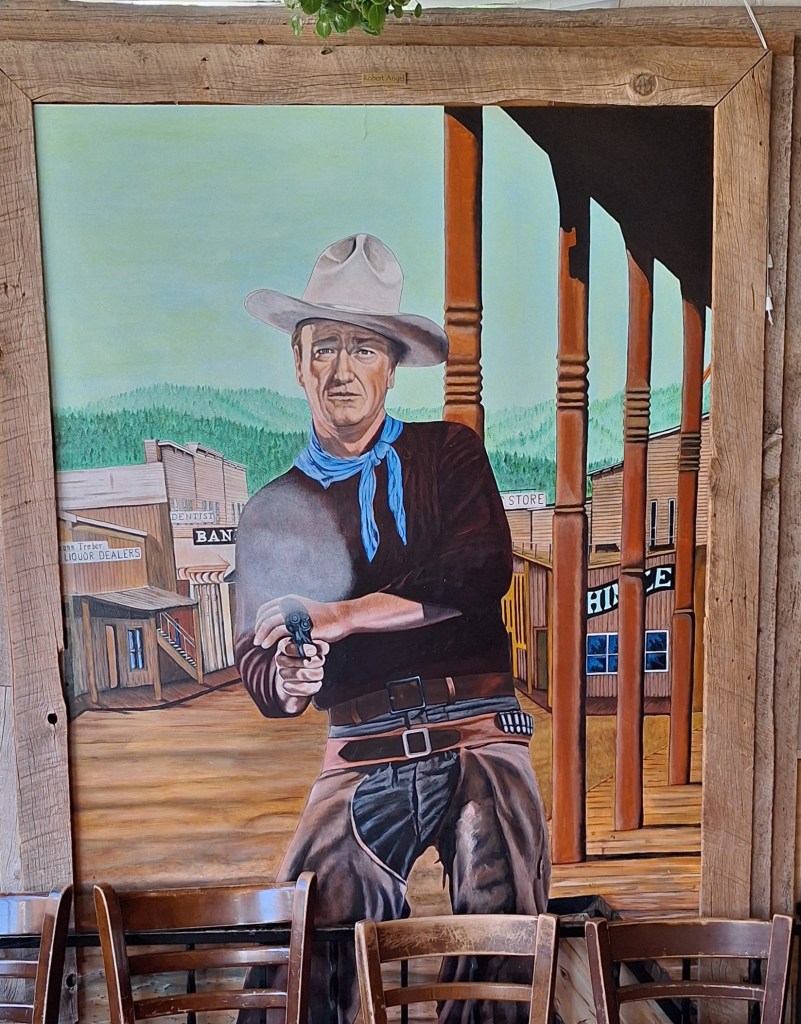
John Wayne in the Frontier
There were far too many interesting things to take pictures of in here, even though the main point of our visit was to eat breakfast. Which was very good, actually.
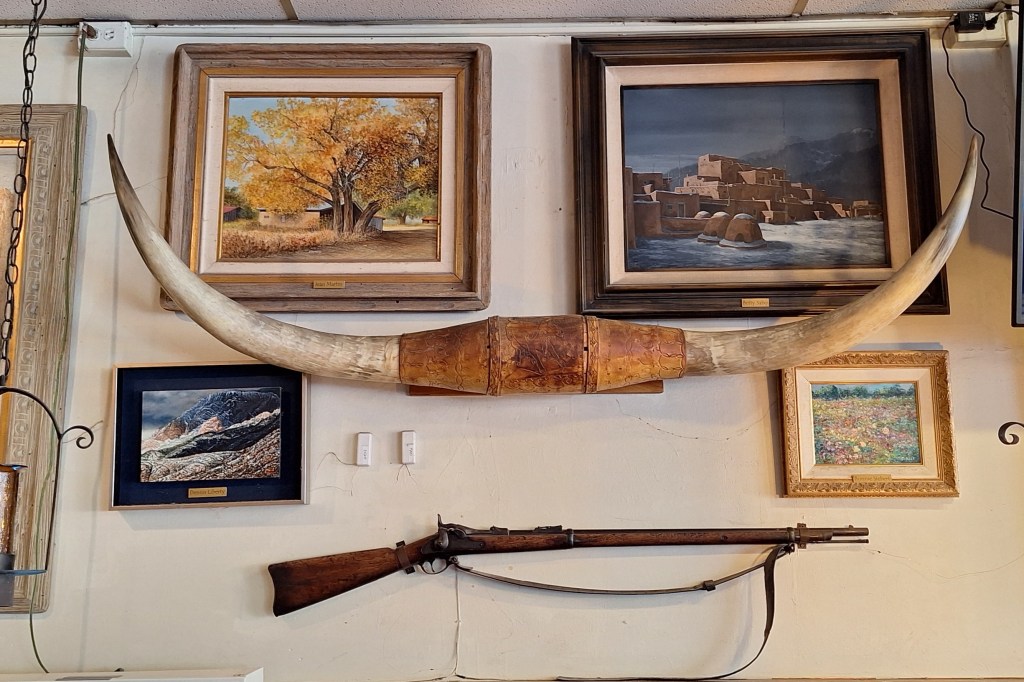
Horns and a Springfield model 1884 ‘trapdoor’ rifle
I assume the weapon is real and I was glad to see it glued to the wall so well.
The rest of the day, we spent at The Gathering of Nations, north America’s biggest Powwow. It was a beautiful day, and even apart from the performances, it was fun to watch people changing into their various tribal outfits, whether in the car park, or in the queue to get into the venue, or later on, on-site. It was a very colourful display.
Nibble on my ears
Buzz, Leslie and Lisa went into the indoor arena and reserved seats for the rest of us while we wandered around, admiring the various food offerings and watching people.
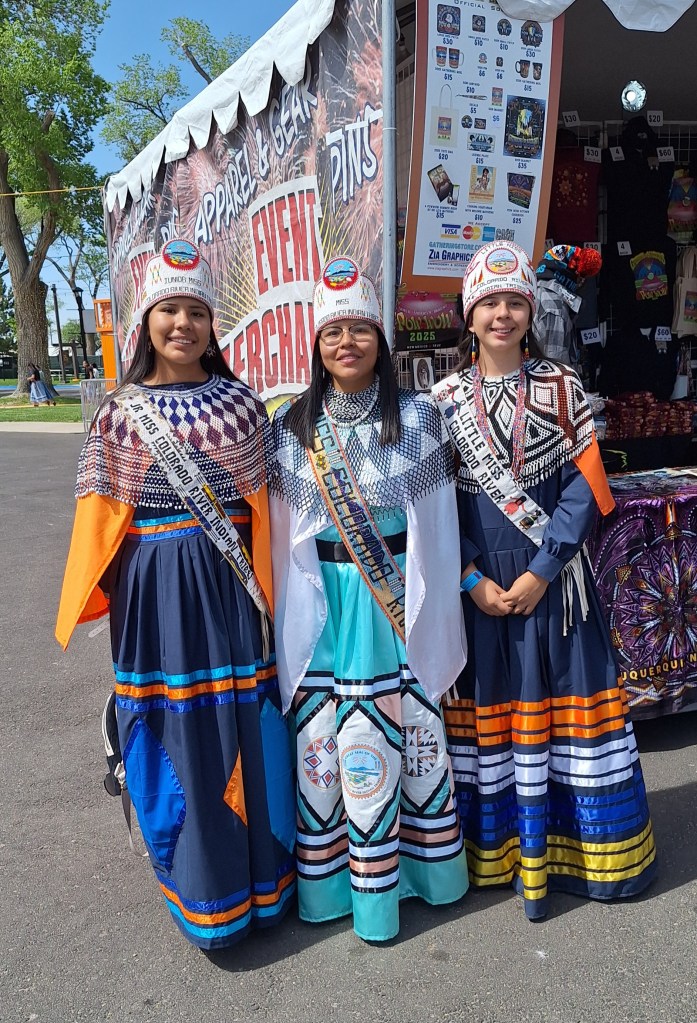
Three beautiful queens
In a couple of the buildings, more jewellery and artwork was on display and for sale. Again, we wanted to buy more than we could afford, or store. The different Indian nations each have their own style, and I think, slowly, we’re beginning to pick them out.
Liesel did buy some earrings, made by an Alaskan Athabascan. I bought a print of a painting that caught my eye from across the room.
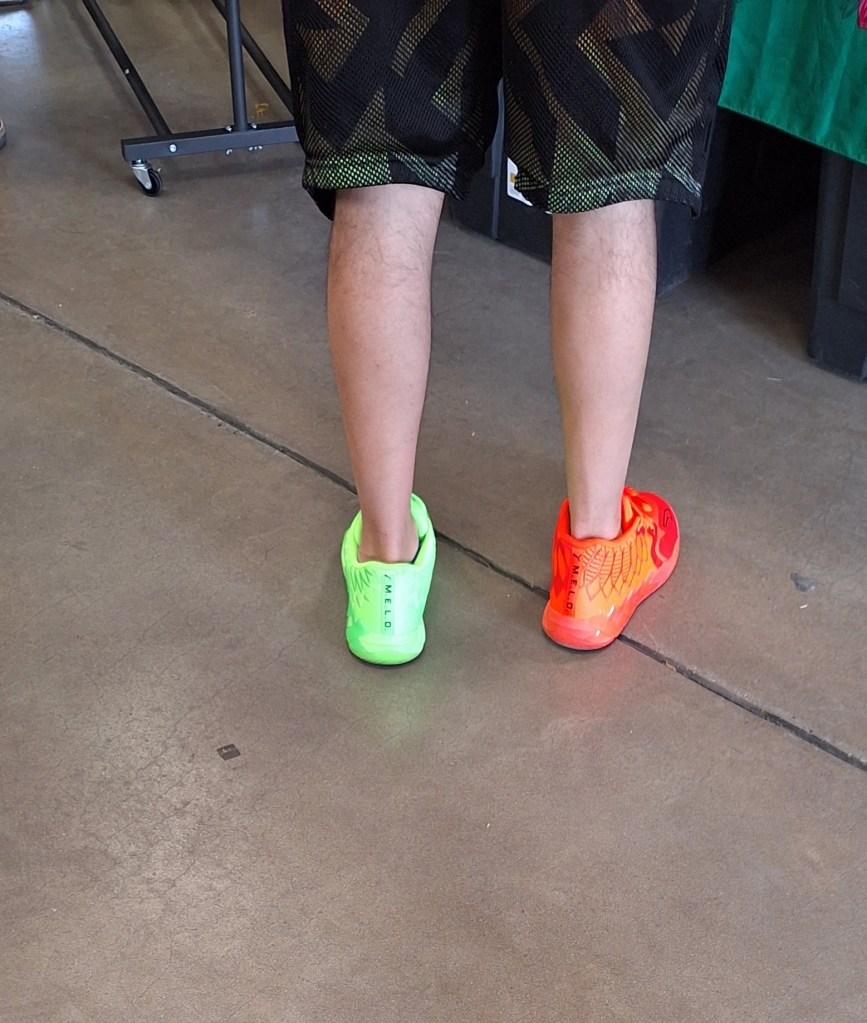
Odd people, odd shoes
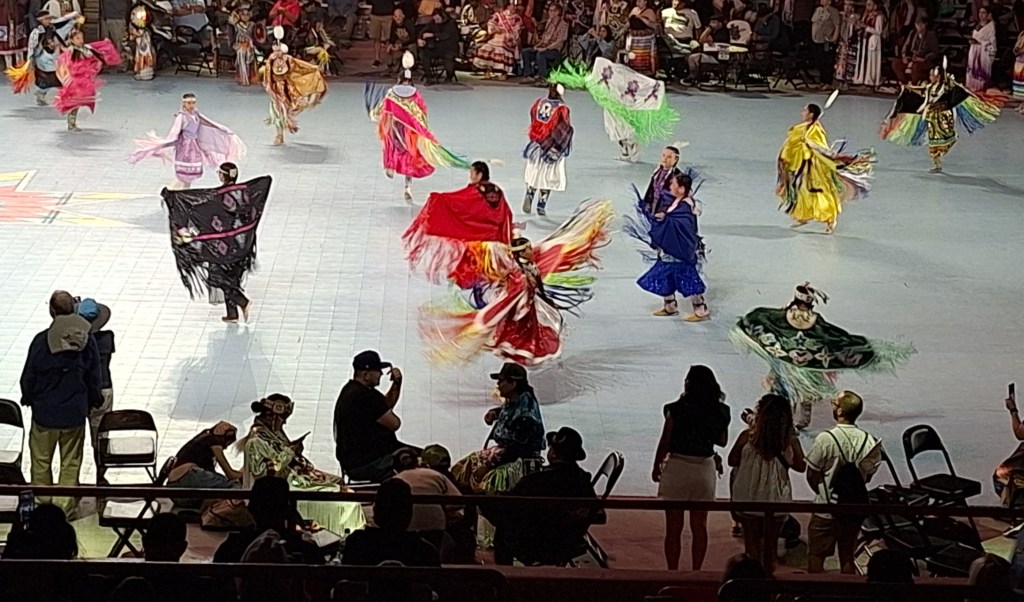
We found our family inside the Tingley Coliseum in good time for the Drum Roll Call and the Grand Entry of Dancers. The auditorium seats over 11,000 people and it was pretty full. A number of drum groups were located around the outside of the floor, they woke us up with their very loud rhythms.
We witnessed Elders, Chiefs and other Dignitaries lead the parade, with dancers from the many tribes joining the throng in the arena, dancing round until the whole floor was covered. It was a very colourful sight, exuberant and quite loud. I went as far as tapping a foot and trying to drum out the rhythms on my leg.
A full house
I took several picture like this during the day. You can see how busy the place was, but it’s hard to focus on any one individual, so here are a few of those:
Colourful dancers
Liesel and I went outside for a quick walk and found lunch, an Indian taco in my case, and very tasty it was, too. When Liesel returned to her seat indoors, I found some shade to sit in and eat while I listened to a band, Sandia Sons, performing a couple of songs.
One of the main events at the Powwow is to select Miss Indian Nation 2025-26. The incumbent for 2024-25, Kassie John, performed a dance for us, very nimble footwork.
There were of course a few speeches, all uplifting and positive, apart from one lady who went on and on losing everyone’s attention: this event wasn’t supposed to be about her and her personal religious beliefs.
Some of the performers had cool names: Sharpshoort Singers, from Saskatchewan; Iron Bear; Albert Nicotine; Dark Canyon, although didn’t he used to be a Musketeer?
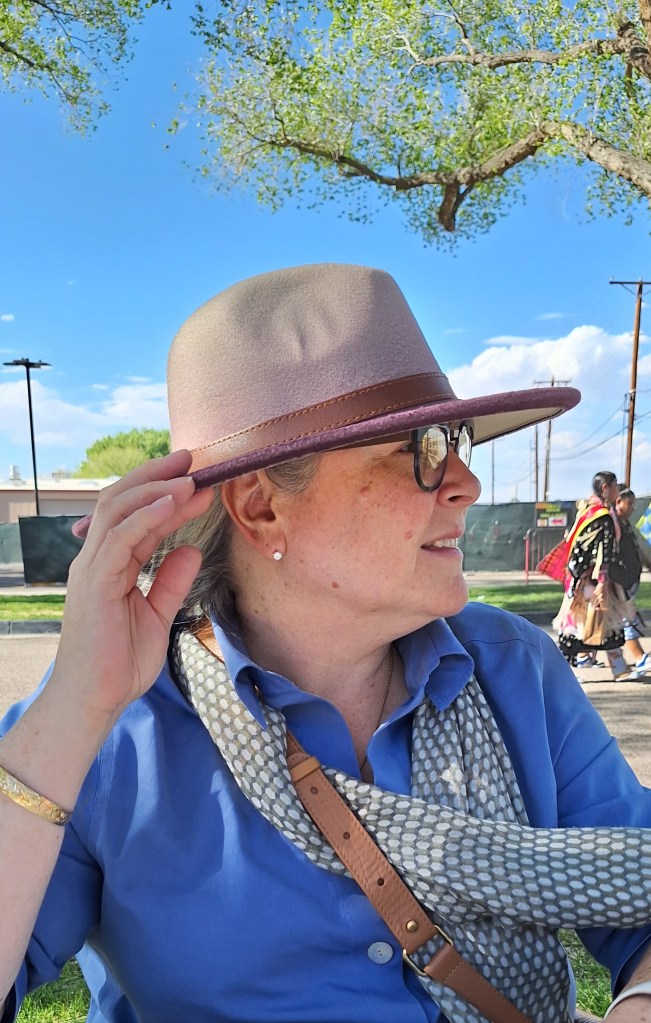
Outside again, and Liesel commented that she’d forgotten to bring her hat. Let’s buy a new one, then, I suggested. So she did.
Liesel’s new hat
I get the impression that Liesel’s not as fond of it as I am, but at least it will keep the Sun off, to a certain extent.
By now, Liesel and I were on our own. Everyone else in our group had gone home. They don’t know what they were missing.
Near to the place where we found this hat, we saw badger with feet, grey fox, Arctic fox, coyote with feet, river otter, dyed black coyote and silver fox. No, not a display of local, wild animals, but a selection of fur coats up for sale. Well, I hope they’ve all still got fleas.
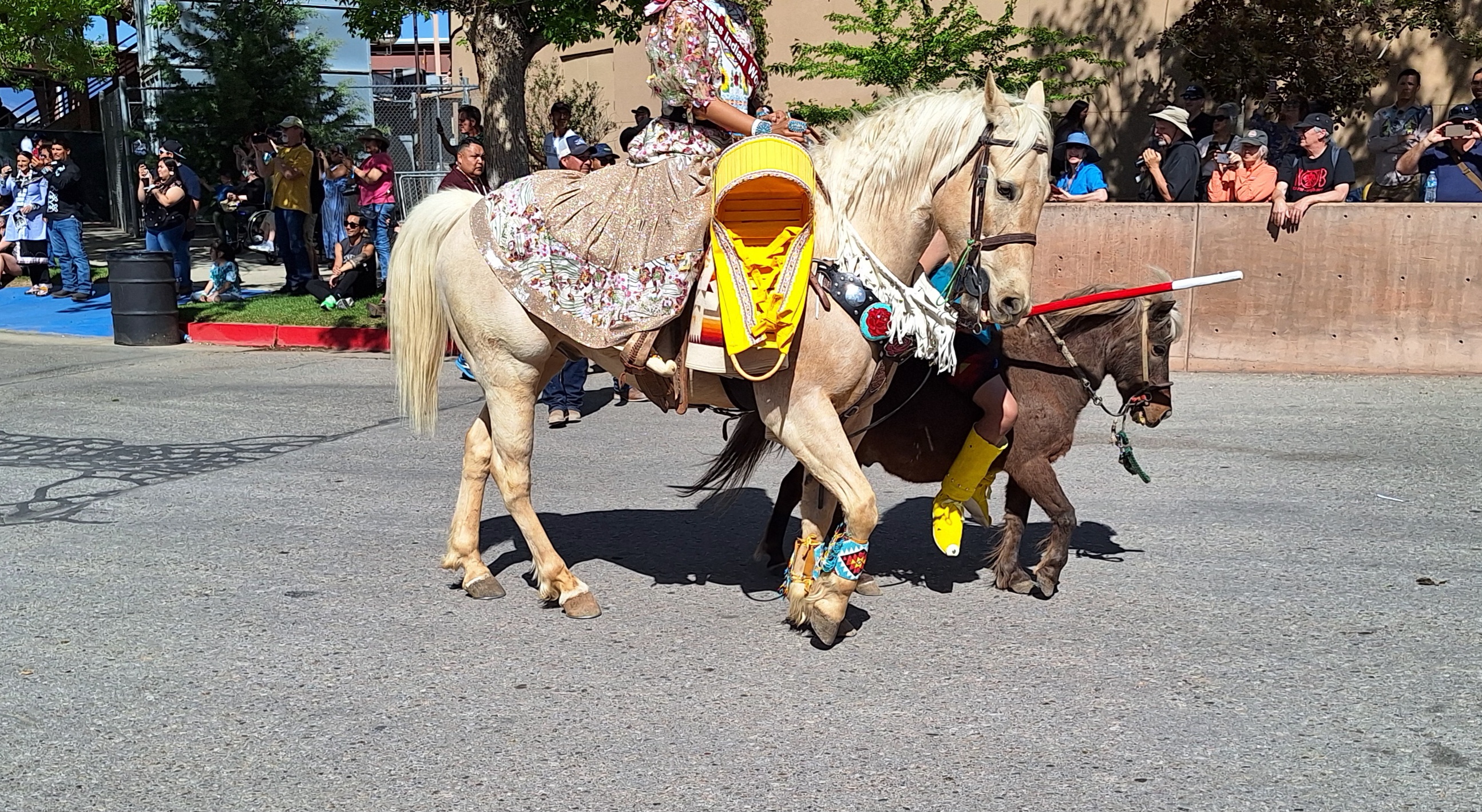
Back outside, we lined up with thousands of other people for the next event, The Traditional Horse and Rider Parade. Here are some of the runners and riders:
Nope, look more closely, it’s not a unicorn – and sorry about the decapitationJust a few of the horses in the parade
Back inside for one more session, I realised that at least one of the MCs reminded me of the DJ who appears at the beginning of The Carpenters’ song Calling Occupants of Interplanetary Craft, just a bit over-excited.
One of them got the audience to perform what can only now be referred to as a New Mexican Wave. When the folks to your right stand up, arms in the air, woohooing, it’s your turn to do the same. And so this wave goes round and round forever, well, four times on this occasion.
The Sacred Eagle staff was carried by an important representative from the Pawnee nation, but he couldn’t get far without being closely pursued by the paparazzi.
Sacred Eagle Staff
To our ears, many of the songs sounded the same but the rhythms of the drums kept up the overall sense of excitement.
At one point, relations of the performers were invited to join them on the dance floor, and then, so were we, the rest of the audience. I thought there was no need for me to be stomping on other people’s feet, so I stayed seated. There came a time when Liesel and I both felt we were fully saturated in Indian culture, and it was time to go back home.
The event has been run continously, apart from a couple of years for Covid, and this was the 42nd Annual World Celebration. When invited, a few people in the audience claimed to have been to every one, so far. Well, this was our first and what a fun, educational and entertaining day it was too. Not so say,exhausting. Thanks to Buzz for sorting out the tickets for us.
The next day was a day of rest, of writing, reading and relaxation, the alternative three Rs. I caught up a bit with emails, Liesel caught up on a bit of TV.
Problems with plumbing always cause me more grief than is strictly necessary, even when it’s nothing to do with me. The fact that my shower leaked ino the bathroom below while I was using it was just pure bad luck. The shower hasn’t been used regularly for a long time and the seal around the drain had dried out over the years. Neil fixed the problem with the help of a friend.
By way of escape, Gabe drove Liesel and me to the Three Guns Spring Trail, a hike postponed from a few days ago.
Precarious rock
I thought this was a good place to balance a large boulder, just above the car park.
From here, the trail was up and up. In places, the gravelly path was quite steep. Gabe was a good guide, both as a geologist and a cactus-specialising horticulturalist.
Looking up
It was very quiet. I could hear the silence even above my tinnitus. Strangely, no birds and very few insects.
Mating bordered plant bugs
This pair seemed to be having a good time though, we look forward to seeing the next generation in due course. There were a few other beetles, including stink bugs. And later on, a couple of bees did buzz around.
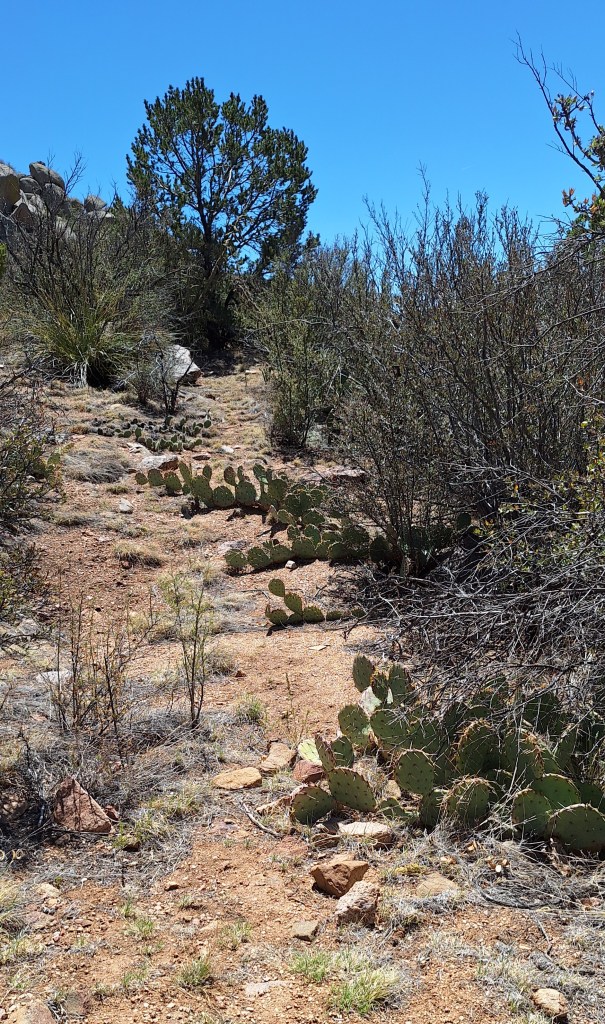
Prickly pear cactus along the trail
I think this was the longest, continuous climb I’d done for several months, and of course my old issue, shortness of breath, affected my performance. We reached a point where reluctantly, I had to stop. I parked myself on a rock, in the shade, and listened to the silence. A gentle breeze cooled me down. Liesel carried on, reaching our erstwhile goal, The Post, and a bit beyond.
The Post (not much to write home about, is it!)
Sadly, neither of us saw the spring that gives the trail its name. Nor three guns, come to that.
Liesel’s view from the top
Surely, there was other wildlife? Liesel saw a single lizard but most/least exciting was seeing less than 25% of a deer on the trail on our return to the car park.
Deer leg
At least my chest no longer felt like it would explode. But other things happened too. Dear body of mine, if I’m so dehydrated, why do you keep producing so much snot? Just stop it.
There’s a house on the road leading to this trail’s car park that is very well decorated. I for one didn’t expect to see this famous statue here.
Statue of Liberty
This guy (I assume it’s a guy, a gal would have better things to do with their time) has built a bird house in the style of an old pueblo dwelling.
Lisa arrived tonight. She is Buzz and Neil’s daughter, Leslie’s niece, Liesel’s cousin. I really should draw up a family tree.
The following day, I went on a road trip with Neil. Neil and Buzz have a cabin near the Zuni Mountains about 80 miles west of their home in Albuquerque. On the drive, Neil and I had a good conversation about philosophy, even if I didn’t recognise many of the names that Neil dropped.
We saw a few long trains on the way too, including a couple passing by each other. Another great photo opportunity missed.
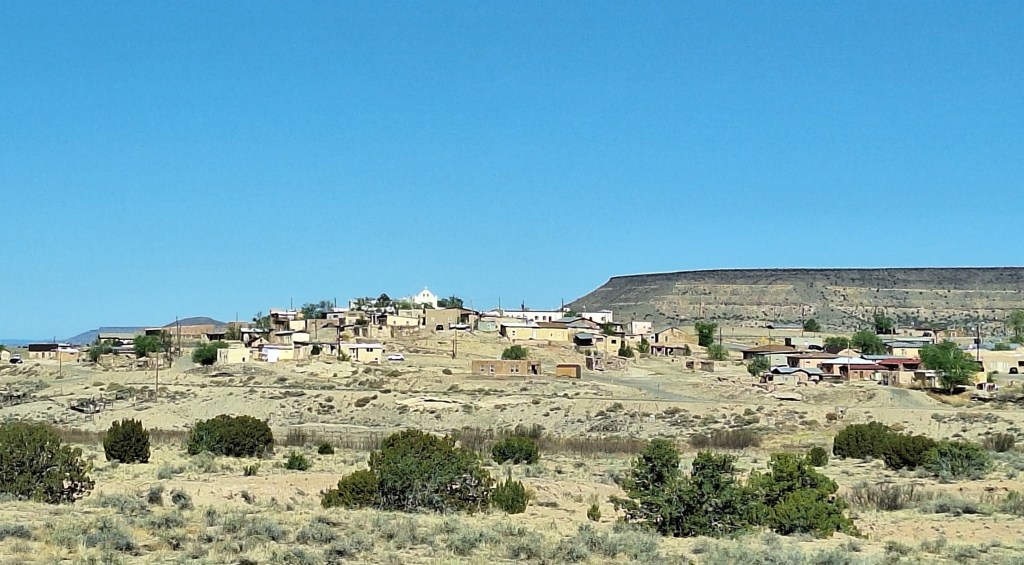
Laguna Pueblo
Once we turned off the main road, the bumpy road was a roller-coaster ride. Luckily, we’d come in a vehicle with plenty of clearance underneath.
The cabin is at an altitude of 8200 feet, significantly higher than the house, so lower air pressure and more chance of a nose bleed, grrr.
The cabin
The second building will be Buzz’s design studio in the fullness of time. It’s definitely a remote location, and Neil should be very proud of having constructed the cabins pretty much by himself.
After enjoying the packed lunches carefully put together by our spouses, we went for a short walk towards Cinder Cone, through the woods, more of a forest really.
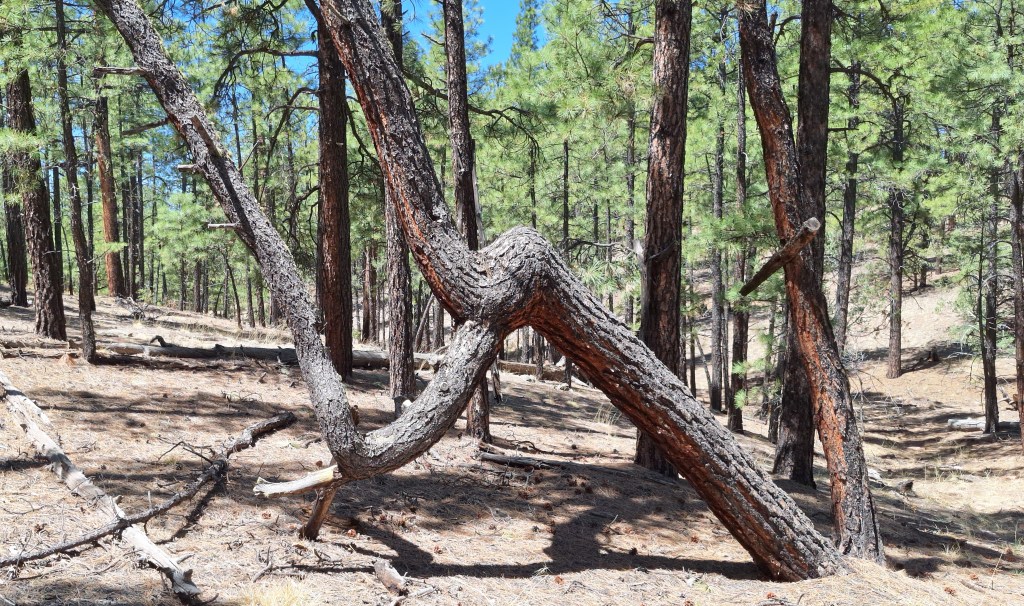
The treesA gnarly tree
Lisa and her sister Andrea (Andi, who now lives in Richmond, England) used to play on this tree when they were younger, according to Neil. No wonder it’s bent.
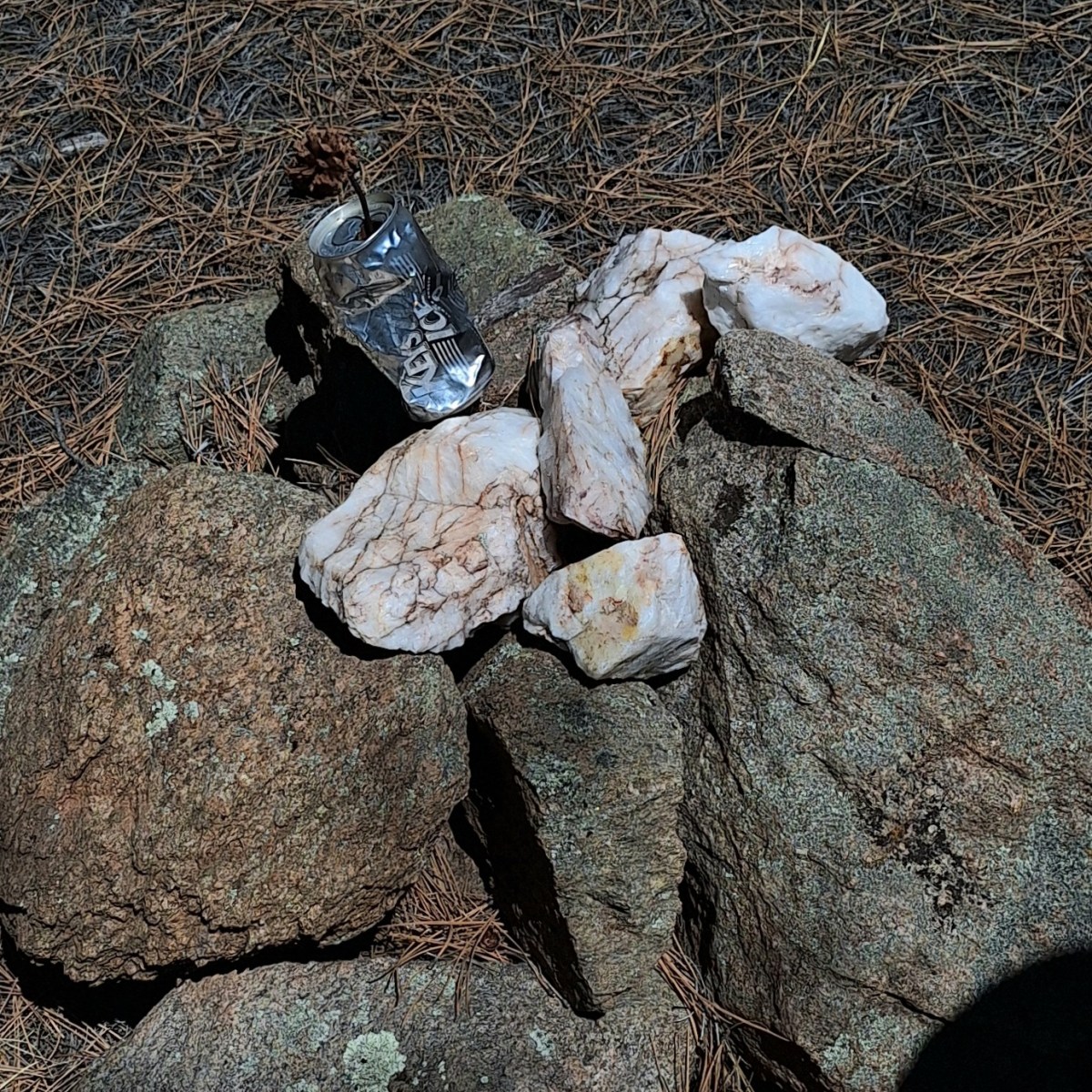
Quartz
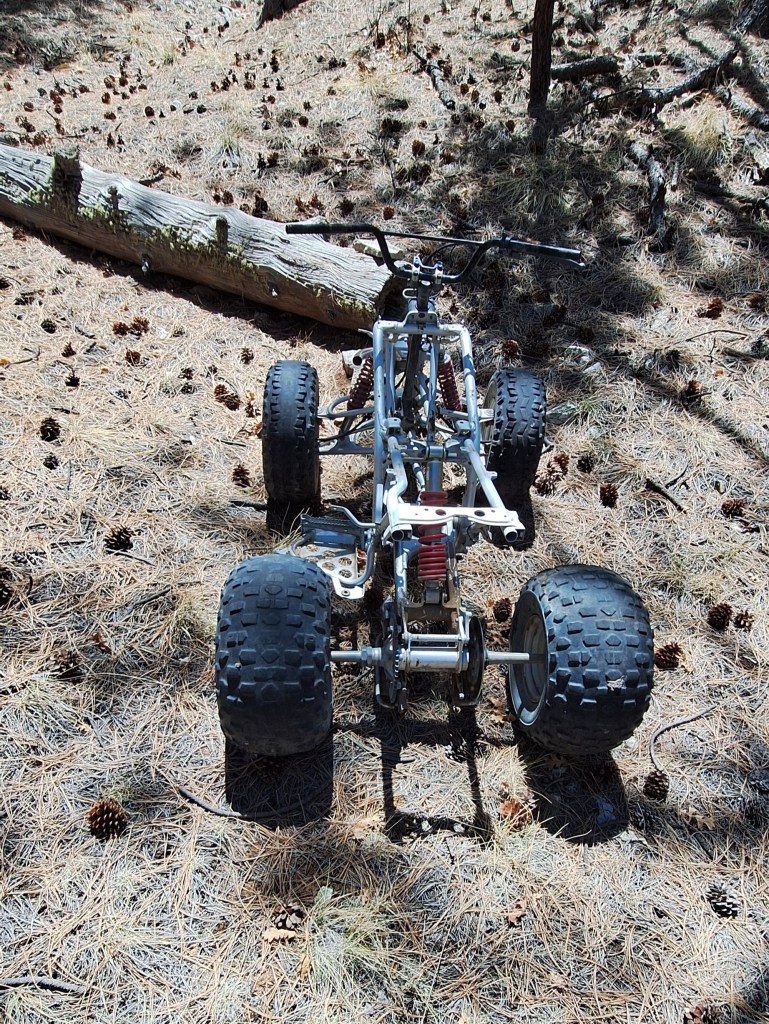
There is quartz all over the place here in the woods, plus fir cones and all sorts of things that our grandchildren would love to pick up and collect such as…
Discarded four-wheelerBarking mad
We drove back along the old Route 66 as much as possible, through Grants. At least Route 66 is paved, not like this road through the Zuni Canyon as we left, which has been newly gravelled (if that’s the right word), so we left a cloud of dust behind us.
Zuni Canyon Road
The canyon itself was stunning, more stratified rock structures than you could imagine.
By the time we arrived home, Hannah was there too, she’s Lisa’s daughter and you can work out the rest of the relationships yourself.

























































 Mick and Liesel's Antics