

I woke up early, soon after sunrise, and was so glad I’d risen in the middle of the night to take some photos of the night sky, and yes, alright, just to gaze at the night sky with zero light pollution.
Neil hoovered the place, well, until the circuit breaker broke because the batteries had lost too much charge. The solar panels will charge them back up during the day.
First breakfast was cinnamon and apple flavoured oatmeal and a cup of tea.

We drove out from the cabin once again via Zuni Canyon. And again, I marvelled at the extent of the lava flows. A squirrel wasted no time in running across the road in front of us, phew. A family of ground hogs (same as prairie dogs?) standing in the middle of the road quickly dispersed in all directions. All except one who defiantly stood up on his hind legs until the very last moment, realising that a heavy American car is not to be messed with
‘Do something scary every day’ is one motto I try to live by, although there’s not always the opportunity to do so. Well, I admit, I did forego the opportunity to climb a ladder yesterday. But today, my challenge was, for the first time since about 1979, to eat an Egg McMuffin. We’d arranged to meet Buzz, Liesel, Gabe and Leslie at McDonalds in Grants at 11 o’clock. On arrival, I gave my order, being sure to enunciate to the best of my ability and to emphasise that I didn’t want any bacon on my Egg McMuffin. Loudly tapping the desk, the server who most definitely was not channeling Ronald McDonald’s jolly demeanour, told me that they don’t serve breakfast after 10.30, like everyone knows that, right?Scary Mary was so scary, I was too scared to order anything else to eat, so I just had a cup of tea.
Liesel and co arrived shortly afterwards and after a bit of a chat over tea or coffee or in Neil’s case, a small McFlurry, we all set off again. Neil returned to Albuquerque. The rest of us, almost in a convoy, set off westwards towards Window Rock.

We ate lunch at the famous Earls Family Restaurant in Gallup. It first opened in 1947 . This date reminded me that I would miss out on visiting Roswell on this visit to New Mexico. My huevos rancheros was accompanied by more green chili, which was just borderline acceptable to my taste buds: a few more Scoville points and my ears would have blown off again. Even so, Liesel did ask whether I was red because of the chili or was I sunburnt?
Window Rock is just over the border in the next state. So I was looking out for a big, brightly coloured sign saying ‘Welcome to Arizona’, maybe with flags flying, accompanied by a troupe of dancing girls and a big brass band. But no. A small, insgnificant, almost apologetic sign coyly saying ‘Arizona State Line’. That’s it? Well, what an anticlimax.
In Ganado, we visited the Hubbell Trading Post, established in 1878, now the oldest continually operated trading post on the Navajo reservation. J. L. Hubbell, whose family operated the trading post for nearly 90 years, was known among the Navajo as trustworthy and honest. His trading post became a pillar of the community, playing a large role in helping Navajo families rebuild their lives after the Long Walk.
The place was full of rug dealers, many beautifully woven rugs that would look good anywhere. Lots of jewellery too, they all seem very talented, the earrings were made by the maintenance supervisor.
Arizona and the Navajo nation have a love/hate relationship with Daylight Savings. For a while, the times on my phone and Liesel’s phone were an hour different, even though we were in the same room. Another quirk in this place: no sales tax.
The Navajo Nation Museum was interesting, and quite moving. But the first thing you notice on arriving and parking up are the large rocks on an otherwise flat terrain.

The next thing we noticed was the big, black cloud that appeared almost from nowhere. And indeed, when we were inside, it did rain for a while.
Between 1863 and 1866, more than ten thousand Diné prisoners of the U.S. were marched to the Bosque Redondo reservation, known in Navajo as Hweéldi, in present day southeastem New Mexico. The Long Walk is actually a series of forced marches, no less than fifty-three, during which captives walked anywhere from 250 to 450 miles, depending on the route taken.
Many of them (Navajos) died from starvation. The kind of food they had, they died from that. Also, I think a larger percent of deaths was caused by homesickness. They wept from day-to-day, many of them, “I wish I was on my own land bark at Chinle or Kayente.” — Dághá Chíí Bik’is, son-in-law of Manuelito and one of the first Navajo Council members (1951).
The Long Walk, then a Treaty between the Navajo Reservation and the United States that is, literally, not watertight. Disputes about the Treaty are still taking place, resulting in ongoing court cases. One current issue is the water supply. The Navajo nation depends upon just three rivers, and they’re being affected by climate change, like everything else.

At the time of the White Land (Ni’halgai), First Man (Áłtsé Hastiin), First Woman (Áłtsé Asdząą), and other Divinities were choosing rock-star mica chips that were laid out on a buckskin robe to place in the sky. They were forming our constellations to light up the dark night.
Mischievous Coyote (Mą’ii) came along and wanted to help, but after witnessing the slow and methodical placement of the constellations, he became impatient. He grabbed the buckskin and scattered the remaining stars into the sky, which is why some stars today are not seen within in the orderly constellations.
After the rain, it was only a quick downpour, we drove to our final destination of the day, Window Rock. At the first sighting of this natural phenomenon, I took this picture:

Window Rock is over there at the back, but, a flying saucer? How cool! Yes, I know it’s a raindrop on the windscreen, but still…

The rock with a big hole in it is well protected, fenced off, we really aren’t invited to go up for a closer look. It’s a great venue for graduation photos, as enjoyed by one new graduate today, having a good celebration with his family.

Here is a fascinating story, we learned a lot about it at the Museum, and there’s a monument here.
The Legendary Navajo Code Talkers:
During World War II, in the South Pacific Theater, the Japanese were extremely proficient at breaking into military radio communications and transmissions. Thus they were able to decipher U.S. Military codes. The U.S. Armed forces needed to find a secure method of communication if they were to have any chance of defeating a clever and intelligent foe. To counter the cleverness of the Japanese cryptographers, 29 Navajo Marines were recruited to devise a secret military code using their native language. By war’s end, there were over 400 Navajo Marines serving as code talkers and the code vocabulary had doubled. So successful was this innovative code that the Marine Corps commanders credited it with saving the lives of countless American Marines and soldiers. It enabled their successful engagements throughout the Pacific Theater which included the battles for Guadalcanal, Wake Island, Tarawa, Saipan, Guam, Midway, Iwo Jima and Okinawa. The code paved the way to early victory for the allied forces in the South Pacific. Major Howard M. Conner, 5th Marine Division Signal Officer stationed on Iwo Jima, commented on the gallantry of the Navajo Code Talkers: “Were it not for the Navajos, the Marines would not have taken Iwo Jima.”
Far from their homes, these brave young Navajo Marines served our nation with honor and dignity. The tale of their exploits remained a closely guarded secret for decades in the event that the Navajo Code Talkers unique talents would be needed again. In 1968 the Navajo code was finally declassified. In July 2001, at the National Capital Rotunda, United States President, the honorable George W. Bush, awarded the Congressional Gold Medals to the first 29 Navajo Code Talkers, their surviving spouses or children. In November of 2001 at the Navajo Nation capital of Window Rock, Arizona, the Congressional Silver Medals were awarded to the rest of the Navajo Code Talkers, their surviving spouses or children. Sadly, many of the Navajo Code Talkers have passed on never knowing of the honor a grateful nation has bestowed upon them. The Navajo Code Talkers will never be forgotten.
Diné Bizaad Yee Atah Naayee’ Yik’eh Deesdlii.

We checked in at our Holiday Inn before wandering over the road to Navajo Westerners Ace Hardware. Some of the fabrics on sale here are very pretty.

Another shop in this Navajo Nation Shopping Center was the supermarket from where we bought a snack: still full from a big lunch, we didn’t need a big evening meal.
We were followed back to the hotel by a stray dog, but I think it didn’t speak English, since it ignored all my stern commands. Another reason to learn Spanish, I suppose. Or maybe even Navajo.
Going down for breakfast in the morning provided the first chortle of the day. Shouldn’t laugh, really, but… There was a poster outside the hotel shop with a mugshot of a young lady. The caption: Anyone know who this is? They stole our security device.
Buzz and Gabe are here at this time for a weekend of fun with the Girl Scouts.They were at the breakast table along with Liesel and Leslie, plus three other Girl Scout leaders, by the time I arrived.

Liesel looked at a very pretty necklace in the shop, but decided not to buy it in the end. ‘It’s only stuff’ and ‘I’ll probably only wear it once’.
Over the road, the famous Flea Market was being set up. We wandered around, admiring all the jewellery (of course), ignoring the car tyres and electronics up for sale, and just passed some time until the Navajo Arts and Craft Enterprise opened. More locally made jewellery, and this time, Liesel did buy something, an unusual pair of earrings.


Leslie chose to stay with Buzz today, with the Girl Scouts, so that left Liesel and me to drive back to Albuquerque. Having plenty of time, we paid a visit to El Morro, for more local culture and a walk. Thanks to some roadworks, we found ourselves driving along the rumblestrips at the side of the road, and that’s a very uncomfortable feeling after a while. You’re doing nothing wrong, but we’ve been programmed to think that that noise means we’re too near the edge. Weird.
We listened to Classic Rock 93X: Putting the rock into Window Rock! Well, classic rock? Over half of the songs they played were new to me. They may have been big hits and very popular in the USA, but it was reassuring when the odd, genuine classic, came on.
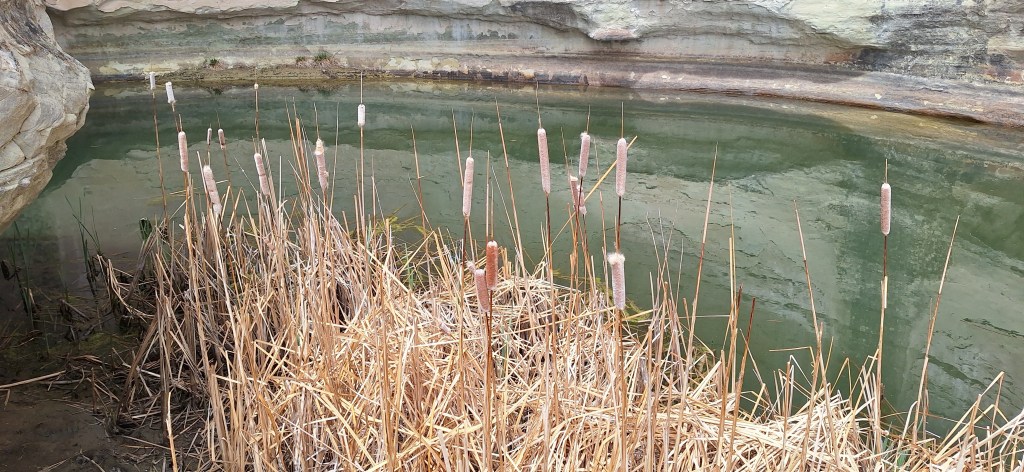
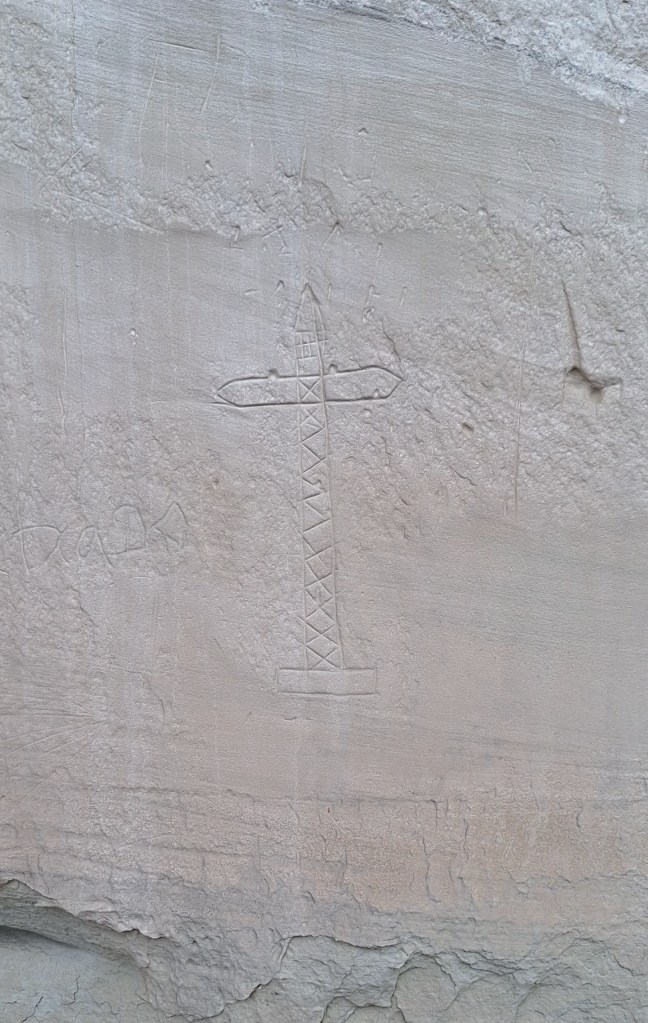
On to El Morro, then. This cuesta has long been an oasis to the travelers who left their mark upon it. A reliable waterhole hidden at the base of a sandstone bluff made El Morro (the headland) a popular refuge for hundreds of years. Native Americans, Spanish explorers and missionaries, and American soldiers and pioneers carved over 2,000 signatures, dates, messages, and petroglyphs. Atop the cuesta are the remains of the fourteenth-century pueblos of Atsinna and North Atsinna where the ancestors of today’s Puebloan communities once lived.
A most enjoyable and interesting walk. The guide lent us a book, and we followed the route more or less as suggested.
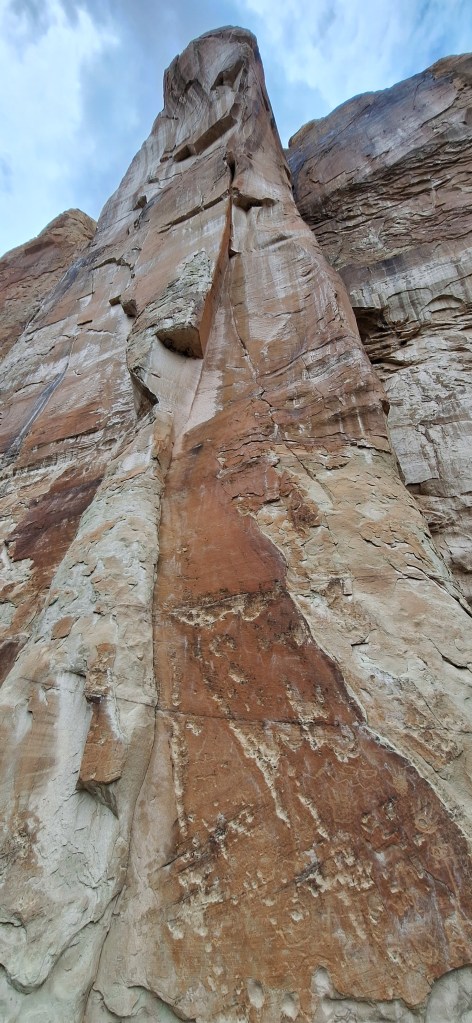
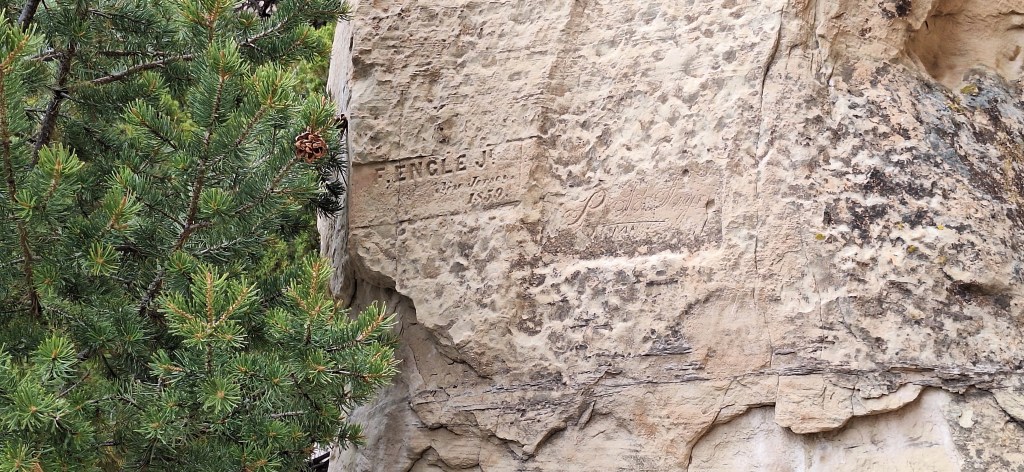
These artefacts won’t last forever, being carved into sandstone and where they’ve tried to hide post-1906 markings, the surface looks unnaturally smooth.
As we walked back to the Visitor Centre, we felt a few spots of rain. Big spots. But, just as quickly, we stepped over a crack in the concrete path, and it wasn’t raining any more.

We heard the thunder in the distance, relieved that we weren’t caught in a major storm.
Our journey back to Albuquerque continued. We saw sheep and horses close to the highway, mostly behind a fence, but not always. Not ideal when the traffic is moving at 60mph or more.
We can sort of understand why people might choose to live out here in the middle of nowhere, miles from the nearest town. But, then, why would you build your house so close to the noisy highway?
We drove over the Continental Divide, elevation 7200 feet. This was a much more interesting sign than ‘Arizona State Line’. And if there was such a sign, we missed ‘New Mexico State Line’.
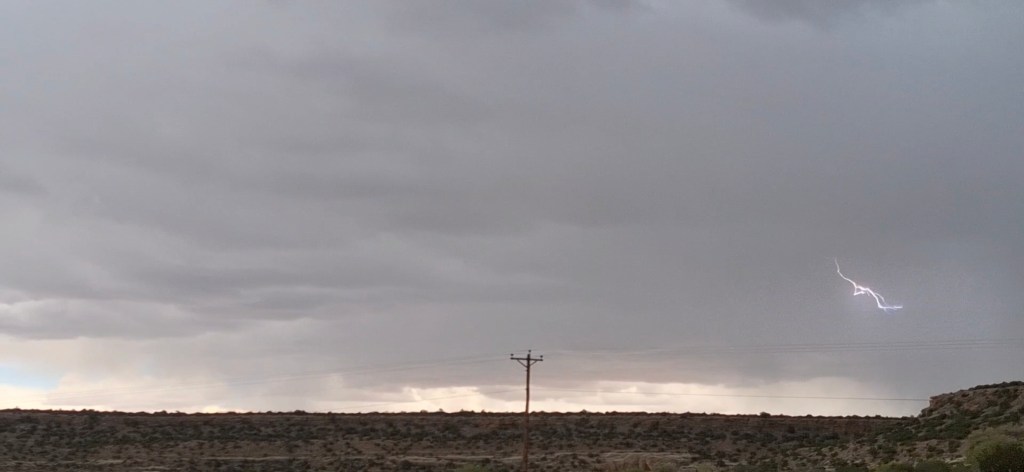
But we couldn’t miss the thunderstorm ahead of us, so of course I had to try and get a picture of the lightning. Liesel wasn’t keen on me almost leaning out of the with with my phone. But it was worth it!
Back at home, we took Neil out for a meal at Monroe’s, a return visit for us. I enjoyed my final New Mexico meal: #6 Veggie Tostadas (Gluten free) 2 bluecorn tostada shells stuffed with avocado, whole beans, pico de gallo, mozzarella, lettuce and tomato. Served with calavacitas and salsa. Hey, I remembered what I ate! But only because I screenshot the menu.
Final NM meal? Yes, my time here was nearly up and I had to do some packing. I have more to take home that I came with, especially the Seestar S50. Four weeks here, and it’s all a bit of a blur right now. I need a holiday, as they say.
Oh, and WordPress has just told me that this is the 600th post on this blog. What a lot of antics!

 Mick and Liesel's Antics