

If we wanted to immerse ourselves in the local culture, we couldn’t have asked for better hosts than Buzz, Neil and Gabe. They’d arranged for us all to attend the Pueblo Immersion, organised by the Indian Pueblo Cultural Center (IPCC). Before leaving for this event, though, Liesel and I started packing for our next little adventure, side-trip, whatever you call it.
We drove past the Cannabis Dispensary on the way to the IPCC but made no plans to pay a visit, sample the goods or anything.
On arrival at IPCC, we were all presented with a Visitors’ lanyard and all of ours had a blue sticker which meant that later on, we would all be in the blue group for the tour around the museum.
We were seated at tables, all facing the front, like being in a school classroom again, not quite trusting the folks behind us to behave.
After an enjoyable lunch, we watched Flo and Lee with an interesting pottery demonstration: Flo making the clay bird while Lee very carefully painted a finished, fired plate.
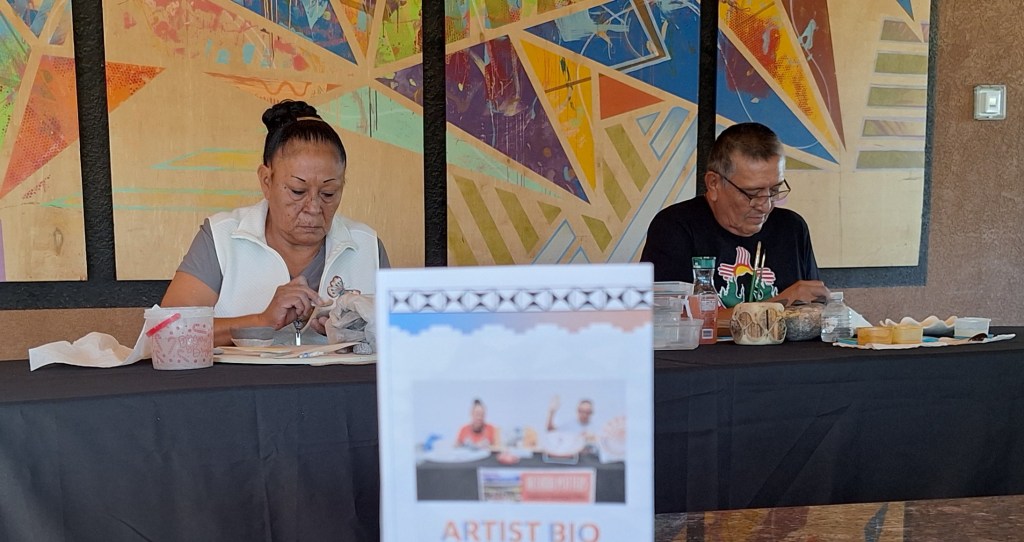
The pottery is made using shale clay mixed with old pottery shards to create a water-tight seal. After “white slipping” with wet white sandstone, the pottery is polished. Orange paint is made from mashed and strained orange sandstone, while black paint is a mix of Iron Oxide and wild spinach juice. The Yucca leaf is used for applying paint after being chewed on to remove excess fibers and achieve the correct thickness for fine line and detailed painting. I would never have guessed that spinach was involved, but all the skills have been passed down through several generations. Flo and Lee are pleased that their grandchildren are now showing an interest too.

Anthony was the guide for the blue group’s tour of the museum. We saw how the different pueblos developed, how the people got on, even though there were several different languages being spoken. And the pots made in different places have distinctive shapes and designs.

We learned about Po’Pay’s successful Pueblo revolt against the Spanish invaders in 1680. The Spaniards were either killed or expelled from the province. Unfortunately for the locals, they returned 12 years later.

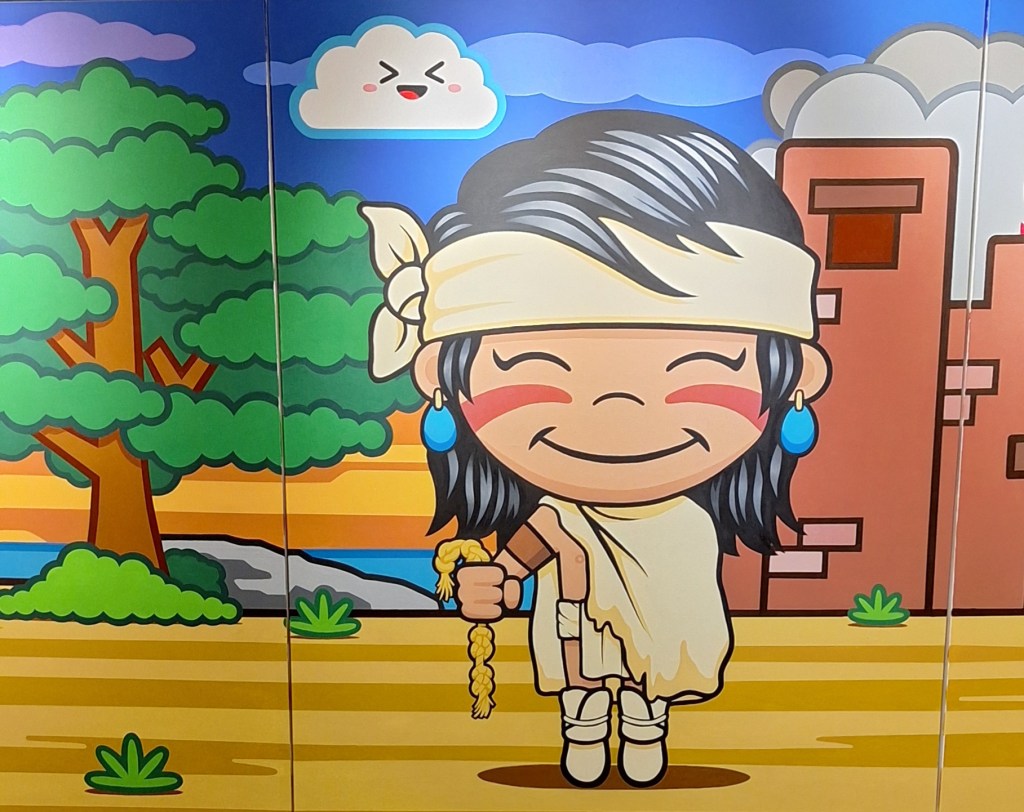
The Indian Pueblo Cultural Center (IPCC) is honored to collaborate with NSRGNTS, an Albuquerque-based duo comprised of artists Leah Povi Lewis (Laguna, Taos, Zuni Pueblos/Hopi/Diné) and Votan (Maya/Nahua), on a commissioned mural created for the Art Through Struggle Gallery. NSRGNTS is a successful Indigenous brand, business, and art collective that advocates for Indigenous rights. They are known for their murals of Indigenous resilience painted in vivid colors in a “kawaii” style – a “cute,” illustrative style similar to Japanese anime. Their seven-panel mural provides a visual story of Pueblo empowerment throughout the past, present, and future.
This, the middle section focuses on an integral event of Pueblo history – the 1680 Pueblo Revolt that resulted in the ousting of Spanish rule in Pueblo lands for 12 years. Holding a knotted yucca cord, Po’pay, the Ohkay Owingeh leader of this revolt, stands at the center as a role model and a figure of strength.
As soon as the tour ended, Liesel and I had to rush off to the airport, oops, sorry, Albuquerque International Sunport. Jyoti and her new man, Rupert, were joining us from North Carolina. We found them easily enough, hugged and all that, and took them back for a quick hello-goodbye with Buzz, Neil, Gabe and Leslie. The new arrivals were joining Liesel and me on our trip to Santa Fe. This will be the first significant amount of time Liesel and I have spent without Mom for about a year.
The drive to Santa Fe was interesting, as we passed many different landscapes. It seemed to me that the further north we were, the greener it was. Santa Fe is also 2,000 feet higher in altitude than Albuquerque and I was already fed up with the nosebleeds caused by, or at least exacerbated by, the high altitudes and low humidity.
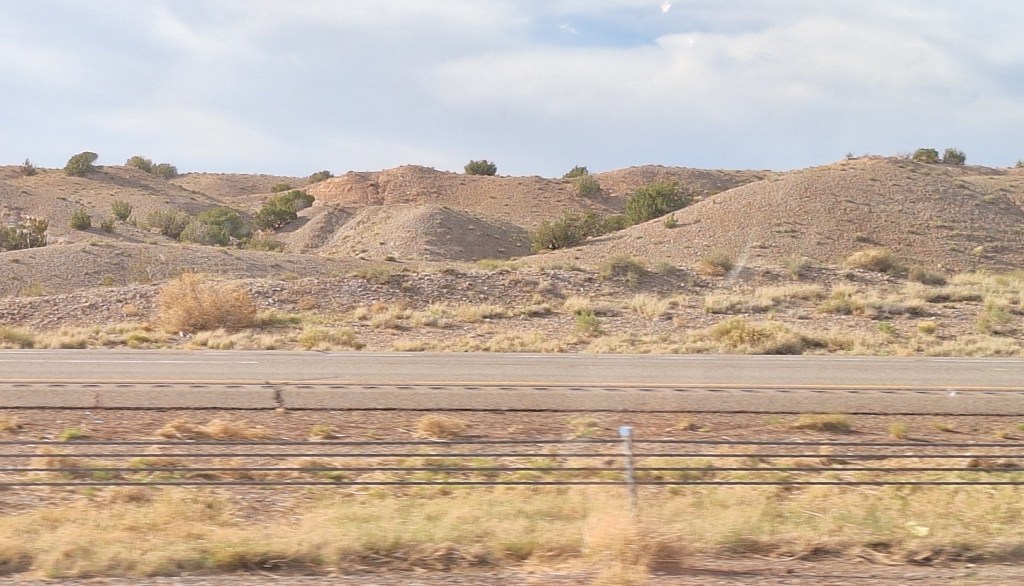

This isn’t a volcano but a naturally eroded hill southwest of Santa Fe.
We arrived at Tammy’s house while it was still light. You remember Tammy? She walked Hadrian’s Wall with Liesel, Jyoti, Teresa and me two years ago. Sadly, Teresa, Tammy’s sister, wasn’t here for the grand reunion. We miss you, Teresa! For the first time, I met Tammy’s husband, Aaron.

After breakfast (Jyoti fixed me her world-famous fried eggs on toast, and I still don’t know why Americans fix food, it’s not broken, is it, but there you go, separated by a common language, now where was I…?) oh yeah, after breakfast, we all drove into Santa Fe and had a walk around the Old Town.
The original walls and altar of the San Miguel Chapel were built in 1610 by a group of Tlaxcala Indians from Mexico, who accompanied the early Spanish settlers to New Mexico. The site of the chapel shows evidence of previous human occupation from around 1300 A.D.
The chapel roof was burned during the Pueblo Indian Revolt of 1680. Evidence of the fire that destroyed the roof can be seen in the adobe bricks of the chapel today, since new adobes for the reconstruction were mixed on the site and bits of charcoal were inevitably mixed into the mud.


This city too is proud to show of its artworks, murals, sculptures and of course, the architecture is wonderful, and it’s always good to see a low-level place: there are few skyscrapers here
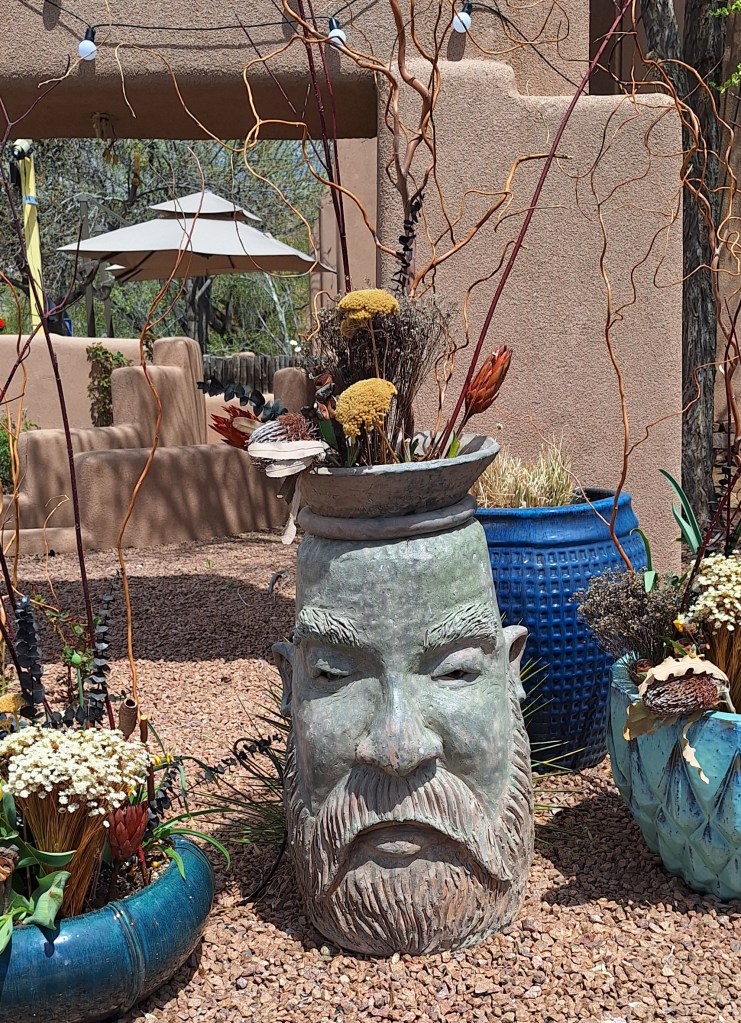
There are 300 art galleries along Canyon Road. We’ll probably visit them one day, but we’ll need to find something to do later on in the afternoon.
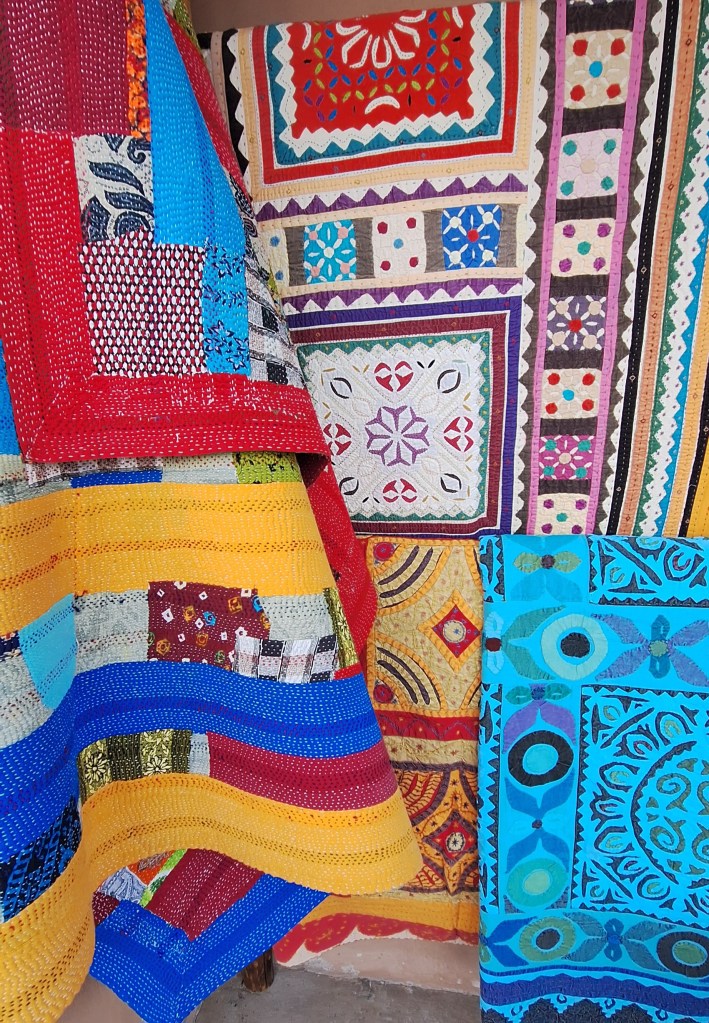
The locally made rugs attracted our attention. They’re not necessarily perfect, sometimes the colours run, but if we had the wallspace, I think we might have purchased one.
We viewed some phots taken by Edward Curtis. He was an American photographer and ethnologist whose work focused on the American West and Native American people. Sometimes referred to as the “Shadow Catcher”, Curtis traveled the United States to document and record the dwindling ways of life of various native tribes through photographs and audio recordings. I was going to buy a book about him, but the typeface was tiny, so I’ll get it on the old Kindle later on.
Liesel and I had visited an exhibition of Georgia O’Keeffe’s paintings at Tate Modern some years ago. It was good to visit the Georgia O’Keeffe Museum here in Santa Fe. She lived for a long time in New Mexico.
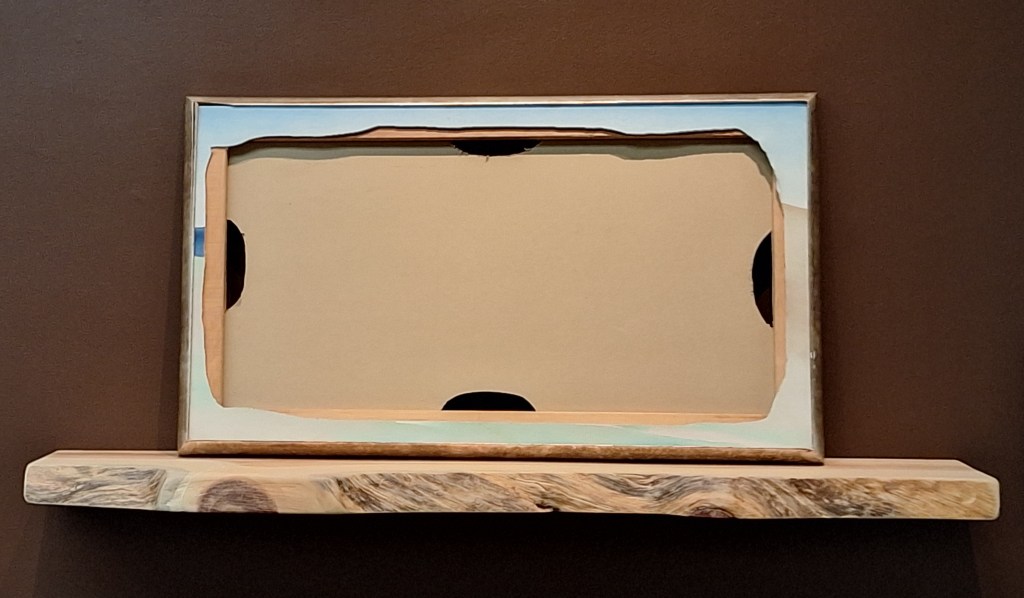
No idea what this picture was, but Georgia didn’t like it and cut it up just a couple of years later. What a shame.
I realised that I have a lot in common with Georgia O’Keeffe. She liked to dress in black or white. And all the socks I currently own are either black or white. I wish I had her artistic talent, though.
Have you ever seen a horse box?

We sat outside watching the Sun go down behind the trees and the mountains, listening to the birds and even a train tooting its horn as it passed by in the distance. And it did become noticeably colder as the evening wore on.

 Mick and Liesel's Antics