
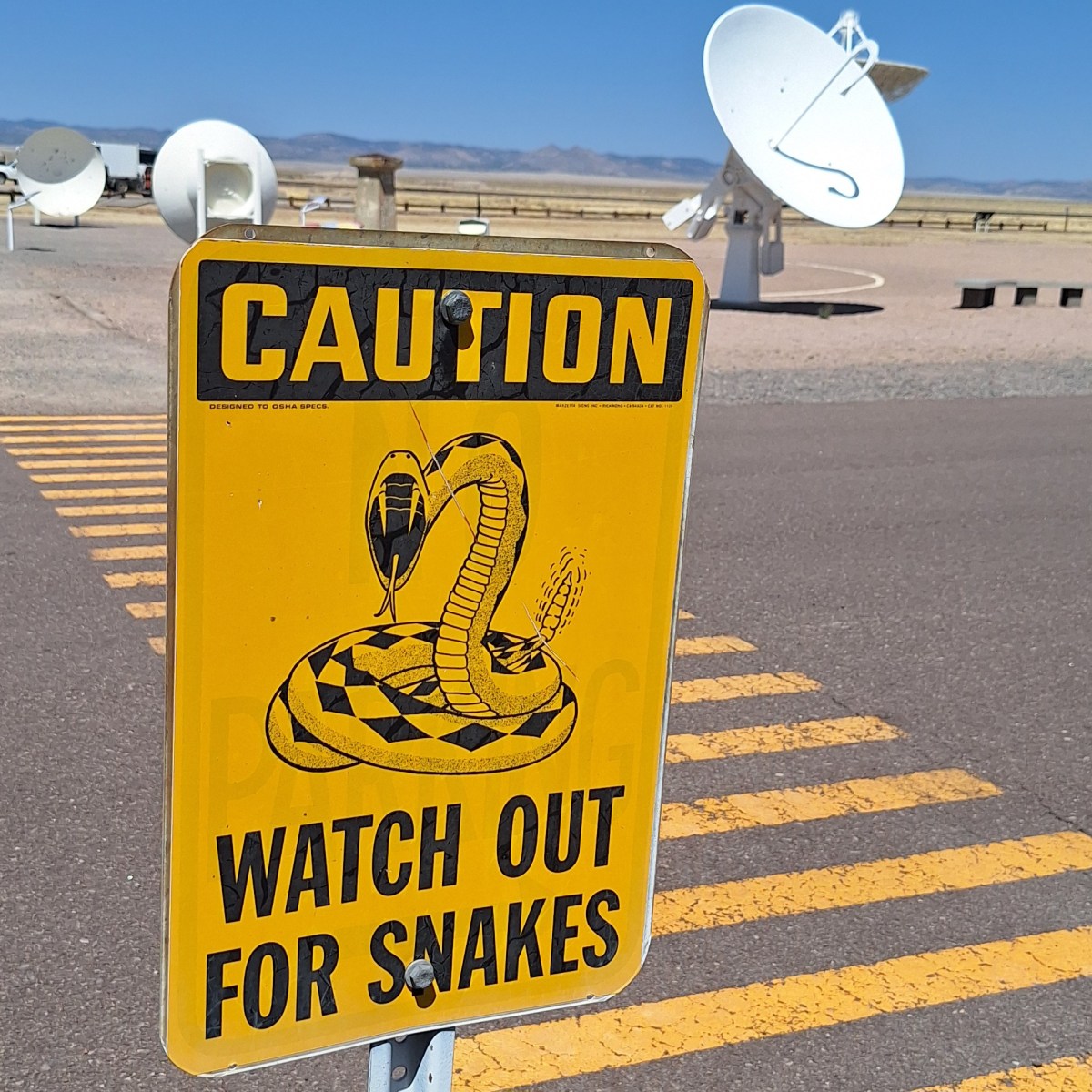
The Karl G Jansky Very Large Array is a two-hour drive from home, about 130 miles. Neil, Liesel’s uncle, invited me to join him on his first visit there for several decades. I will always enjoy a visit to an astronomical telescope, whereas Liesel thinks she’s seen enough.
During the drive, Neil told me about many of the events that occurred during his long and varied career in the Air Force, some details of which are still classified. He explained why and how he and Buzz settled here in Albuquerque.
We drove through a lot of desert, what I expected New Malden to look like, no, not New Malden, New Mexico, no idea what happened there, muscle memory in the two typing fingers, I guess. Anyway, we even drove through an Indian Reservation, but if I hadn’t seen the sign, I wouldn’t have known.
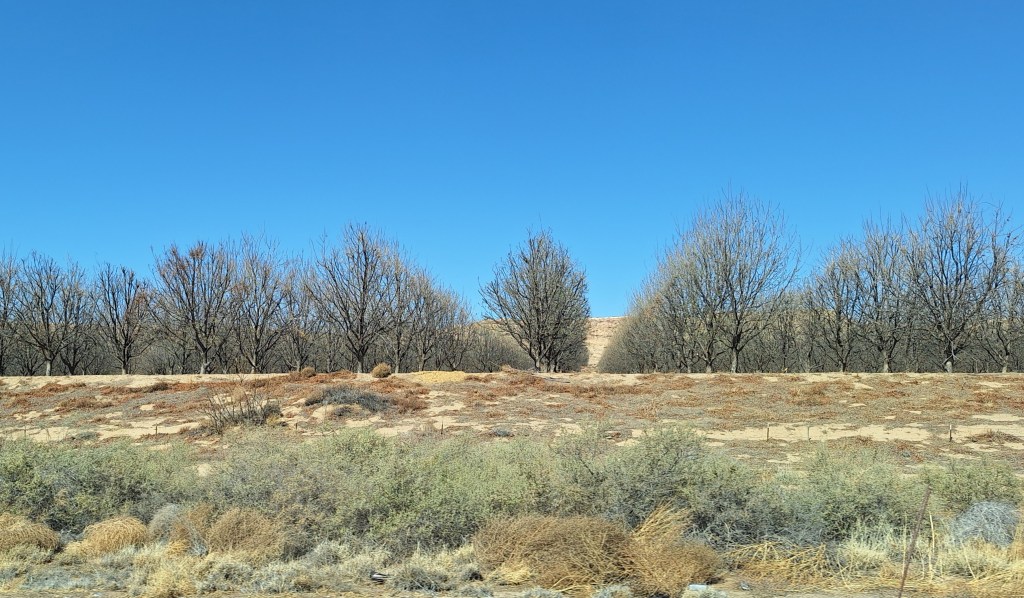
Apparently pecans require a lot of water to grow, so it seems strange that there is such a large plantation here, in a state which is really quite dry. Even the great Rio Grande has been known to dry up sometimes.
On the way, we passed an array of solar panels much larger than I’d ever seen, anywhere. It must produce a lot of energy, but what a shame the panels aren’t a little bit higher, so that grass can grow underneath for the local flock of sheep, or other grass-eating food. My offer to drive a bit and give Neil a break was declined. I’m sure I would have coped on the long, dead straight highways with little other traffic.
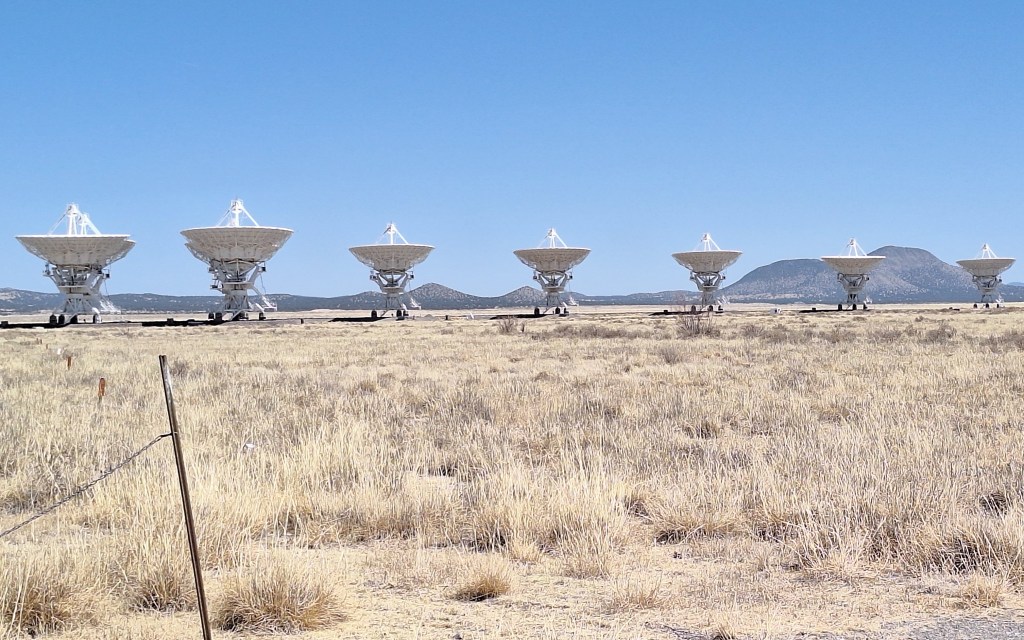
After nearly two hours, we saw the VLA in the distance, through the trees and we soon parked up.
We took our time on the self-guided walk around the site. The solar radio telescope looks more like a musical instrument, being horn shaped, but no, I didn’t blow through it.
I was very impressed by the Bracewell Radio Sundial, though, so different to all the other sundials I’ve seen, and indeed, even made, in my youth.

I’m so glad Neil gave me the information sheet so I don’t have to remember all the details myself…
Using the Bracewell Sundial
The Bracewell Sundial has a large sphere mounted atop a slim metal post. Locate this sphere and note where its shadow falls. There are three major sets of markers – metal disks – set into the concrete that mark the hours from 8 a.m. to 4 p.m. at four dates of the year. The disks labeled “Summer Solstice” show the time on June 21; the disks labeled “Winter Solstice” are for December 21; and the disks labeled “Equinoxes” are for March 20 and September 23. Small, diamond-shaped markers indicate the hours at intermediate dates, such as July 21, August 21, etc. The sphere’s shadow thus indicates not only the time of day but also, roughly, the time of year. All the markers for a particular hour, the round disks and the diamonds, trace a line toward one of the concrete piers.
It’s a long way to go to find the time. Plus, of course, they have to pick up all the posts and move them round a bit to accommodate Daylight Savings.

The main attraction here of course is the Very Large Array, comprised of 27 radio telescopes, each of which weights 230 tons. They are moved along the ‘wye’, a Y-shaped configuration of railroad tracks, each 13 miles long. In effect, the array acts as a single antenna with a variable diameter. The angular resolution that can be reached is between 0.2 and 0.04 arcseconds.
The building in which we believe most of the work is done seemed deserted today: at least, we couldn’t see anyone as we peered through the window from the balcony.

Funded through the New Mexico Arts Council, this three-armed sculpture represents the three tracks of the VLA and the floating, three-dimensional natures of the objects the VLA studies.
On the drive back, we stopped for lunch in Socorro and yes, of course, I couldn’t finish my avocado salad, the serving was far too big. Even Neil an acclimatised American, couldn’t manage that much food.
And of course, the problem with eating that much food meant that come dinner time, I wasn’t at all hungry.
Thank you very much, Uncle Neil, for a fascinating day out!
Liesel and I enjoyed seeing the petroglyphs in Australia a few years ago, so it was only fair to go and view some here in New Mexico. They’re hundreds rather than tens of thousands of years old, but just as fascinating.
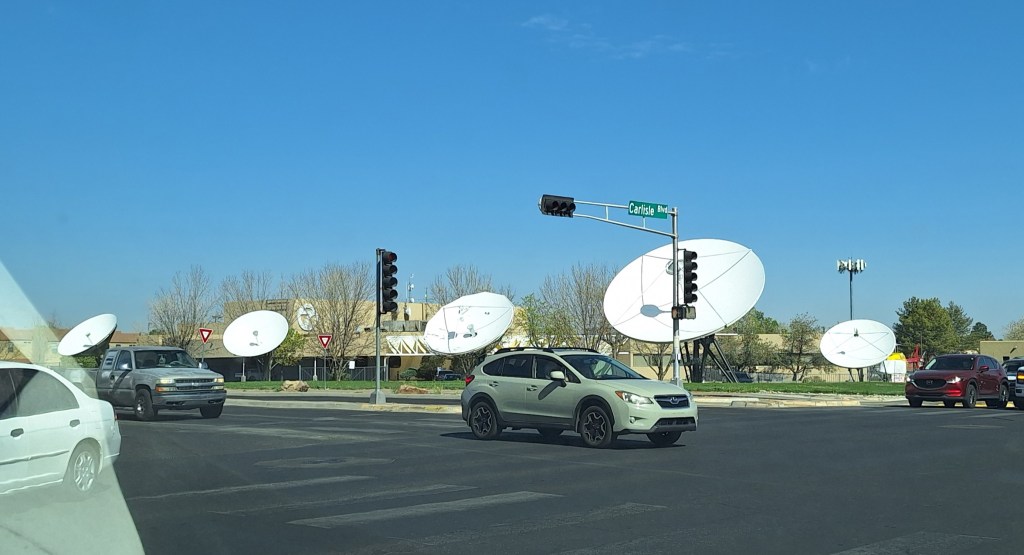
On the way through the city centre, we passed a rather smaller array of dishes than I’d seen yesterday.
Piedras Marcadas Canyon looks like I expected the whole state to look like. Desert sand, a few volcanic rock, some cactuses, a few cacti as well. Because it was flagged as ‘strenuous’, we chose to do the Mesa Top Trail, a ‘quick’ mile and a half hike that would lead us to the Petroglyph Viewing Trail, another mile and a half of fun. We were also warned that on the mesa: no petrogyphs, no water, no shade, no facilities and definitely no bushes behind which one could take ones ease.
What we got instaed was a challenging hike up a fairly steep rocky and sandy slope to the plateau. The view of the city was stunning but sadly, my attempted panoramic picture just shows too much foreground. We did see a few small lizards, though, and a few ants. The hinted-at millipedes remained hidden from sight.


There were plenty of other people on the path which now was almost pure sand. The volcanic rocks, basalt, were well spread out, and it was onto these that long ago, people were happy to show off their artistic skills.
Among the petroglyphs, we saw stars, birds, hands with six fingers (proving that in fact, they were made by aliens), an alien face (see?), road-runners, snakes, reversed music notation and a man wearing a funny hat. One was dated 1541, but we couldn’t determine whether that was when the conquistadors turned up or if it was drawn in 1541 BC.


Ah, but here’s an explanatory plaque: Petroglyphs represent a valuable record of cultural expression and human occupation in the Rio Grande valley. They have deep spiritual significance to modern Pueblo groups as well as other indigenous people such as the Diné (Navajo) and the Apache. Similar images continue to have value in contemporary ceremonial life for many Southwesten tribes. The associated meanings of some petroglyphs are known by a few Southwestern tribal groups, while the direct meanings of other images have been lost over the centuries.
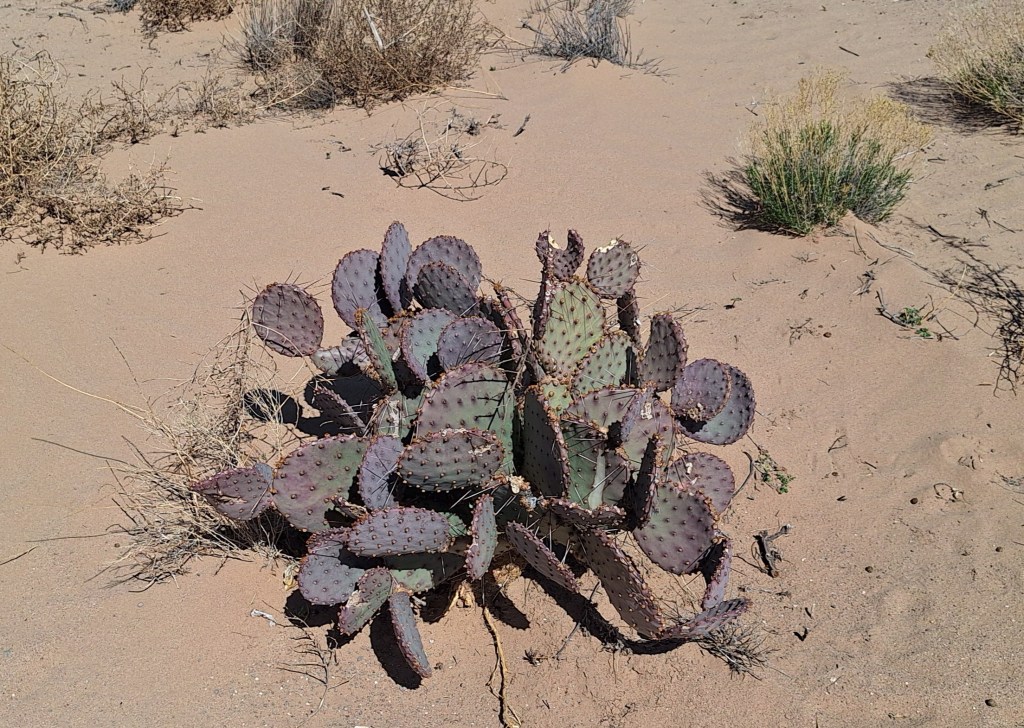
It was a really good hike, in the heat of the Sun, and looking around, we could see mountains in the distance and, again, just a few solitary clouds drifting by.
When we got back to it, the car was like most politicians: full of hot air.
Meanwhile, back at home, Martha took part in a performance of Annie at school, singing all the hits from the show with great gusto. Yes, Great Gusto and all her other class mates.
The sun will come out
Tomorrow
Bet your bottom dollar
That tomorrow
There’ll be sun!
Well, there’d better be, here in New Mexico, thank you very much.
At home, making use of one of her birthday gifts, Martha built a machine that blows bubbles. A scientist in the making.


 Mick and Liesel's Antics