

So it’s now late in the afternoon. We went for another walk, again in the direction of the river. The plan was to walk all the way back to Jardim do Morro from where we could watch the Sun set. We walked along some streets we’d not seen before. Best of all, there was even a branch of a much loved, much missed high street shop from home.

Well, I do recall the last time I visited a C&A, in London’s Oxford Steet. And on this occasion, I felt no urge to go in and buy another green coat. I was warm enough, thank you.
And as the Sun moved lower in the sky, it beautifully illuminated the local architecture.

After all this time, we are still finding churches dedicated to Saints we’d never heard of before. We found our way back to the Luis I Bridge, but this time, the upper level, along which runs the train track. We found it, yes, and so did hundreds, possibly thousands of other people, all here for the sunset. Which is strange because the Sun goes down behind buildings and trees here, it doesn’t disappear into the ocean. As each metro train passed, the bridge shook, but everyone moved away from the tracks, and only a couple of drivers had to toot their horn to warn people.
Looking up towards the gardens, we could see it was already packed, so we decided to stay on the bridge.
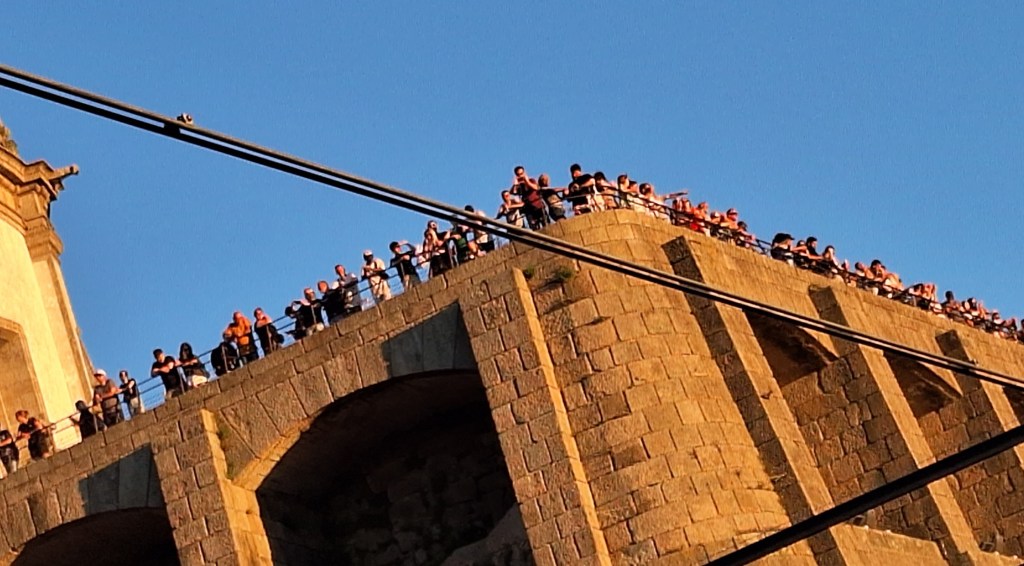
Watching the Sun and the people. It wasn’t a spectacular sunset, depending on your criteria, but I got a few good pictures.


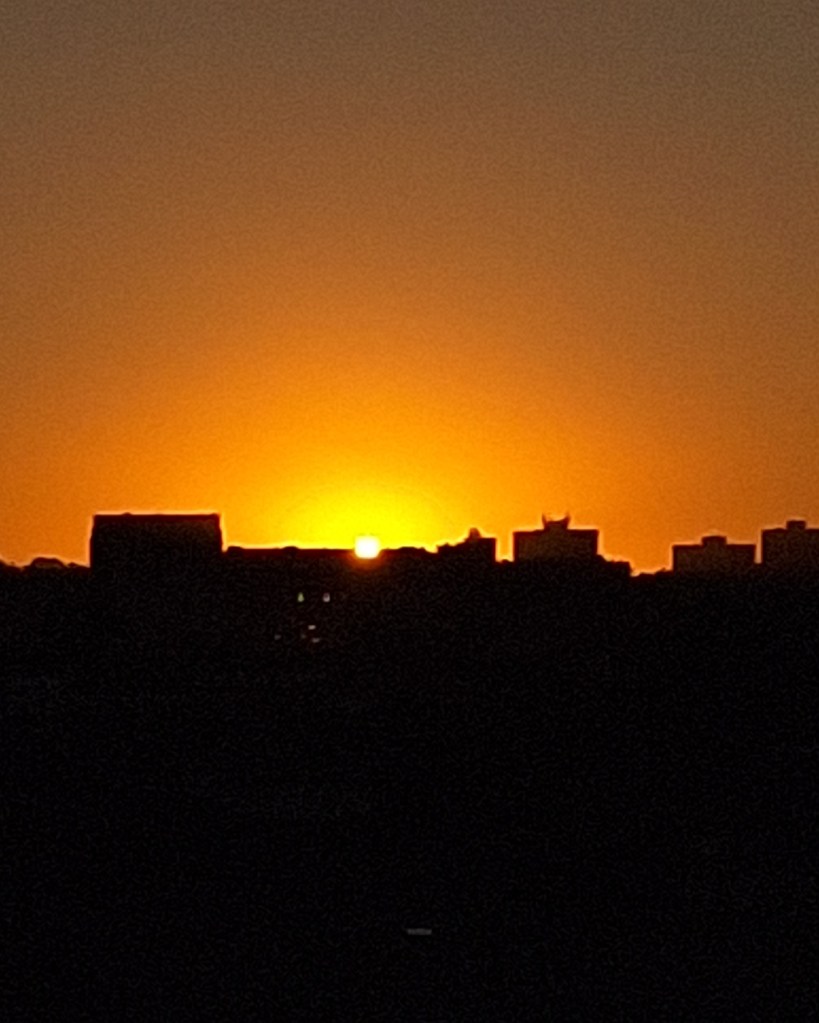
No point boarding the metro here, so we walked towards home, and took public transport a bit later. For dinner, we ate at a place called Mamma Mia, a mere four-minute walk from home.
It didn’t take long to pack in the morning, but the walk up the hill to Marquês was tough!
Some of the paving stones and tiles felt quite slippery, even with my trainers on, so I can only imagine how perilous it is to walk around this hilly city when it’s been raining.
Two rides took us to the main railway station, Campanhã. Now, I don’t know if we missed a sign, or just decided to follow the wrong people, but it was a ridiculously long walk from the metro to the station. There were no signs, well, until we saw one directing us to the bus station. Then, as I was thinking maybe we should backtrack, I saw a very tiny little sign, with a titchy tiny rendition of the CP logo (Combiois de Portugal, the train operator), along with a minuscule arrow pointing up a long slope. Other people were plodding upwards, so we thought, why not?
This long haul took us to beneath the station platforms, hooray! That’s progress. While Liesel looked after the bags, I went for a wander, to try and ascertain where we should be. I found a toilet, I got some water, I saw TV screens with useful information, including the fact that our train would depart from platform 6. I also noticed that if we’d got off the metro and turned left instead of right, we would have found the station’s main entrance straightaway. And this, ladies and gentlemen, is why we tend to arrive at places far too early. If there’s a 50-50 chance, sorry, but I’ll get it wrong.
Our train arrived, and we found our carriage and our seats. Numbers 32 and 38. Aren’t we sitting next to each other, asked Liesel? Yes, of course we are, said I. But the seat numbering system is bizarre. I couldn’t work it out at all. But yes, 32 is next to 38.
During our trip, we had to change trains at Alfarelos. If we’d wanted to avoid the 2½ hour layover here, we could have caught the 6am train. And if we’d know what a dry, deserted, desolate place Alfarelos station is, we might have given that option some serious consideration. The Portuguese countryside was interesting but then, so was the book I was reading. But Alfarelos?
In the small café just over the road, the elderly lady had no English. My limited Portuguese deserted me so I felt bad that my request for an americano sounded so brusque, but in the heat of the moment, I forgot the words for ‘please’, ‘por favor’. As the lady wiped and swept up all around us, we realised: she’s hinting, this place is closing.
Fortunately, there was an air-conditioned waiting room at the station, and a WC, but no other facilities. And it really was too hot to walk around. 98°F, 37°C was the highest temperature we recorded. Hot, and dry, and no breeze at all.

As my addled brain carried on addling, I realised that there is a lot in common between Portugal and Japan. For instance, thank you: ‘obrigado’ and ‘arigato’. And the station announcements, even here at this small place in the middle of nowhere, are preceded by quite long, very melodic jingles, just like in Japan. And another rule or convention in both places is: no tipping.
One other couple was waiting for the same train as us. Other trains came and went. A few people came and went. One poor soul approached the ticket office, which actually was staffed. She’d caught the wrong train and needed to go back somewhere. This isn’t the sort of place you’d want to be stranded.
Our train arrived and we departed for Caldas da Rainha. The view from the window was unchanging for miles and miles. Liesel crocheted for a while, I read and did puzzles. I went for a walk, but was limited to two carriages. What I did find was that the other end of the carriage we were sitting in was much, much cooler. Its AC must have been working.
The railway station at Caldas da Rainha is very pretty, especially once you get outside.

We had to wait a while for a taxi, so I walked around a bit and decided to answer the call of nature. The toilet’s over there, in one direction, but you have to get the key to the door over there, in the opposite direction, just go to the last door. I took the key back and vastly increased my step count for the day.

The blue tile panels at the station depict various events and people from the town’s history.
The taxi arrived and took us away from the town centre, up into the hills. Some of the roads are very steep, even cars have to take a run-up, or so our driver would have us believe. Twenty five minutes later, we arrived at our destination where my brother David and his wife Glen gave us a very warm welcome and a very cold beer.
This was only the second time I’d met them both, and a first time for Liesel. They live in a large house, not quite in the middle of nowhere, but certainly not on top of the neighbours.
We sat outside and chatted for a while, drank beer, cooled off. I’d mistakenly thought it might be cooler, higher up in the hills, but no.
Apart from the main house with its many rooms and hidden nooks and crannies, there are many outhouses. In one email, I now realise, David was joking about their goats. They don’t really have any. Just one cat and a budgie.
I’d forgotten that David has a very slight Liverpool accent, and also, having lived in the Netherlands for four decades, there’s a bit of Dutch in there too.

If you’re in the area and need a lemon, this is the place to come. I don’t think I’ve ever seen such a productive lemon tree. Not even my sister’s in Christchurch, sorry Pauline!
There are apple trees too and a couple of grapevines. The nearest village is a nearly half-hour walk down the hill, and we thought we’d pay a visit the following day. But after a hard day’s travel and a hard day’s night, not sleeping well because of the heat and a bleeping mosquito, but mainly because I had acquired an annoying cough, we decided to stay put and have a ‘rest day’.
And that was exactly what we needed to do, a bit of pottering about and a guided tour of the garden.
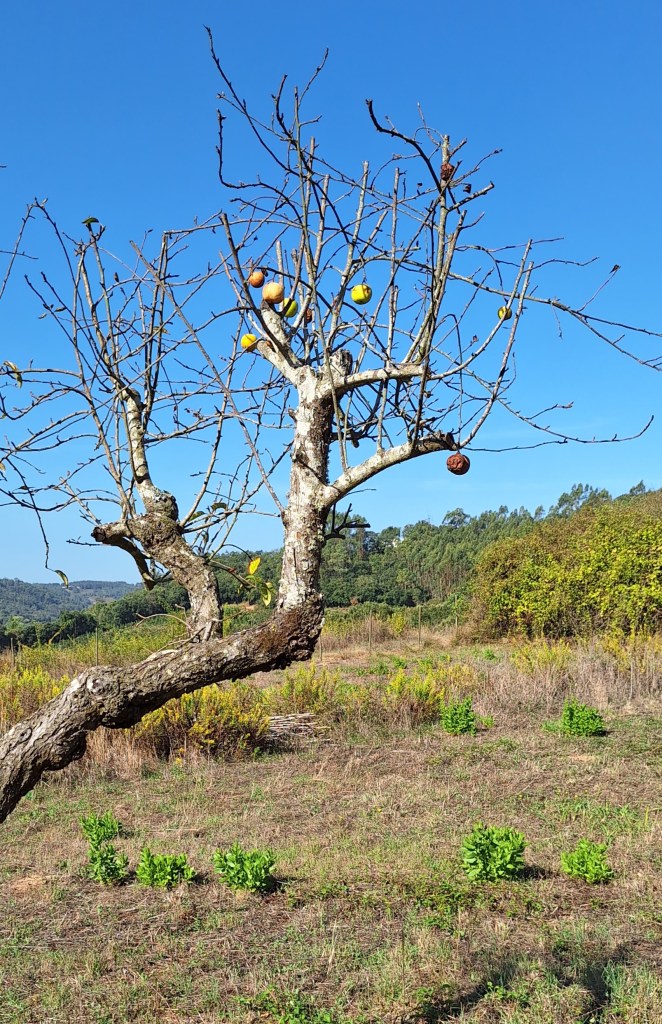
Liesel and I even donned our costumes and ventured into the pool for a while, which was very refreshing indeed. I like the Sun a lot, but even I found myself thinking ‘it’s too hot’… and I believe this lower tolerance has become worse since I had Covid that time. Sitting in the shade, trying to commit the blue skies to memory, so that the dark grey skies at home lose their hold over my mood.
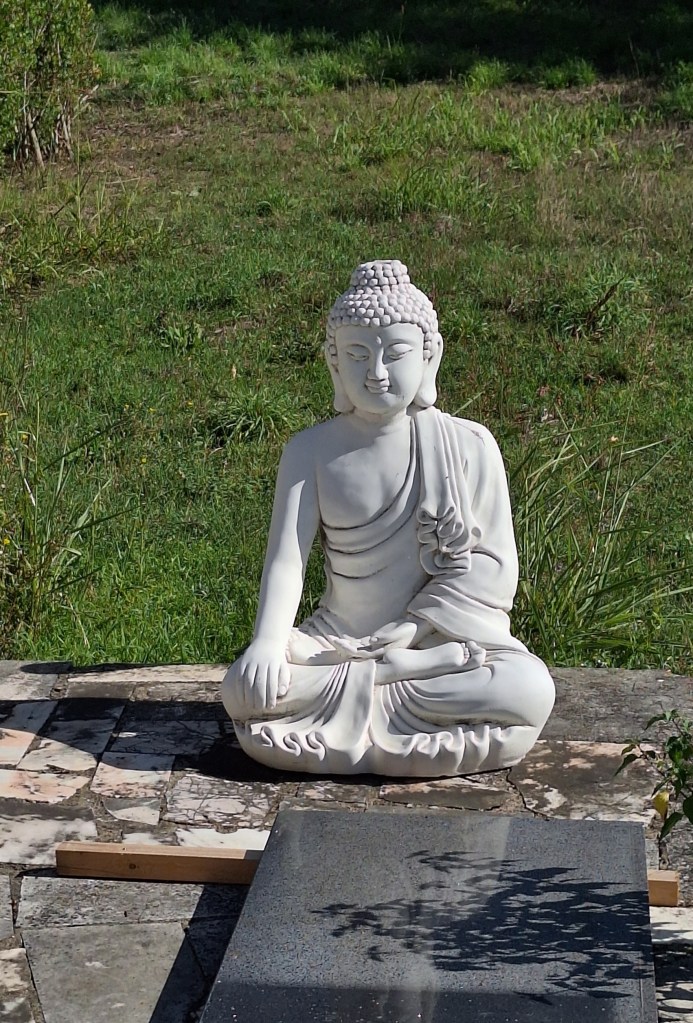
David was a Japanese warrior in a previous life and he now has a collection of Japanese swords. He showed me one, which I actually touched, by mistake, but I could see how sharp it was. And during another conversation, I again realised that Portugal and Japan are natural soul mates in the sense that both have very fish heavy diets.
David likes to cook and he prepared chili con pumpkin for us. It was quite spicy. In fact, it was very spicy. Actually, there came a point when there was no more steam left to come whistling out of my ears. It was very nice and very tasty, but boy, was it hot!
Flight features a lot in David and Glens’ lives too. Glen worked for KLM for over 40 years. And David enjoys building model aeroplanes. He showed us one by dragging the box out from under the bed. It’s a Freewing A-10 Thunderbolt II “Warthog” Twin 80mm EOF jet, in case you want to order one too.

Here is an impression of what it will look like when complete. For now, none of the wiring has been connected, there is no battery nor remote control, so it won’t be flying anywhere any time soon. When complete, it will be over five feet in length and have a five-foot wingspan. It takes up far less space, in its place, in its box, under the bed!
This was our second and, for this visit, final night wih David and Glen. I’m sure there are many more family stories that we can share.
Thank you both again for your welcome and your hospitality and for the fantastic weather! But for now, time to move on.
I tried to book a taxi online, but the app didn’t work. It couldn’t allocate a driver ahead of time. And, because it therefore didn’t know who the driver would be, it couldn’t calculate the fare. Uh? Error, you can’t do that. No, but you won’t let me do anything else either! So David kindly booked a taxi from a different company for us. It arrived earlier than anticipated to take us back to Caldas, this time to the bus station.
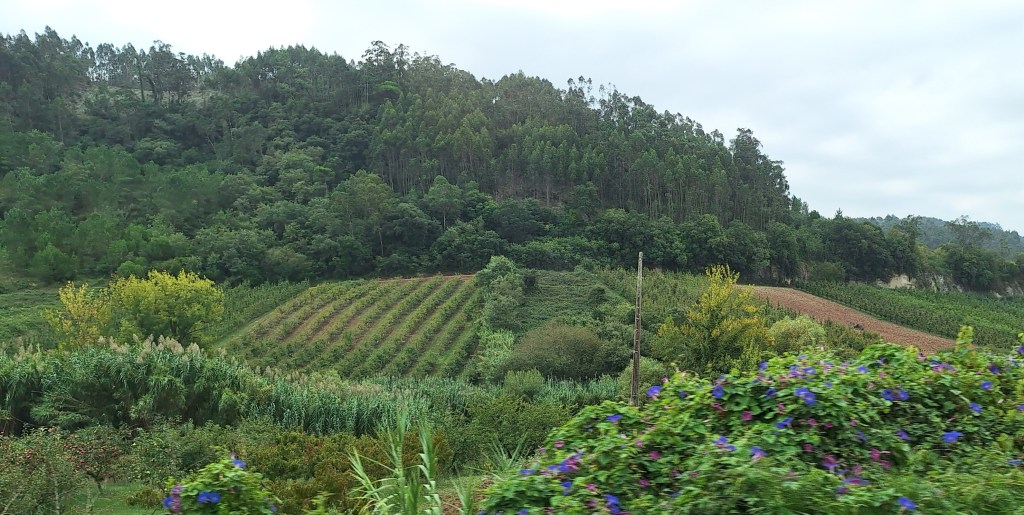
The hour wait for our bus passed quickly enough, we each explored that part of town near the bus station while the other guarded the bags in the café. In which, they’ve been very creative with a (n apparent) random collection of leftover wall tiles. From a distance, you can see an image.

Although three buses left for Lisbon within 10 minutes of each other, we actually managed to board the correct one. In between sight-seeing through the window of the bus, we read and crocheted, guess who did what?
Just outside the capital city, we passed under this:
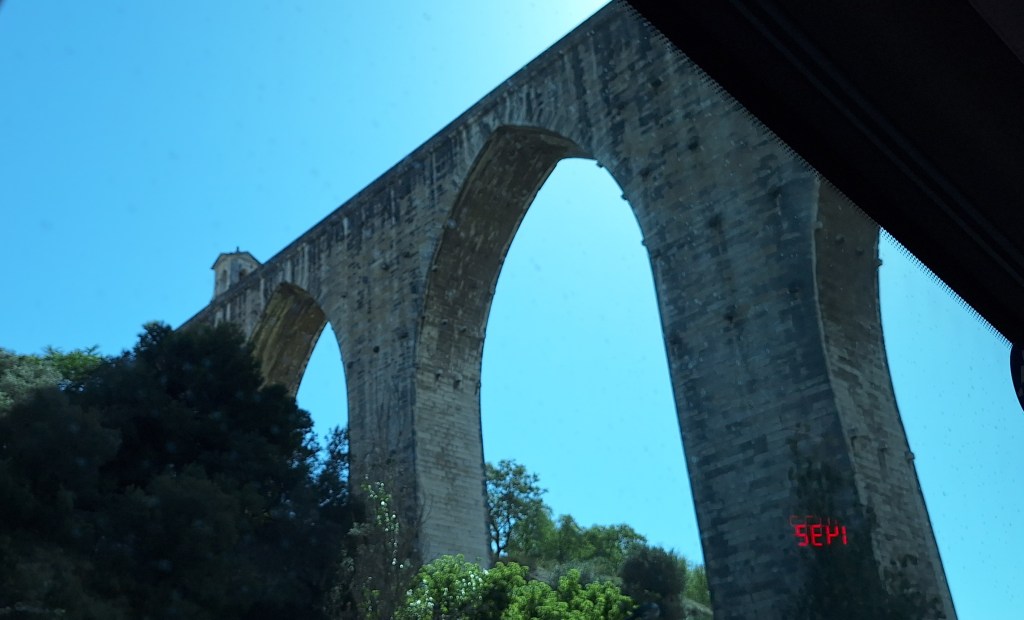
Ooh, exciting, an old Roman aqueduct. The map says: Arcaria do vale de Alcântara do Aqueduto. Roman? Well, some of the actual contruction workers might have come from Italy I suppose, but this is one of Portugal’s most remarkable examples of engineering from, wait for it, the seventeenth century.
We passed by another Lisbon landmark, but we’ll explore this city more fully later on.

Our main concern right now was that our bus was running a little late, we had a connection to make, and we didn’t know how far we had to walk from this bus to the next. So it was a relief to finally arrive at Lisbon’s bus station, disembark and retrieve our bags from underneath.
Did we catch the next bus? Did we reach our final destination? DUN. DUN. DUN DUN D-D-D-D- de de de di de dun de…

 Mick and Liesel's Antics