Nourlangie and Yellow Water

It was a short stay in Jabiru but our next abode wasn’t too far down the road. We drove via Jabiru Town Centre, or Plaza, where we refuelled the car. The bakery shop was probably very good in its day, but it’s now closed down.

The Post Office proved useful. It’s late, but we posted the rest of Martha’s birthday present. We could get used to this slow, unhurried, leisurely pace of customer service, stopping to chat to all the local customers, trying to extract confidential information about an on-going case from the local cop, telling someone obviously known to the counter clerk that she couldn’t take away someone else’s packet without formal id. We bought a newspaper too and read it from cover to cover while waiting for the paperwork to be completed. Well, slight exaggeration. Then, to cap it all, the machine didn’t like my payment card.

As we drove along the road, we were on the lookout for wildlife of course. Our score? One kangaroo and two black cockatoos. Yes, we’re 99% sure they were black cockies but they flew away as soon as the car stopped.

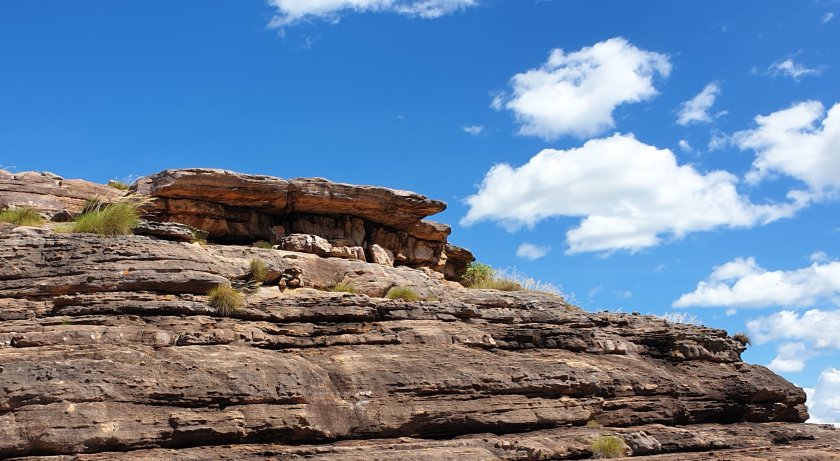
Our first proper stop was for a walk to Nawurlandja Lookout. This harsh, rugged, rocky landscape was typical Northern Territory. Bare rocks but with lush vegetation breaking the monotony. Although ‘monotony’ isn’t the right word, really, the whole place is just fascinating.

Nawurlandja Lookout

The rocks reveal the course of flood water cascades during the Wet. Black algae grows where the water flows, then it dries out and leaves what looks like sooty stains when it’s dry.
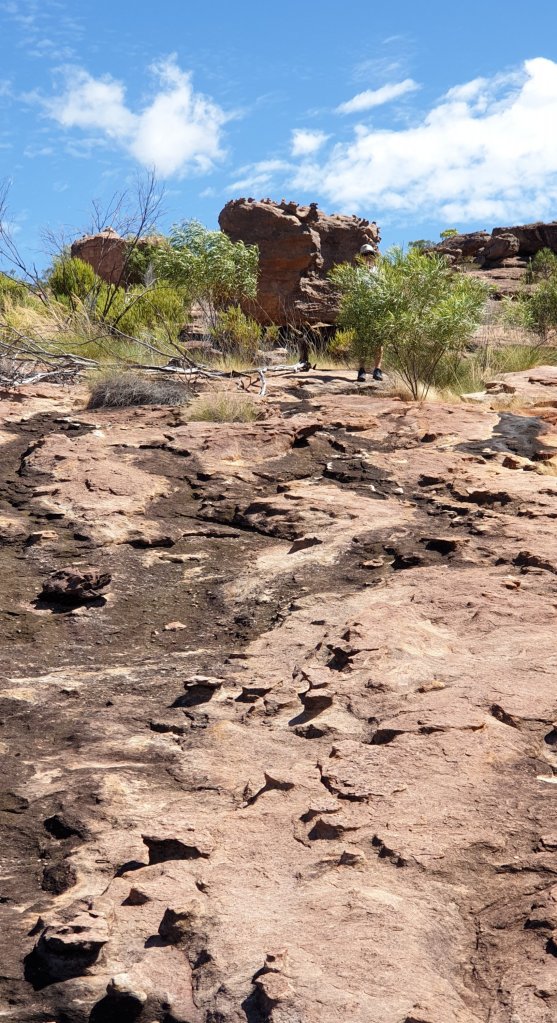
Water was here

We admired the tenacity of one lone tree, surviving at all, and keeping lookout over the plains of Kakadu, towards Anbangbang Billabong.

The lone tree

The escarpment way over there would be a challenging climb, but not for us, not today. We proceeded up as far as we were allowed to go on this Lookout, the breeze cooling us down as we gained altitude. It felt more humid today than it has for a while, and this was confirmed by a local, later in the day.

Nourlangie Escarpment (I think)

Big. That’s the word. Big environment, big place, big country.

Where’s Liesel?

And it’s not just the landscape that is too big to comprehend. Some big rocks are standing and there is no obvious explanation for how they arrived where they are.
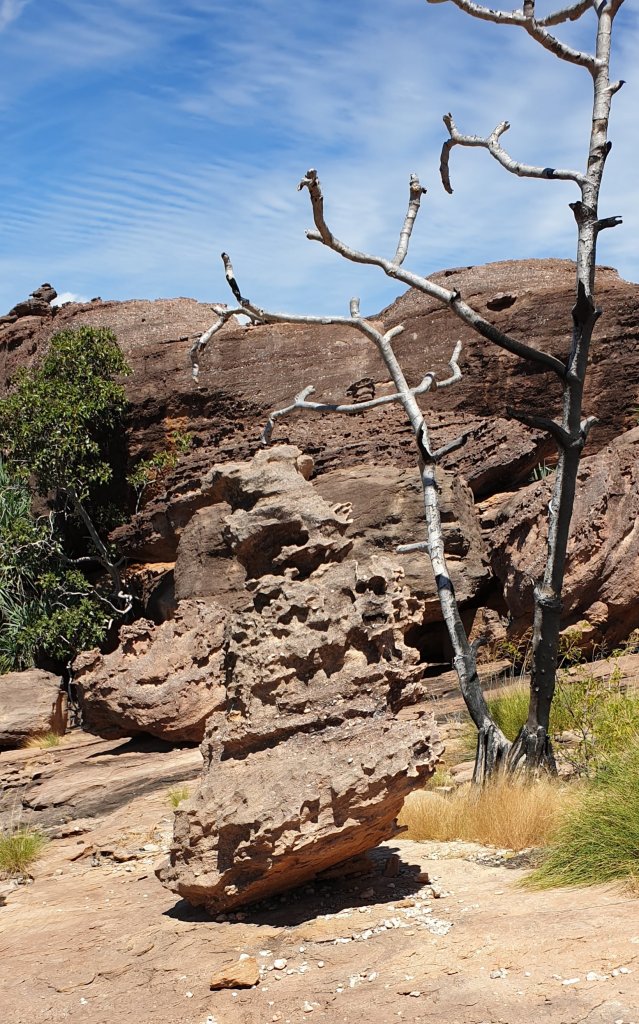
A standing stone

Rocks, green grass and other plants and again, just the rare, odd splash of red.
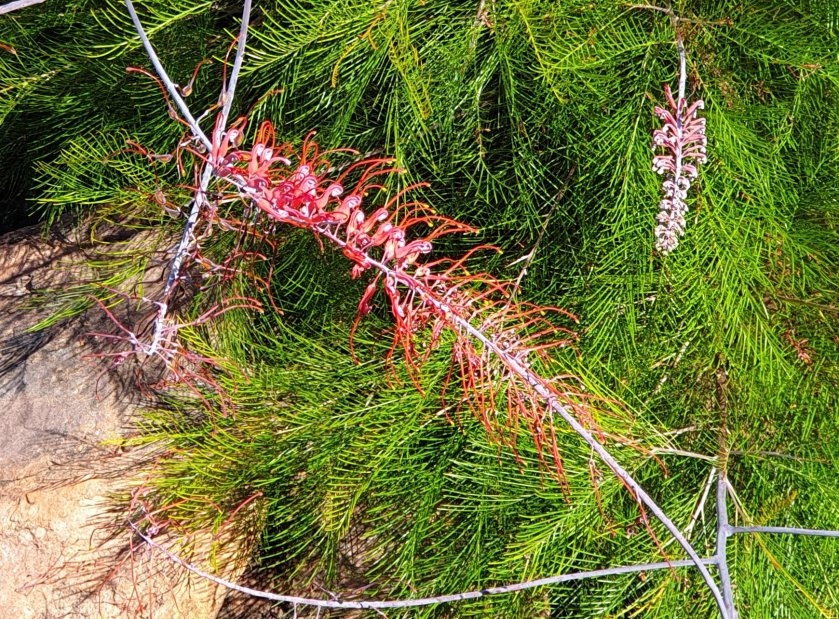
A dash of red

We were going to walk to Anbangbang Billabong but the path was closed. Probably flood water or maybe a muddy path, we surmised.

Seasonal closure

A shame to miss it but there was plenty more to see. You can add Kakadu to the list of places where we’ll never spend enough time.

And if there wasn’t enough to worry about, snakes, spiders, crocodiles, floods, mosquitoes, we also have to take care to avoid Heat Illness.

Heat Illness

One litre of water per person per hour while exercising outside is recommended, but that’s a lot of water to carry around, so this limited the distance of any hikes we planned to do. But, if we come back…

My new favourite place name is Nourlangie. It, like the word ‘favourite’ itself, contains all five vowels. We went for a short hike here, to see more rock art.

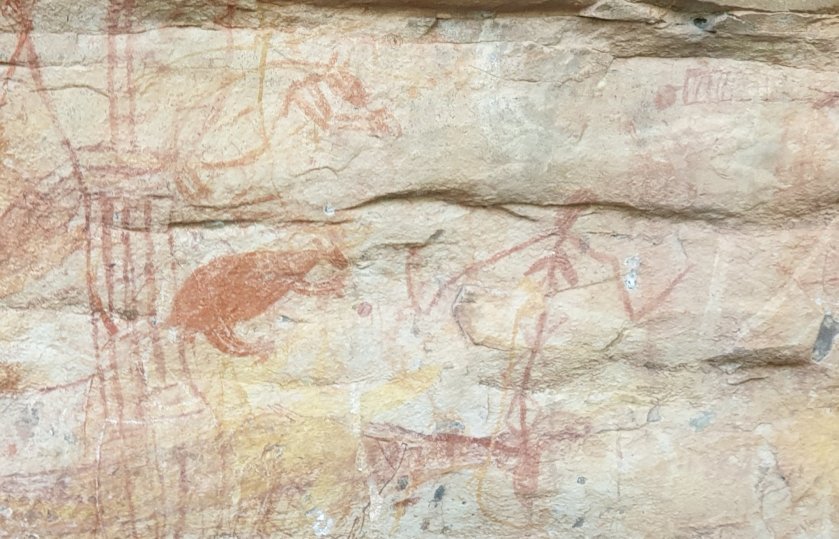
Kangaroo

The escarpment was much closer now, but still, too much of a climb for us.

There’s no escaping the escarpment

A lot of the artwork was painted on walls underneath overhanging rocks, so sheltered a bit from the elements. When an overhanging rock looks dangerous, they prop it up with the thinnest tree trunk they can find.

Holding up well

Or maybe that was just put there for comedic effect, a lie to tell tourists.

I feel so proud of the Europeans that came here and tried to civilise the natives.
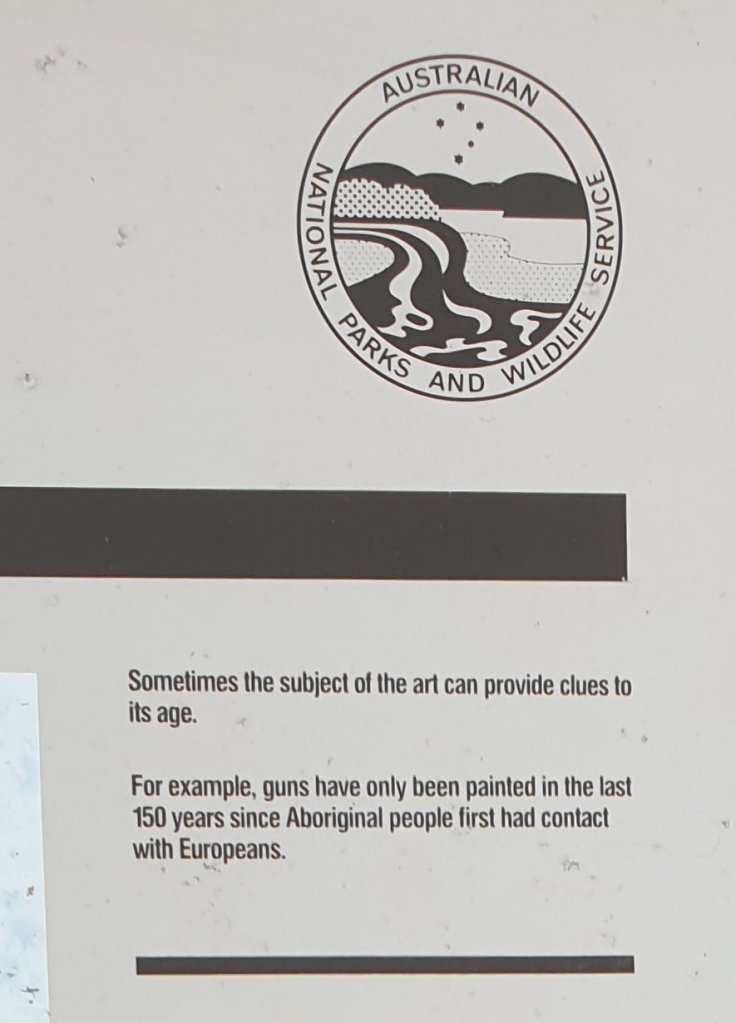
Hooray, we gave guns to the Aboriginal people

I wonder if, like the Maori, the Aboriginal clans were given firearms if they converted to Christianity? Or, at least, pretended to?

Dancing is a big part of ceremonial occasions, and is depicted in many paintings.

John, I’m only dancing
Now there’s a story

Some paintings have been altered, against Aborginal conventions, probably for whitepellas’ sensibilities. But the old stories are still being told. Namarndjolg eventually became Ginga, the estuarine or saltwater crocodile.

Today, the Gunwarrdehwarrdeh Lookout walk was a more practical option for us than the 12 km Barrk Walk, fabulous though that would undoubtedly be.

It’s a Lookout, the clue is in its name, so why am I still surprised by a stunning view?
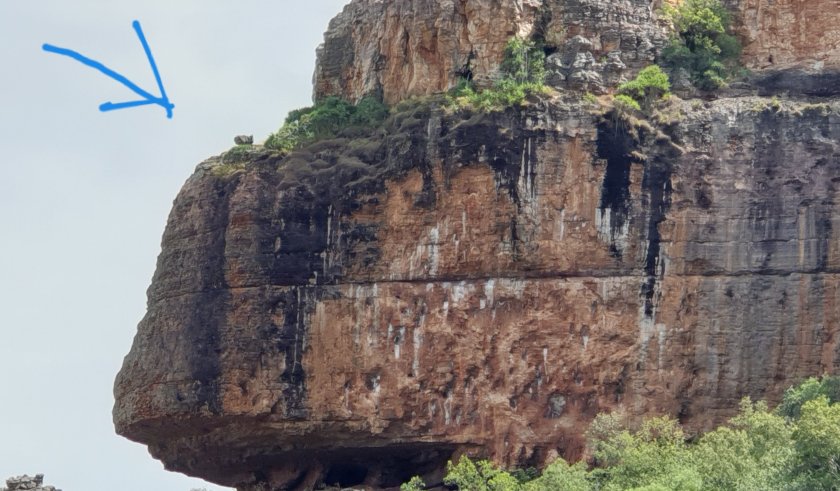
Narmandjolg’s Feather

Namanjolg’s Feather is a small rock perched high up. It’s the feather that his sister took from his headdress after they had broken the incest laws. She placed it here to show what she had done. Later, she became the Rainbow Serpent. Even on the sign depicting the story, the poor fella’s name is spelt two different ways. As if he wasn’t suffering enough already by having a boulder in his hat, euphemistically referred to as a feather.
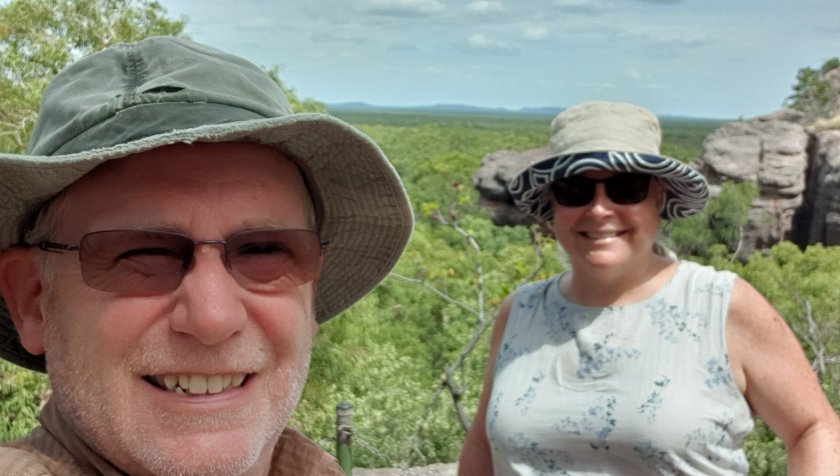
Selfie of the day

Later on, we passed a gorgeous little billabong, and Liesel requested this photo, taken from a low angle, presumably so that the croc wouldn’t have to jump so high to eat me.
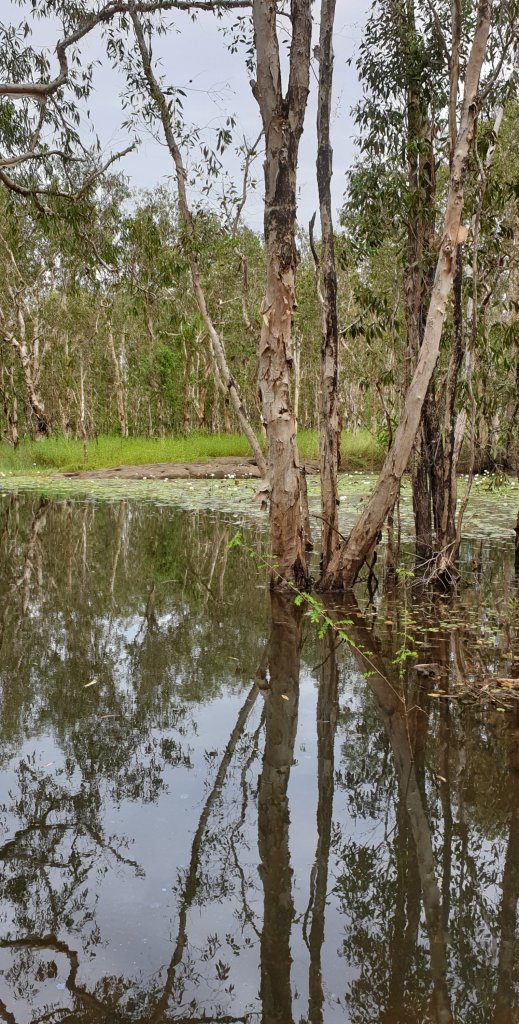
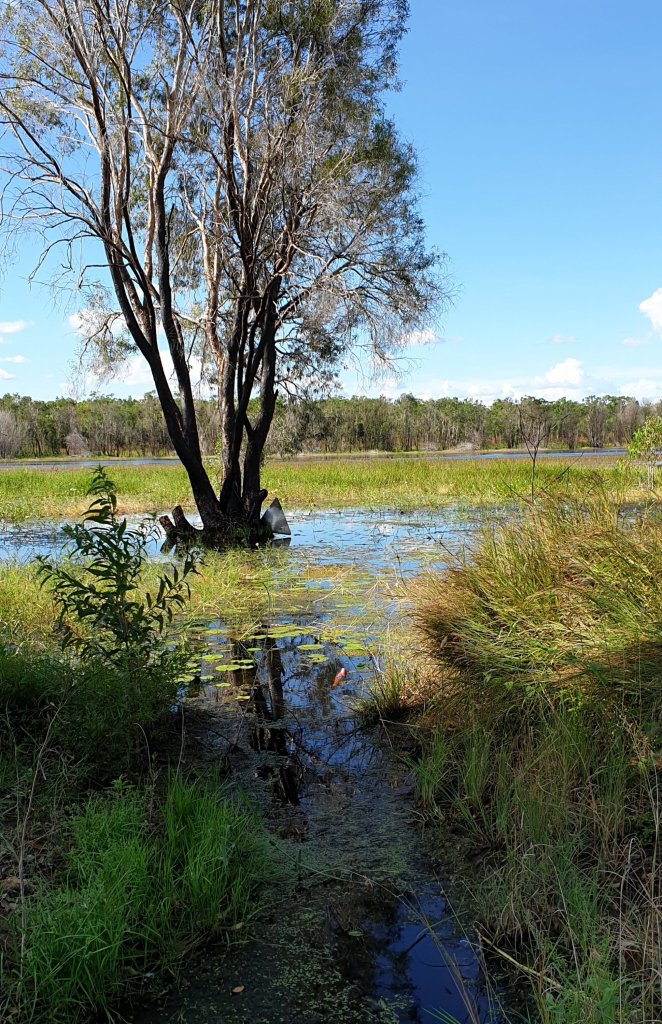
Reflective, peaceful billabong

Other than a few insects, we saw no animals here, but I did hear what I thought was a frog, possibly a bullfrog, as its croak was so deep.

We spent some time at Warradjan Aboriginal Cultural Centre. There were many stories, some passed down through the generations, and some modern people telling their own stories. Some were very sad, about how the country has changed, and been taken over by other people.

We decided not to visit Yellow Water Billabong right now, which is just as well because the road was closed due to seasonal conditions. Probably mud or floods or something, again.

Our new place is not an Airbnb, it’s a Lodge. Cooinda Lodge if you believe the booking form, or Gagudju Lodge, Cooinda if you prefer the sign outside. Home of Yellow Water, as the sign says.

There are boat trips onto Yellow Water, and we booked one straightaway for this evening, ending at around sunset. So we only had a short time in our room to recharge ourselves and recharge the phone battery before joining over 20 other visitors in two buses to the jetty.

The driver opened the gate that had prevented our earlier visit and closed it after the bus passed through. As the bus went down the track towards the jetty, the water became deeper and deeper, and produced quite a wash.

The bus needed a wash

This is why the place was closed to casual visitors like us, we thought. But no. The real reason is that a 4-metre long crocodile had taken up residence in the flooded part of the car park. Everybody breathed in sharply at this news. We were very carefully shepherded from the bus to the jetty which was enclosed in very thick metal fencing, and then onto the boat.
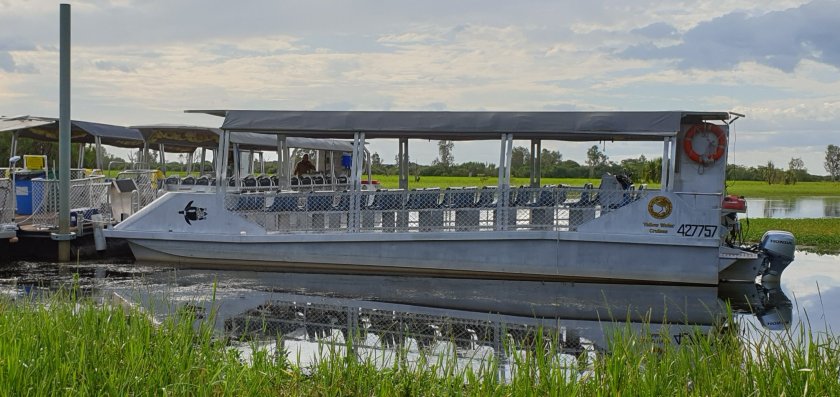
Our croc-proof boat, not sure about ice-bergs

The boat looked strong enough, the sides were very strong metal mesh and there was no way we could pester the crocodiles through that.

It was a very pleasant two hours out on the water, mainly in Yellow Water, the billabong, itself but also venturing into the East Alligator River.

How did Yellow Water get its name? I recalled the book titles we made up at school ‘Vegetarian Breakfast’ by Egbert Nobacon for instance. Or ‘Yellow Waters’ by I P Daly. Well, from experience, when I’m dehydrated, I produce a lot of yellow water and I’m sure that’s quite common in these hot and humid places. But that’s not the origin of this placename. Buffalo were introduced here about two hundred years ago and they had the habit of eating the marsh grass, then walking around and compacting the clay so it was impossible for anything else to grow. When the rains came, they washed the clay away, turning the water yellow.

First East, now South Alligator River: how come, when it’s crocodiles that live here? Unfortunately, the guy that gave three rivers the Alligator name just got it wrong when he saw hundreds of crocs. He probably didn’t want to get too close to them, either.
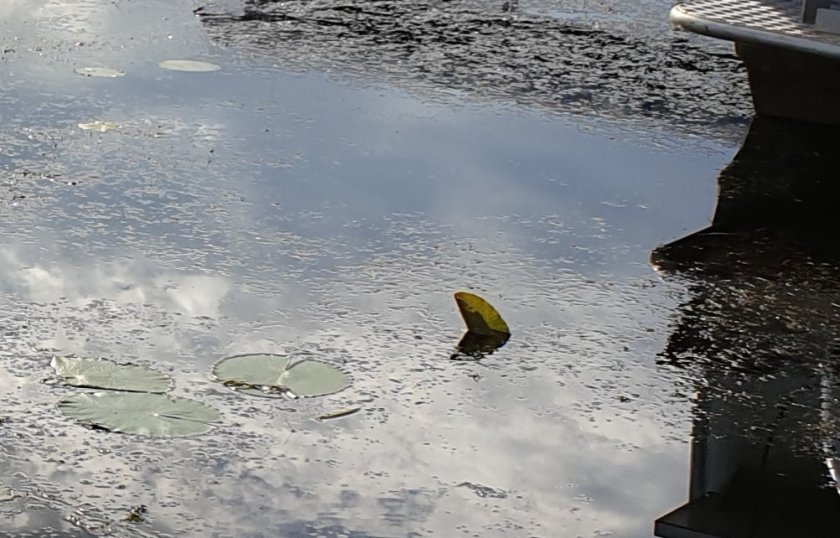
Shark!

There was almost a cheer when we saw the first croc before even setting off from the jetty. I was impressed at how quiet the engine was and it made me wonder why many boat engines are so loud.
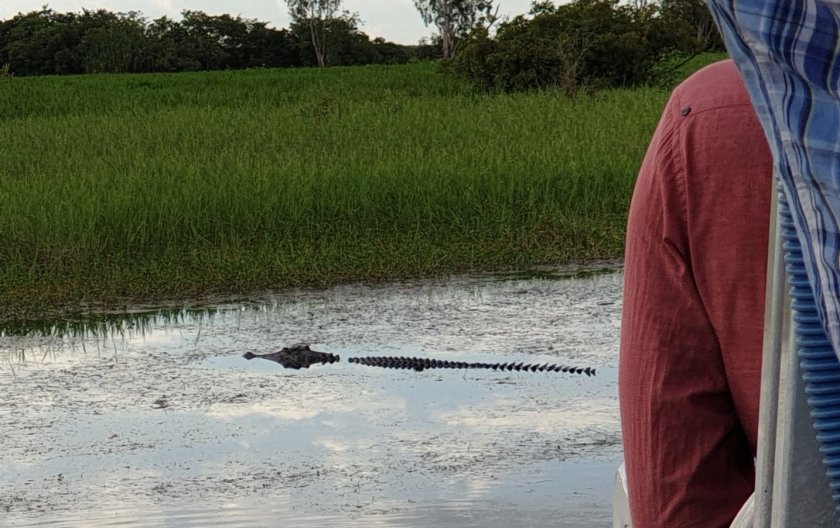
Our first decent crocodile picture
White egret

We were really lucky with the amount of wildlife we saw, in its natural habitat. As Damo, Damien, the pilot and guide said, they’re probably all used to the boats now and know we mean them no harm.

Side by side
On her own

We’d brought water with us but we had to refill our bottles a couple of times from the boat’s own supply. I thought walking around such a small vessel might affect the balance, but it was only genuinely of concern when everyone went to the same side to take pictures.
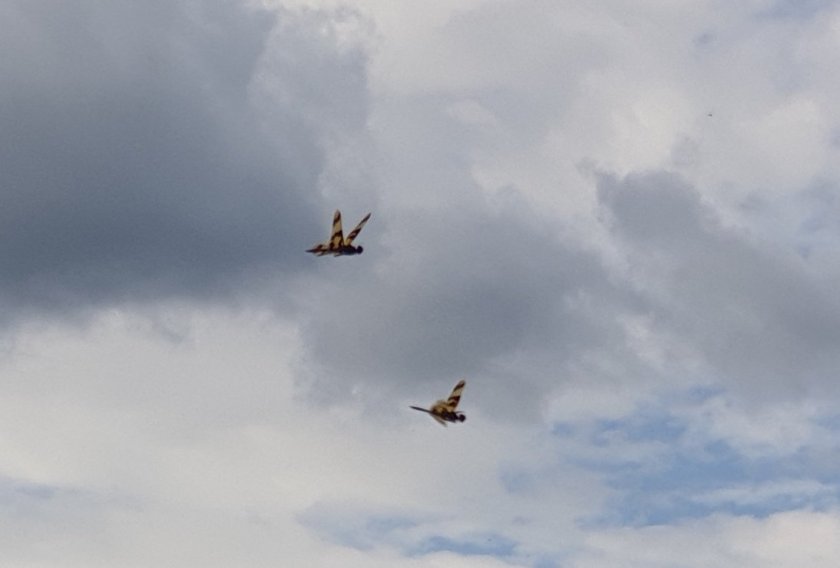
Bugs and clouds

It was a cloudy sky and Damo suggested this might enhance the sunset. Lots of bugs came by. The dragonflies are ok but we soon got fed up with the mosquitoes, so we applied bug dope.

One guy had a huge video camera and another had a very long zoom lens. I’m sure they have some terrific pictures and film, but I’m quite happy with my little phone camera. Next time, however…

Crocodile and sky

We saw about four or five different crocodiles, mostly female, and the only thing that could have been better is seeing a whole family or group having a siesta on the bank.

Sea eagle

We’re over 100 km inland, yet we saw a few sea eagles. They’re very graceful in flight, and happy to pose on a tree, but not if you get too close.

Whistling ducks gathered on the bank, and whistled a merry, if warning, tune as we sailed on by. Their only fault is in being the same colour as the sand, so quite hard to spot.

Whistling ducks

After seeing the warning sign yeserday about the presence of buffalo, we knew we wanted to see one. And our wish came true. Damo spotted one hiding behind a tree, having a rest, chilling out, eating grass.
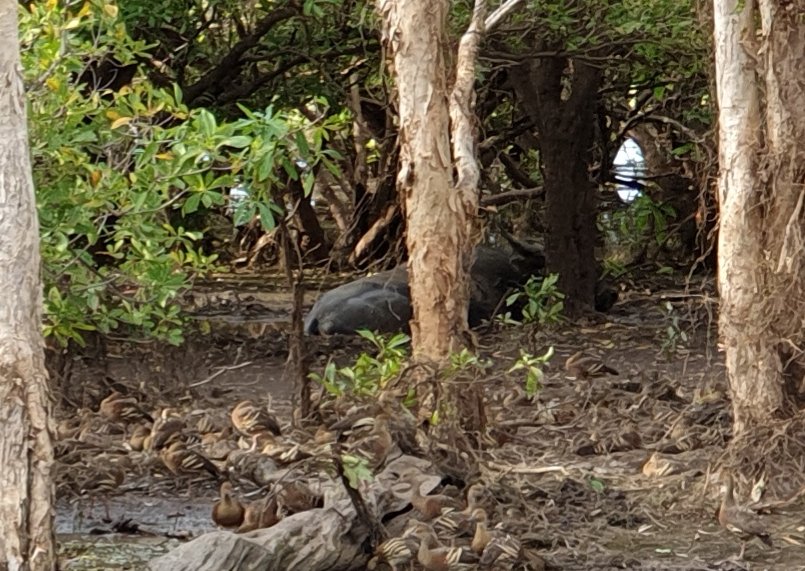
Buffalo behind the tree

He wasn’t bothered by the boat, just looked up in a nonchalant manner. He may have been bored with this group of whistling ducks though, with their tuneless and insistent whistling.

More whistling ducks

As the Sun slowly sank, it occasionally peeked through the clouds, taunting us with the possibilities of a glorious sunset.
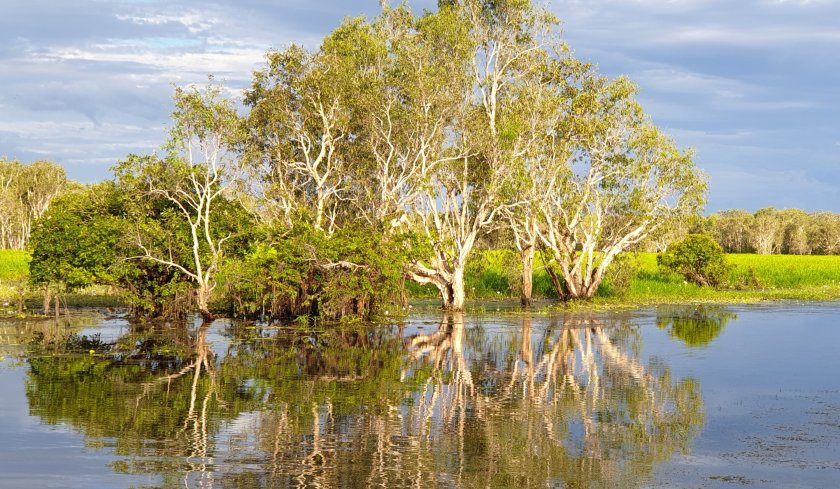
Still water, gorgeous tree

Cormorants go fishing here as do snake-necked darters. They too like standing there, drying their wings out.

Darter drying his wings

We saw more crocodiles, some of which stayed on the surface and some of which dived when the boat approached too closely. I think everyone who spotted a croc was torn between announcing it to the whole boat or keeping it to themselves for better photos without strangers breathing down their neck. Oh, just me then!

Cloudy sky

The East Alligator River is the only river system in the world wholly enclosed in a World Heritage Site National Park. So, in theory, it has the cleanest water. Unfortunately, some fishing people don’t care, and beer cans have been seen floating by. But the main problem now is with salvinia, a fast growing weed that is in danger of blocking the waterway. It was once sold as decoration for domestic aquariums and it’s thought that someone just poured the whole lot down the drain one day. They’re trying to combat it with a weevil imported from South America that eats salvinia, and only salvinia. I would have thought that after the cane toad episode, Aussies would be very reluctant to import another biological form of pest control. Salvinia fights the lotus lilies for resources, but I think we all agree which looks better.
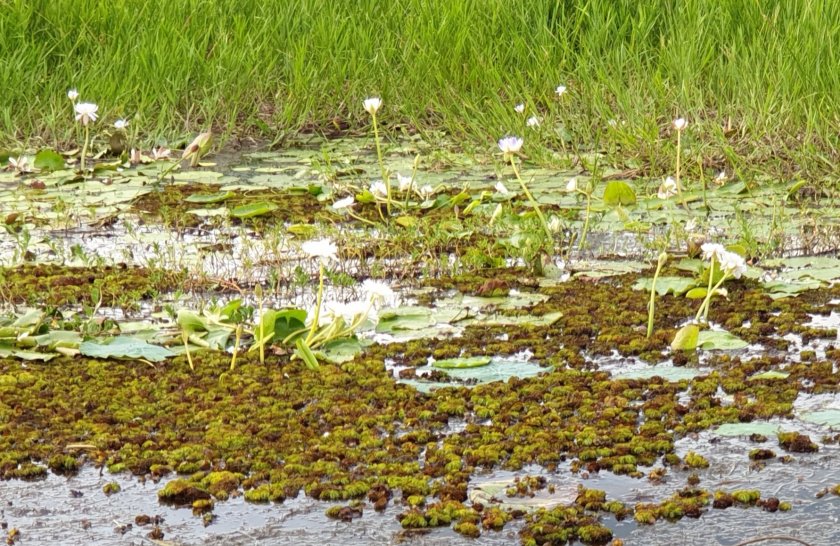
Salvinia v waterlilies

We saw a family of jacana, little birds with long legs, again, hard to spot because they’re so well camouflaged.
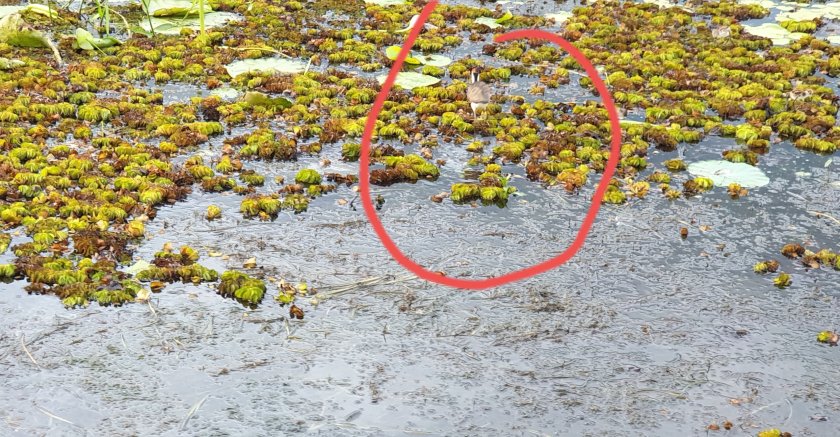
Spot the jacana (spot the subtle clue)

For a brief few seconds, it looked as though the Sun might deliver, but the moment passed, and we went back to looking out for animals.

On the way back, we passed a black-necked stork, a jabiru. Neither name is correct, they’re trying to introduce the Aboriginal name for it, which Damo couldn’t recall in the heat of the moment. The name ‘jabiru’ is taken from a South American bird which it was mistaken for on the day it was named. And its neck isn’t black, it’s more of a dark iridescent blue.

Quick pic of the stork before it flies off

But the consensus is still that it is Australia’s only stork. And I still think storks look prehistoric. The boat drifted by slowly but it was very patient with us.

The stork posed for us

Even if the sunset was doomed, which in general, it seemed to be, there were odd moments of sheer beauty. The Sun has the power to set trees alight.
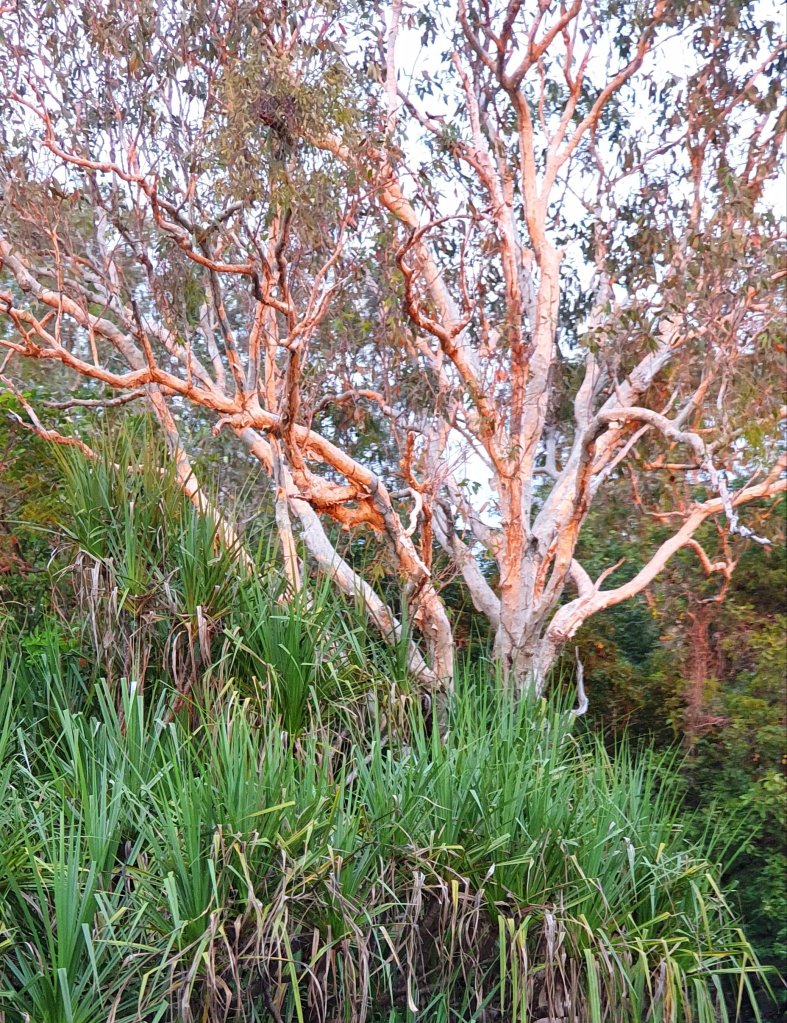
The tree catches the light

We passed by the buffalo again, and now he was standing up, and in a much easier place to see.

Buffalo out in the open

He was big. Mahusive. Probably the size of a rhinoceros, much more massive than a moose, if a little shorter in height.

Sunset arrived and as anticipated, it wasn’t as glorious as it often is. This silhouette of a darter in a naked tree in the foreground isn’t too shabby.

Sunset at Yellow Water

Damo had to get us onto the buses quickly: it was dark within minutes and as he said, those crocs could be hiding anywhere.

Back at the Lodge, we had a meal outside while being eaten by mosquitoes. They’re not normal, these things. Most mosquitoes come along, sit down, rub their hands together and then sink their teeth in. These ones just come at you nose first, straight into the skin. No warning tickle of a hair being touched, no high-pitched whine, just straight in. They kept going for my right arm and ignoring the left, for no reason obvious to me. I applied more bug dope and that helped a bit.

I also anaesthetised myself very slightly by drinking my first beer in many weeks. Fair to say, I’m not a fan of kamikaze Aussie mozzies.

It felt strange going to bed without checking up on all the social media and emails. There is no wifi here and Liesel and I aren’t on Telstra, so there’s no 4G for us either. Totally cut off. It’s surprising how often I quickly look something up online each day. Not today, though. I can’t listen to the radio, I can’t download books or even newspaper articles.

But as the sign here says, without wifi, you have a better connection with Kakadu. And that’s very precious.

Ubirr

One of the places we really wanted to visit was Ubirr, to look at the ancient Aboriginal rock paintings. As we drove along the road, again we passed many Floodway signs. We came across our first flooded road and drove through easily enough, the water wasn’t too deep.

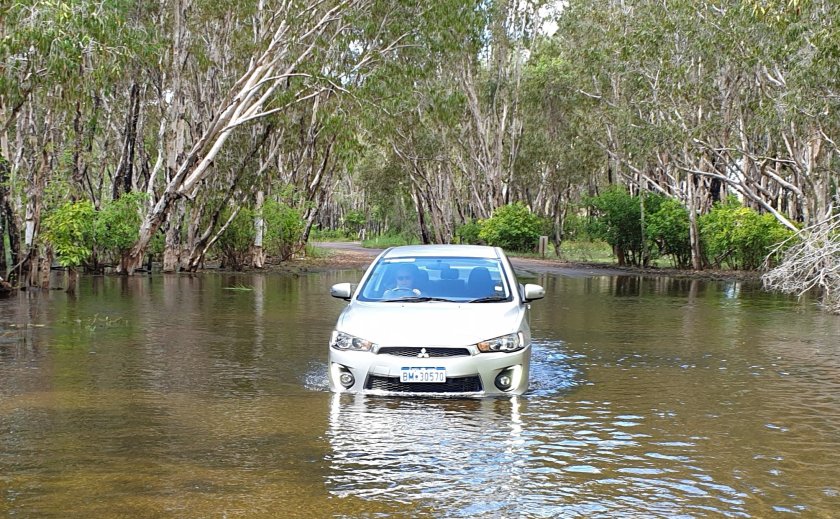
The second flood was much wider. On close inpection, I could see the double white lines in the middle of the road as far as at least half way across the puddle. Puddle? Almost a lake. The car rental man had warned us about some roads only being suitable for 4WD vehicles, and told us that we weren’t insured to drive between sunset and sunrise. He hadn’t said anything about flooded roads.

But, if we hadn’t continued, we would never see Ubirr. There was comfort in seeing other vehicles at the car park, and they definitely weren’t all 4-wheel drive. Certainly not the campervans! So, if we became stranded, at least we had company!

East Alligator River at Cahill’s Crossing

Helen had told us that crocodiles can be seen at Cahill’s Crossing when the tide changes. We were here at low tide, and the water was low enough to be able to cross over into Arnhem Land, if we wanted to, and if we had the permit. But, no crocs in sight. Just a couple of fishermen and a few fish jumping in the fast flowing water. Actually, fishermen jumping in the water would be quite entertaining. High tide wouldn’t happen for another twelve hours, which is a shame.

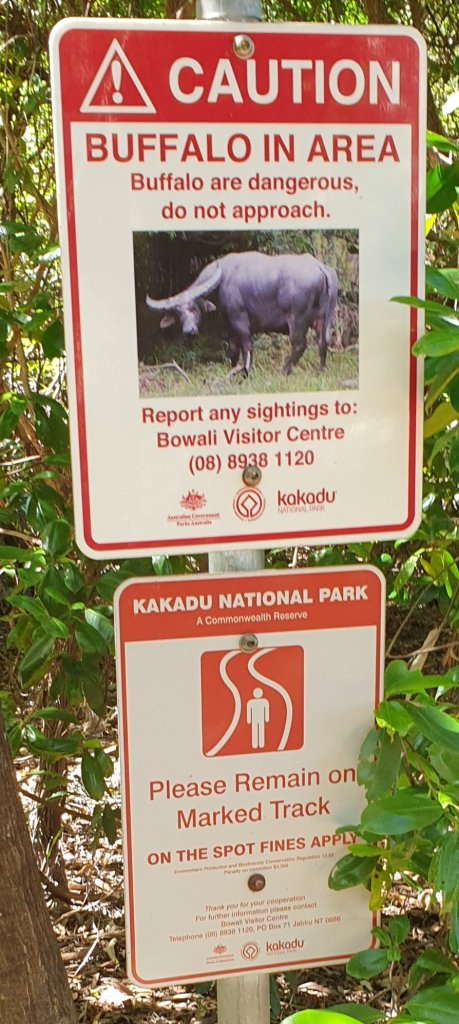
Buffalo in area

As we drove into the car park, we saw a black snake slither sinuously across the road in front of us. It was very fast, totally black as far as I could tell. Yes, it was good to see from the safety of our vehicle.
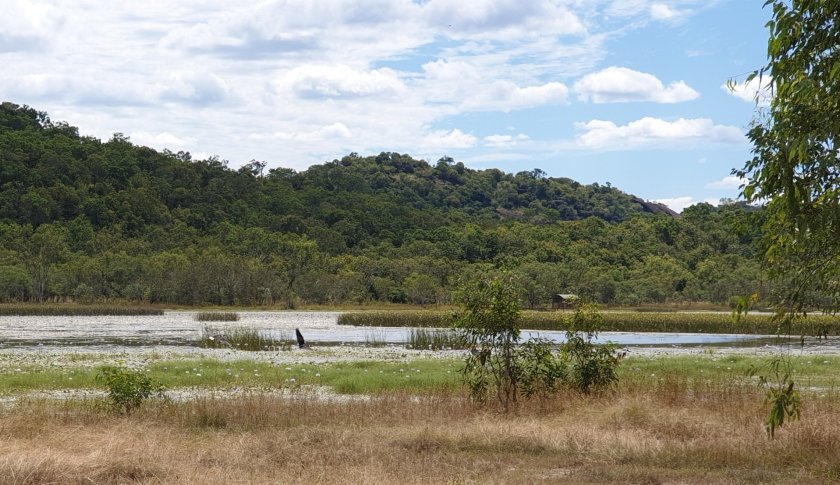
We also saw our first dingo, out in the wild. Jenny sent a video warning. “What do dingos do, Martha?” “They bite our bottoms!” This advice, given to Jenny on Hamilton Island some years ago, will now be passed on down the generations. And has been passed back up to us ancients.
Dingo
Another warning sign

Some of the tracks were closed, probably overgrown vegetation or a landslide or something, we surmised. But, knowing the dangers in this area, well, in Australia generally, we didn’t venture beyond the sign.

Even so, we saw plenty of fascinating geological artefacts. Rocks stacked up as if by human intervention, large cliff-like escarpments, things last seen in a TV documentary, or even in a Geography text book at school.

Rocks and boulders

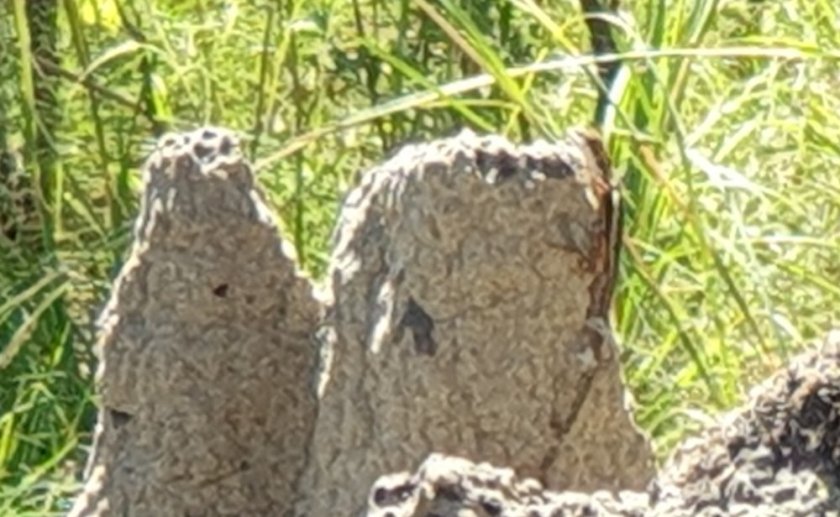
Termites know no limits and their skyscrapers provide magificent lookout posts for lizards.

A skink on a termite mound

No luck with crocodiles, but this fallen palm frond has some very impressive sharp teeth.

Palm frond

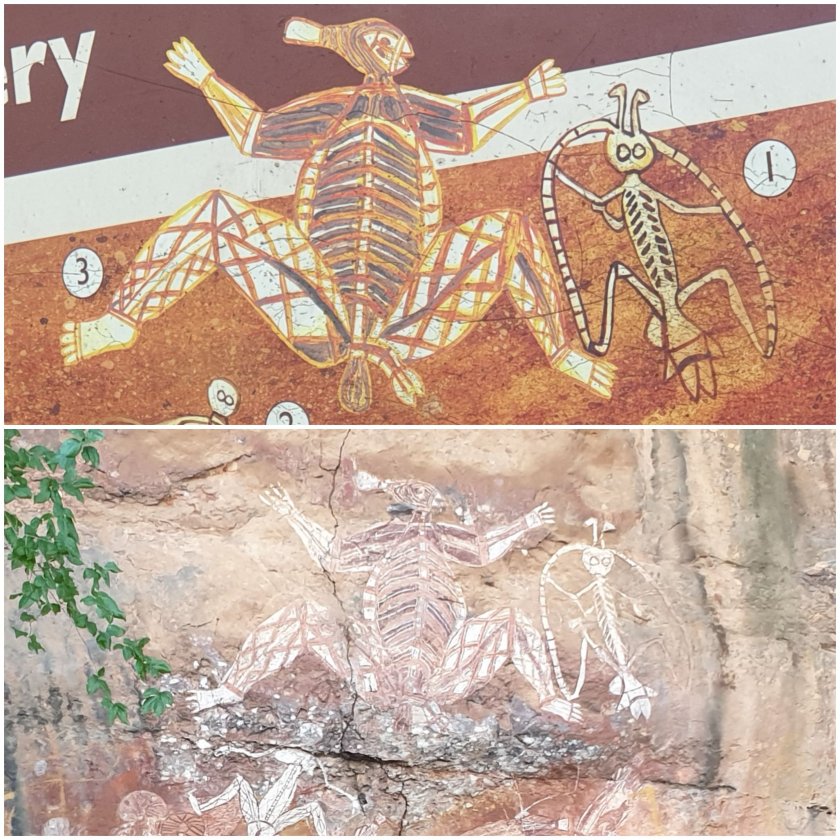
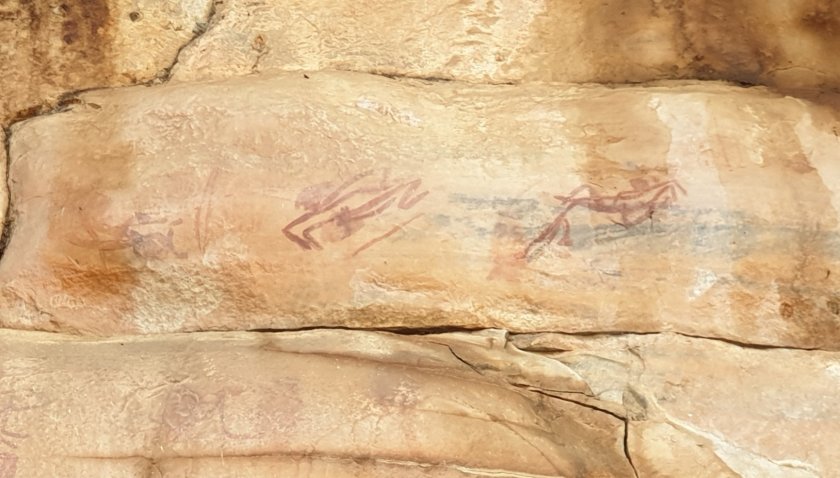
From Cahill’s Crossing to Ubirr was a short drive, and we joined many other people as we walked around the trail, admiring the rock art. Some was easily identifiable, but fortunately, the information boards helped with some interpretation.

Ancestral art
Fish supper
Local wildlife

From Ubirr too, we could admire the rock structures, including the overhanging rocks that provide shelter, and a place for the paintings to be preserved, sometimes for tens of thousands of years.

Pride Rock

Although an Aboriginal artist is not supposed to touch up or improve on someone else’s work, after a time, a painting can be overwritten with a new one, a palimpsest. Experts can tell the various ages, and see how the ancients’ lifestyles changed over time.

We climbed, or clambered, up the rocks and were both taken aback by the view, in all directions. It really is a big country, almost overwhelming.

Marsh grass forever
Hot rocks and blue skies

The colours here are incredibly bright, as if the intensity has been turned up to 11. The green grass, the blue sky, the white clouds.

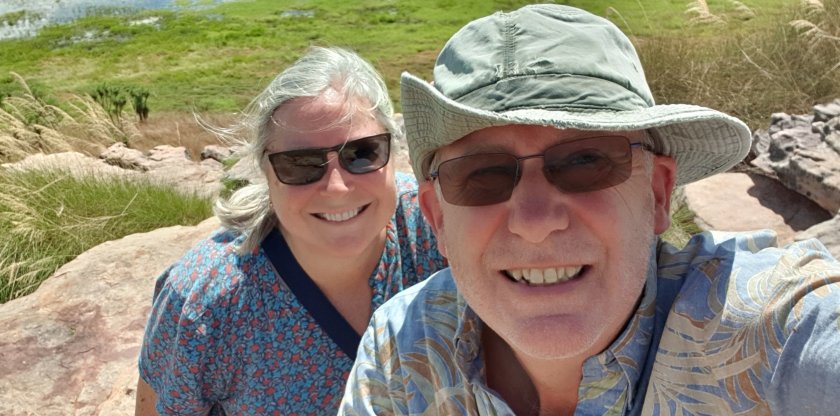
Selfie of the day
Rainbow Serpent

At first glance, this picture could be an elephant, but it is the Rainbow Serpent, a character that features in many Aboriginal stories, some not very nice. And some stories are really warnings , without happy endings.

The Rainbow Serpent usually lives peacefully in waterways but can be upset by some noises, especially children crying.

One day, the Rainbow Serpent heard the constant cries of a child coming from an Ulbu camp. The child was crying for sweet lily root but when night fell, the child was given sour lily root by mistake. The cries became even louder and could still be heard in the morning.

Suddenly, cold gusts of wind sprang up – a sure sign that the Rainbow is near. The Rainbow Serpent ran into the camp, trapped everybody with its huge circular body and swallowed the child and most of the people.

Just one chapter in the journey of the Rainbow Serpent, passed down through the generations.

Some Aboriginal sites are deemed sacred because they can be the source of a horrible disease. The swollen joints of Miyamiya are depicted in an old painting.

Miyamiya swollen joints

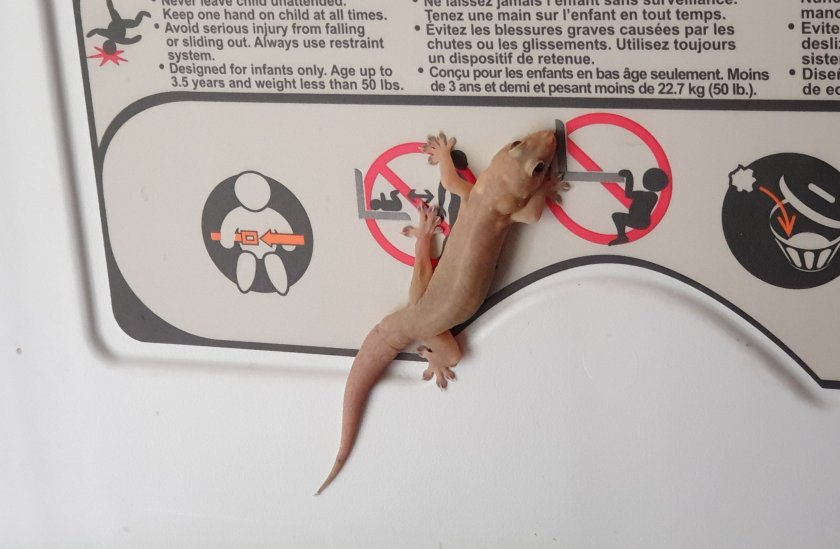
It’s been a mystery during our travels in Asia and Australia: just where do geckos go during the daytime? I now have the conclusive answer.

Gecko in a baby changing unit

I visited the public lavatory before leaving Ubirr, and when I opened the baby changing table, I revealed not one but two geckos having a rest. Not the sort of thing you need to see unexpectedly if you have a baby in one hand and a nappy in the other.

And another first: we saw a goanna run into the bush at the side of the road as we drove away. I didn’t even catch the tip of its tail in the photo!

We reached the flooded road again and at least now, we knew it wasn’t too deep.

The flood

I waded through the water, hoping there were no crocs, nor even leeches, but I was surprised to see little fishes in the water above the road surface. All that, just so I could take a picture of the boat we’d rented in Darwin.

Our rental boat

Next stop was the Bowali Visitor Centre, near Jabiru, the Headquarters of Kakadu National Park. Amongst other fascinating exhibits, we saw this notice. It’s a few days out of date but we were glad we hadn’t seen it before the morning excursion!

Road conditions: floods

It goes without saying that I had a cup of coffee, so I won’t say it. We watched some wildlife through the window. Window? There was no glass, just a hole in the wall.

Orange-footed scrubfowl

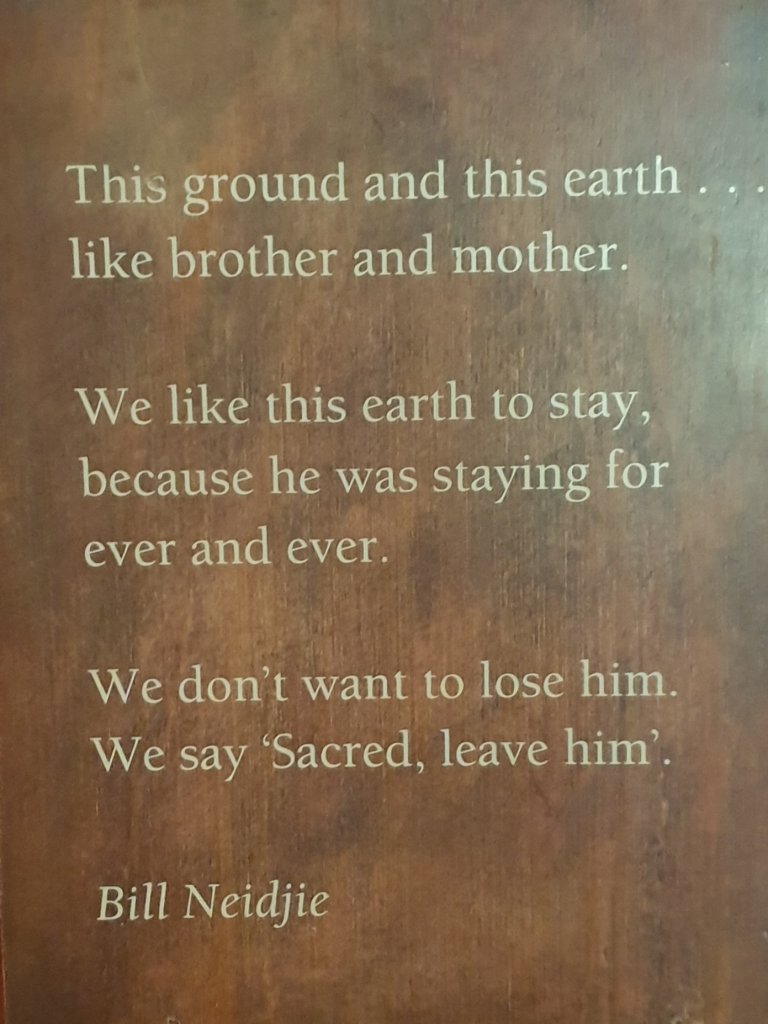
We read a lot about how the original peoples here live with the environment, look after it for future generations and it’s a philosophy we could all adopt.

This Ground and This Earth…

Yes, I am aware of my own contribution to the destruction of the planet by flying all over the place for the last nine months. And when I can think of one, I’ll add a ‘but…’. The displays in this visitor centre certainly makes you think about things in a non-white, non-European, non-western manner.

Ner ner ner ner, ner ner ner ner, ner ner ner ner, ner ner ner ner, Bat Fan
Look up, there might be a snake in that tree

I’m sure we’ve seen these trees without realising. An-binik trees grow in the rock country of Kakadu and nowhere else in the world. They’re typically thirty metres tall or more, and provide shade for smaller monsoon forest plants. A relic rainforest species with links to ancient Gondwana. Every time I think the breadth and depth of the history of this place is within my grasp, something else even older, bigger comes along. In another quirk of fate, our Jabiru accommodation shares its name with this ancient tree.

We haven’t seen a warning sign for a while, so what a delight to see this one.

Another warning sign

This is Aboriginal country but that doesn’t stop mainly white prospectors from wanting to mine for the uranium here. That would be terrible for the local environment, no matter how much they bribe the local officials, if that’s what it comes to.

Kakadu is one of the few places in Australia where there has been limited or no extinctions of plants or animals during the last 150 years. It hosts more than 200 ant species, more than 1000 species of flies, most of them buzzing around my face at any given moment, more than 100 species of reptile, more than 64 species of mammal and about 280 species of birds, over a third of those known in the whole of Australia.

Like the song says: Since they built the uranium mine, what’s just left now is just toxic slime.

Jabiru Lake

One final stop today, at Jabiru Lake. We were going to walk around it, but it is much bigger than anticipated. And yes, there were croc warnings. People have had plans to keep the crocodiles out and let the lake be used for leisure activities, such as swimming. One expert says that to do that, you’d have to build a 20-feet high fence all around. Twenty feet? The implication is that crocodiles could, if they wanted, get over a 19-feet high fence. The mind boggles.

So we sat by the picnic table and watched birds for a while, instead of walking.

Three cockatoos in flight, just like our living room wall in the 1960s

We saw cockatoos, wagtails, magpie geese (in the distance, natch) and other water birds. And another first: actual termites outside, looking busy.

Termites

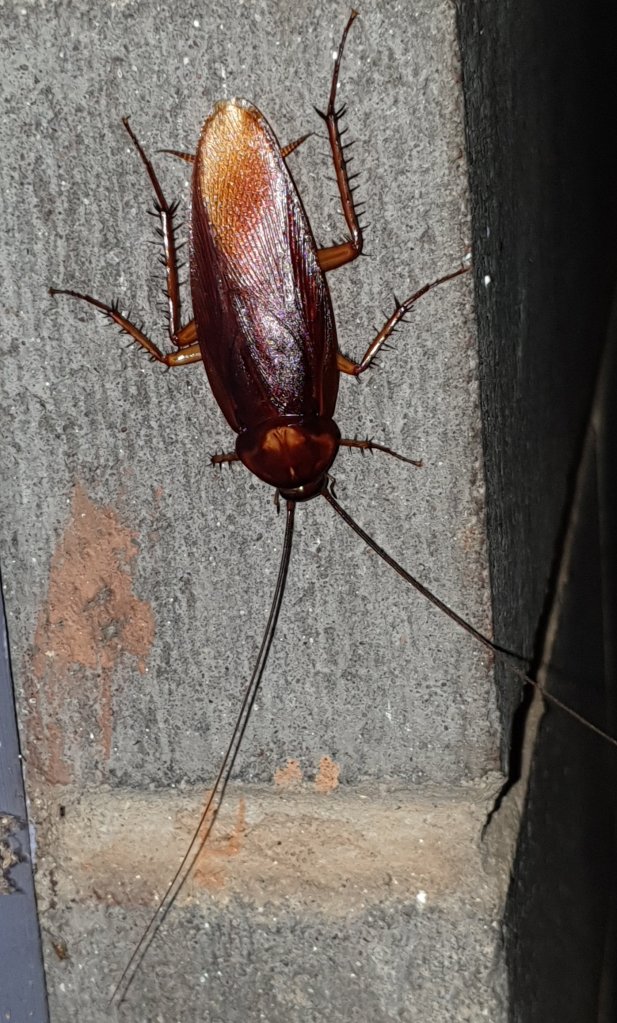
Later, as we were eating in the communal kitchen, Liesel asked if what she’d just seen was a snake. Where? There, up by the ceiling. The only way I could check was by holding the phone out at an awkward angle and taking a picture. Glad to report, it was just a plain ordinary gecko. What I didn’t really need to see was the cockroach outside the communal bathroom. All showy with its antennae as long as its body. And you just know, if there’s one, there’s a million.

La cucaracha

Good night, sleep well, don’t have nightmares.

Darwin to Jabiru

We’re back in the land down under, where beer does flow and men chunder. Specifically, we’re now on a road trip in the Northern Territory. We’ll see sights unique to Australia, enjoy experiences unique to The Territory and potentially learn words from about forty different local Aboriginal languages.

The first port of call as we left Darwin is a common place here in Aus but no longer seen in the UK. Woolworths provided some vittles for the next few days as well as a short, sharp kitchen knife, something missing from otherwise well-appointed Airbnbs.

I also bought Darwin’s only flynet, for Liesel, just in case. It took some tracking down and the bad news is, it’s attached to a baseball cap. But beggars can’t be fashionistas, as they say.

As I walked to the ATM, a man asked me where the post office is. I apologised for being only a visitor and then remembered that actually, we had some stuff to post too. Oh well, it’s all in the bowels of one of our bags, now. It can wait a few more days.

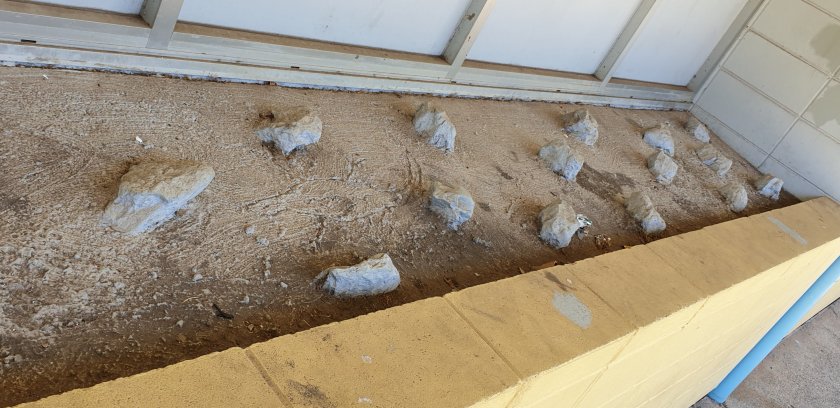
The one disappointing sight in Darwin was this.

Homeless folks not welcome here

A row of three former flower beds by the looks of it, but now devoid of plants, just some rocks embedded on the otherwise flat surface. I think this is to deter homeless people from kipping there. It’s sited at the back of the Uniting Church which had so much else on offer to the community. Very sad.

As we drove out of the smallest Aussie capital, we passed by numerous termite mounds of various sizes. There seems to be no pattern to their location, out in the open, right up against trees, some in shade.

We enjoyed watching the birds of prey hovering and swooping: there must be some tasty titbits around. We couldn’t identify the birds sharing a carcass on the road, but they were like very large overgrown crows.

Humpty Doo is a lovely placename but we had no reason to stop there, with such a long drive ahead of us.

We turned off the Stuart Highway onto Highway 36. At least one sign said ‘A36’. And it was exactly the same as the A36 at home apart from there was much less traffic, there were no potholes, the sky was blue and there were termite mounds at the side of the road.

Highway 36

We stopped for a quick coffee at Allora Garden Nursery. Did I say quick? Make yourself a coffee and sit back, it’s a long story.

Probably not a real stuffed dragonfly

We entered the nursery, passing by some very kitschy garden ornaments and sat down in Estelle’s Café. There was nobody behind the counter so I gently rang the bell for service.

A young man arrived, let’s called him Bruce. What do we want? Two coffees please. I’ll have to get someone to make the coffee.

A couple of minutes later, a young lady arrived. I’ll call her Sheila. Can I help? Yes, we’d like two lattés please. She went behind the counter and looked at the coffee machine.

We then heard an announcment over the PA asking Estelle to come to the café. She arrived and made us our coffees. Very nice. We looked around at the various garden ornaments, including tigers and giraffes. There were some actual plants to admire too.

When we’d finished our beverages, I went up to the counter to pay. Oh no, we don’t have a cash register here, you’ll have to pay at the front desk.

At the front desk, we ended up behind an Australian lady who had fallen in love with a concrete dog and she just had to buy it. Bruce was there, politely wrapping it in several layers of bubble-wrap. Oh, but she did love this dog, as soon as she saw it, she knew she had to have it.

Another lady, Doris, cooee’d me to the other cash register. I’d like to pay for my two lattés please. Two lattés? Yes. Bruce, how much does a latté cost? I have no idea, sorry.

Doris then walked all the way back to the café presumably to ask Estelle or Sheila how much a latté cost. I don’t know if there was a correct answer because on her return, Doris suggested, $5 each, is that alright? Yes, just let me out of this place, I said as I threw the money at her and pounded on the counter. No, not really.

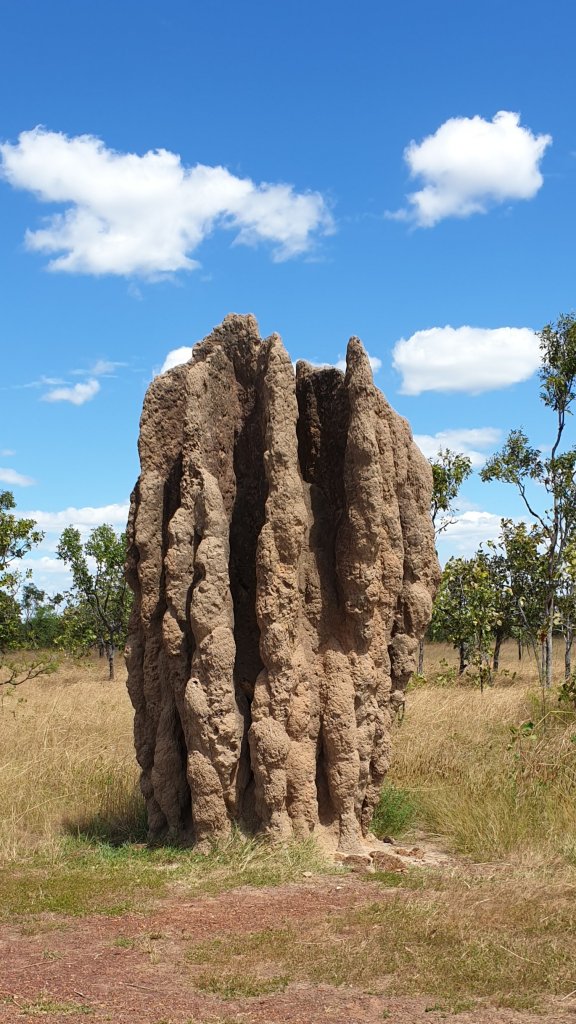
A big, 8-foot tall termite mound

The car told us it was 35° outside and we could believe it although we were much cooler in the vehicle.

We made a slight detour to go for a hike, a tramp, despite the temperature. We’re here to see nature, and that’s easier to do outside the car.

We never did find out whether Bird Billabong was so named because of the ornithological delights here or because it was discovered by a Mr or Ms Bird, thousands of years after the Aborigines first found it.

It was so quiet. When the birds and insects briefly ceased their singing and buzzing and chirruping, there was no sound. Nothing. Not even the wind rustling the leaves in the trees. The faint thumping sound was blood pulsing through our ears.

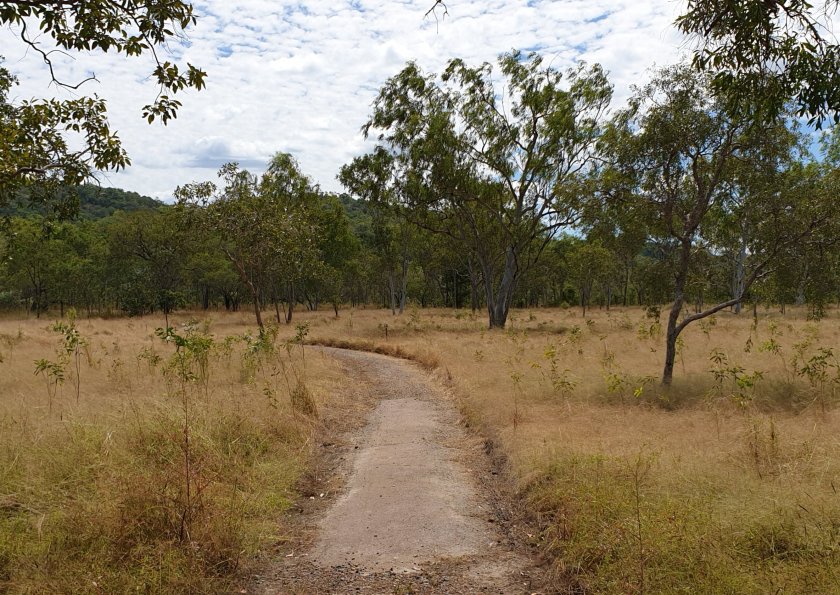
The gentle path to Bird Billabong

The path was well-defined and we made good use of the sparse shade. We also stayed in the middle of the path because… snakes. We stomped to warn them of our presence but the side-effect of this was that we scared the insects away too. The sad thing is: we’ll never know how many snakes we’ve deterred because they’ve legged it after sensing our vibrations. Legged it? Hmm, yeah, that’ll do.

This was a great walk for entomologists, so many butterflies, dragonflies, damselflies and other flies. If only there were a Shazam for insect identification. We heard but didn’t see grasshoppers.

A pretty and populous dragonfly

As I brushed something off my arm Liesel asked if we’d just walked through a spider’s web. It certainly felt like it, I agreed. We accelerated very slightly but neither of us turned round to see what gigantic, lethal spider we’d potentially upset.

There’s the billabong

One interesting thing we noticed was different kinds of scat. We told ourselves, kangaroo, wallaby, echidna, but definitely not crocodile, oh no, no, no, never.

Probably wallaby poo

The quiet, the sky, the solitude, all wonderful. Yet for some reason, while I was really pleased and excited to be here, it didn’t send the same shivers up the spine as my first visit to Uluru or Henbury did, all those decades ago. But there is something almost electric in the air, something very special, a connection with the first people here, perhaps, and with nature.

Odd splashes of colour emphasised just how green and lush the landscape was, after what was apparently a relatively dry Wet Season.

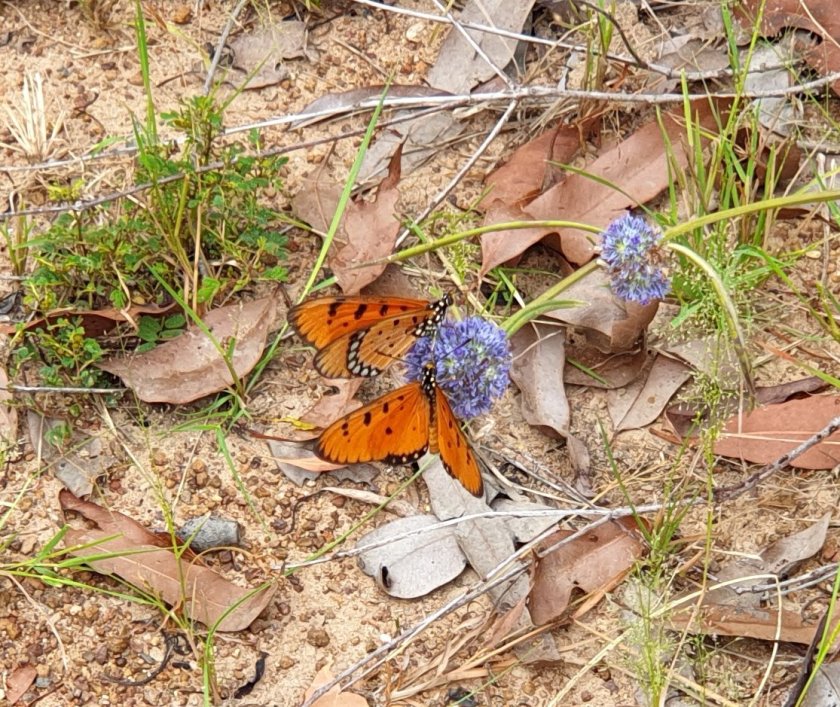
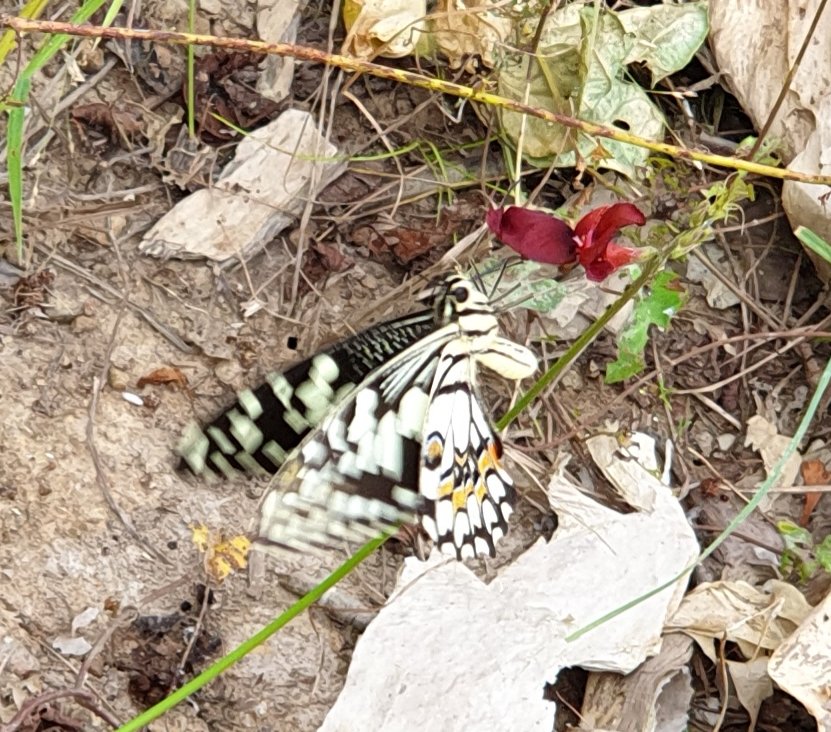
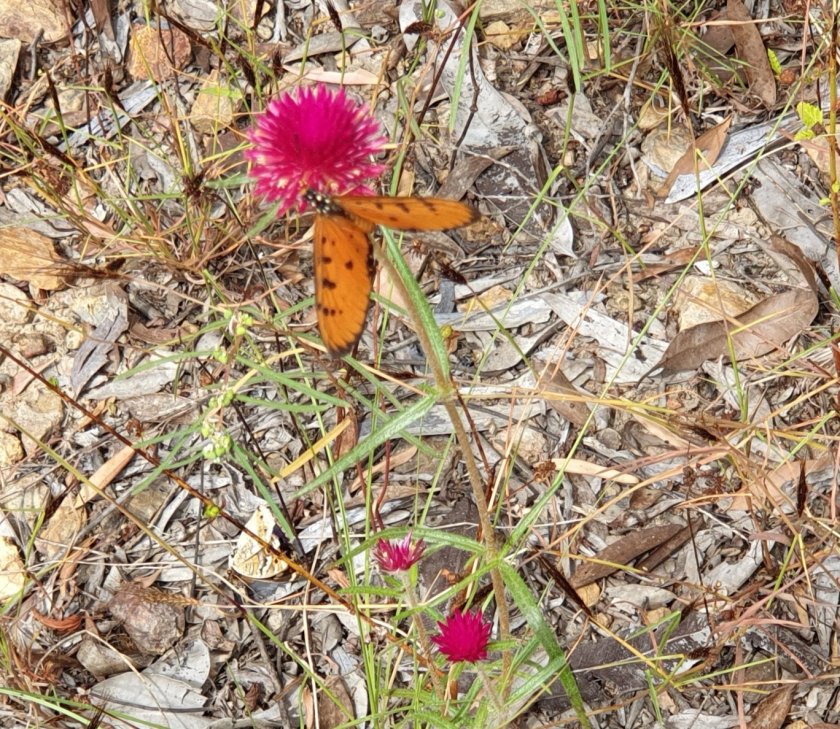
A butterfly enjoying some raspberry coulis

The flash of sky was too fast for my shutter finger. The bright blue dragonfly wasn’t going to be caught on camera that easily. But blue flowers certainly appealed to the orange butterflies.

Two butterflies sharing

It was terrific seeing so many butterflies here, and so many different kinds too. We lost something really special at home by using all those pesticides for so many years.

One more butterfly

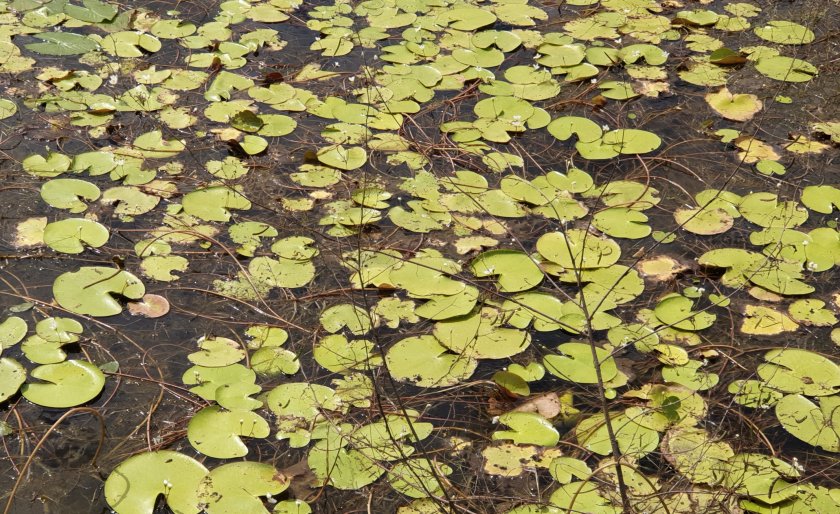
The view over Bird Billabong from the lookout point was stunning. We sought out frogs sitting on lily leaves but suspect it was the wrong time of day for them. We stayed still and some birds did come a little closer but they know about the crocodiles that live here and were on full alert. I think we both hoped to see a pair of nostrils and a pair of eyes on the surface of the water, but sadly no such luck today.

Picture of lilies

Despite what the Lonely Planet Guide said, this was not a circular walk, so we retraced our steps back to the car park.

Ooh, just caught a glimpse of blue

We noticed other tracks. Certainly at least a couple of motor vehicles had driven along this trail. But there were also horse hoofprints. Unless of course the local crocs have taken to wearing horse shoes.

Out of the blue, a kangaroo hopped across the path in front of us, closely followed by a second. Well, that made the whole exercise worthwhile!

Then we saw a couple of small, beige birds up in the trees. Bugs are great, but birds and mammals, especially marsupials are greater. Sorry, bugs. The magpie geese were numerous, we saw them from a distance but they weren’t going to hang around for us. The rubbish, blurry black and white photos are now nothing but a memory.

Soon after rejoining the main highway, we saw an emu cross the road in front of us. Wow, a actual emu! And then another. We couldn’t believe our luck. This is when you need a dashboard camera on 24/7, to catch the things that I’m too slow for.

There was a kangaroo by the side of the road, eating grass, not necessarily waiting to cross.

Then another. Then another pair. And for the next couple of miles, we lost count of the roadside kangaroos. We knew that slowing down or stopping would be their cue to hop off into the bush, so we just kept moving.

They all looked up as we passed, but none of them waved at us. In fact, even the other drivers didn’t wave back at us. In the old days, driving in the Aussie outback, all drivers acknowledged each other with a wave. Not the Aussie wave of a fly being swatted away from in front of your face. It was more raising the forefinger of the right hand as you approached and passed by an oncoming vehicle.

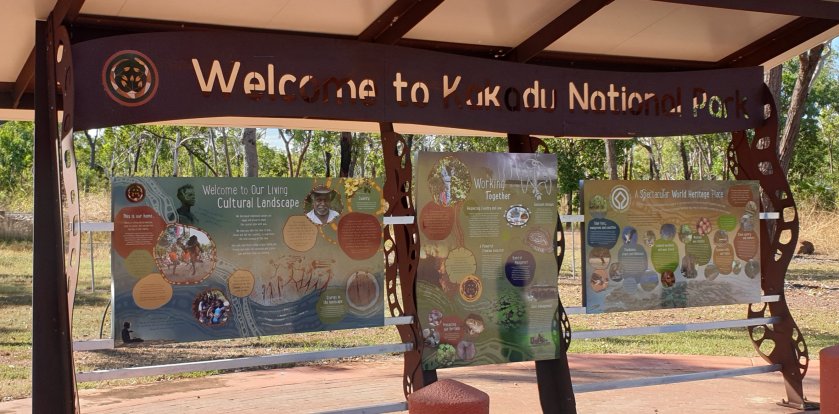
Welcome to Kakadu National Park

Kakadu National Park is a name that resonates. It’s real outback Australia, old, old, Aboriginal history, rugged, Crocodile Dundee country. And here we are!

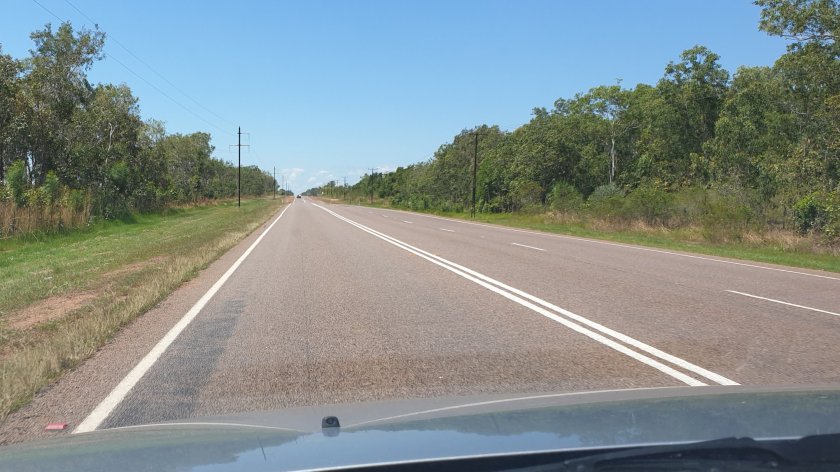
The speed limit in Northern Territory is 110 kph except where otherwise stated. We assumed this meant that any exceptions would be slower. No. We passed signs indicating a limit of 130 kph, that’s 81 mph in English money. No, we didn’t. The highway was dead straight, perfect surface, no potholes, no side roads but still, we’d seen animals cross the road. Yes, we let some other vehicles overtake us, but we were in no hurry. The road surface was quite loud, we realised. It has to withstand very high temperatures all year plus flooding for possibly months at a time. It’s probably a much more resilient and harder material than the cheap stuff British roads are made of.

There are many signs telling us we’re about to cross a Floodway with depth meters close by. This whole area must totally change at the height of the Wet Season, and would be interesting to see.

Most if not all of the creeks and rivers that we crossed warned us of the presence of crocodiles, and suggesting it’s best not to swim. But it’s so hot, I can see why people might be tempted to jump in the water.

We decided not to join a cruise to see jumping crocodiles. We know they jump naturally if they fancy chomping on a bird, but to encourage them to jump for visitors seems a bit risky. As Liesel said, one of the only advantages we have when running away from a croc is being able to climb a tree. You don’t want something like that jumping up after you!

Small bug close by or big bug a long way off?

Although we didn’t come across any flooded roads today, we did pass several areas of wetlands, just off the side of the road. I’m sure there are crocs lurking there too, so no, not really tempting.

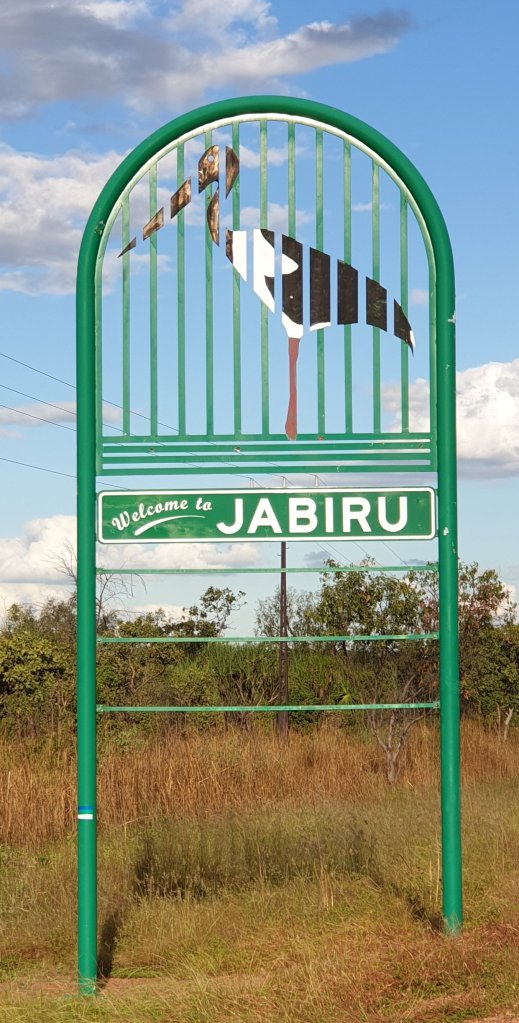
Welcome to Jabiru

We were welcomed to Jabiru by a jabiru, a black-necked stork: in fact, Australia’s only stork, and we soon found our new place. We looked at the Bush Bungalow, the so-called ‘Love Shack’ that we’d booked online, the one without aircon, and we looked at another room, which did have aircon. Yes, we chose the latter. We needed some decent sleep.

We’re in one room in a block of six, and the receptionist, with her gorgeous east European Aussie accent, told us that we’d probably have the place to ourselves anyway. If not, we’d have to share the bathroom.

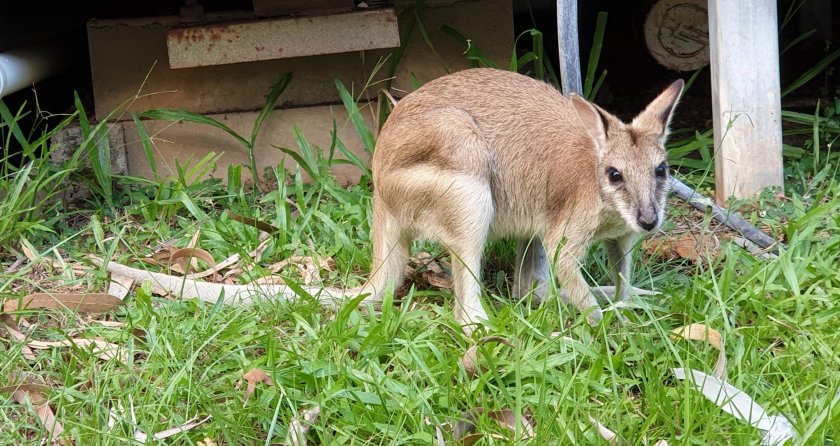
Our next-door neighbour was very friendly, and very nearly answered to the name Skippy.

What’s that, Skip?

We had a nice, simple salad and some nice crusty rolls to eat. And yes, we had a good night’s sleep, despite the AC unit being the loudest we’d so far encountered!

But we agreed that our decision not to rent a campervan on this trip was a good move. It’s fab country and the heat makes the place what it is, but neither of us sleep well if we’re too hot, and that just makes both of us cranky. Yes it does.